

For the past few years, the C-suite has approached Artificial Intelligence with the air of a chemistry professor observing a controlled experiment. They have funded innovation labs, approved isolated pilot programs and sat back to see if the technology would work. But as we move from the actual business part, we notice that leaders are no longer testing AI, but instead – the AI is testing them.
The beginning, as seen in many instances, is often deceptive. In a controlled environment, a visionary leader acts as a strategic buffer, using their influence to protect an innovative AI team from the restrictive bureaucracy, rigid processes and cultural resistance of the existing corporate structure.They can hand-pick the team, bypass some hurdles and ignore standard reporting lines. Under this “executive protection”, the AI appears to be successful.
The Scaling Trap
The crisis begins the moment the technology is asked to act on its own within the wider enterprise. Scaling is not just doing more, but it is the process of integrating machine autonomy into the company’s daily processes.
When someone scales, then it indicates that they are moving from a protected environment to a structural environment. This is where the scaling trap appears. Most organizations find that while their AI models are ready for the big leagues, their leadership structures are still playing by 19th-century rules. The technical roadmap says “accelerate”, but the organizational wiring goes in a state of confusion.
The Core Argument: The Failure of Decentralized Trust
Scaling AI fails not because the GPUs are too slow or the data is too messy, but because scaling requires the delegation of logic. In a traditional, weak leadership structure, power is centralized. Decisions flow upward to a person that takes all the responsibility or “chief decider” who provides a sense of security through manual oversight. However, AI operates on a premise of decentralized trust. For AI to provide ROI, it must be allowed to act without waiting for a human signature at every junction, including how to price a product, to reroute a supply chain or even to generate a contract.
A weak leadership structure is structurally incapable of this trust. It views machine autonomy as a loss of control rather than an expansion of capability. Therefore, the “AI failure” we see in the headlines is actually a leadership rejection. The system trips its own breakers because the people at the top are too fragile to handle the power of a truly autonomous enterprise. 
From “Command and Control” to “Orchestration”
The transition from a manual enterprise to an AI-driven one requires more than a software update. It actually requires a fundamental reassessment of what “leading” actually looks like. McKinsey & Company and Gartner have explained this in their report about The agentic organization: Contours of the next paradigm for the AI era. For decades, the gold standard of management has been the “command and control” model which is a vertical hierarchy designed to minimize variance through constant human oversight. But as AI enters the fold, this model doesn’t slow down, it breaks.
The Visibility Illusion
The primary hurdle is what is called the “visibility illusion”. The term refers to a cognitive bias where leaders equate seeing or manually verifying a process with having control over it.
Many leaders suffer from the cognitive bias that “control” is synonymous with “visibility”. They believe that if they cannot see, touch, or personally verify a decision, they have lost grip on the organization. In the age of Information Velocity, this is a fatal flaw. In this context, information velocity is a strategic evolution of the technical term “data velocity”. Data velocity focuses on the speed of bits and bytes, while information velocity focuses on the speed of insight-to-action.
AI operates at a cadence that renders manual oversight obsolete. A leader attempting to watch a high-velocity AI system is like a person trying to track every individual frame of a high-speed film with the naked eye and the result is: by the time the person has processed the first image, the movie is already over.
The Bottleneck Executive
This psychological need for visibility manifests as the Bottleneck Executive. There is a reason why the term “Bottleneck Executive” (often referred to in management circles as the “Bottleneck Leader”) is a centerpiece of modern AI-strategy critiques. While “bottleneck” is a general business term, Boston Consulting Group has used it to describe an executive who neutralizes AI’s speed through manual “Human-in-the-Loop” oversight. This is the leader who insists on being the “Human in the Loop” for every automated output, under the guise of “quality assurance” or “governance”.
While they believe they are protecting the firm, they are actually neutralizing the technology’s primary value proposition: speed. When a generative model produces a report in seconds, but that report sits in an inbox for three days waiting for someone senior to sign it off, the AI isn’t the failure, it is the executive. These leaders treat AI as a glorified intern that needs constant supervision, effectively capping the organization’s performance at the limit of their own personal bandwidth.
The Shift: Vertical vs. Systemic Leadership
To make effective changes, the organization must move from vertical leadership to systemic orchestration. This is a framework popularized by McKinsey & Company and Gartner in their briefings on the “Agentic Enterprise”.
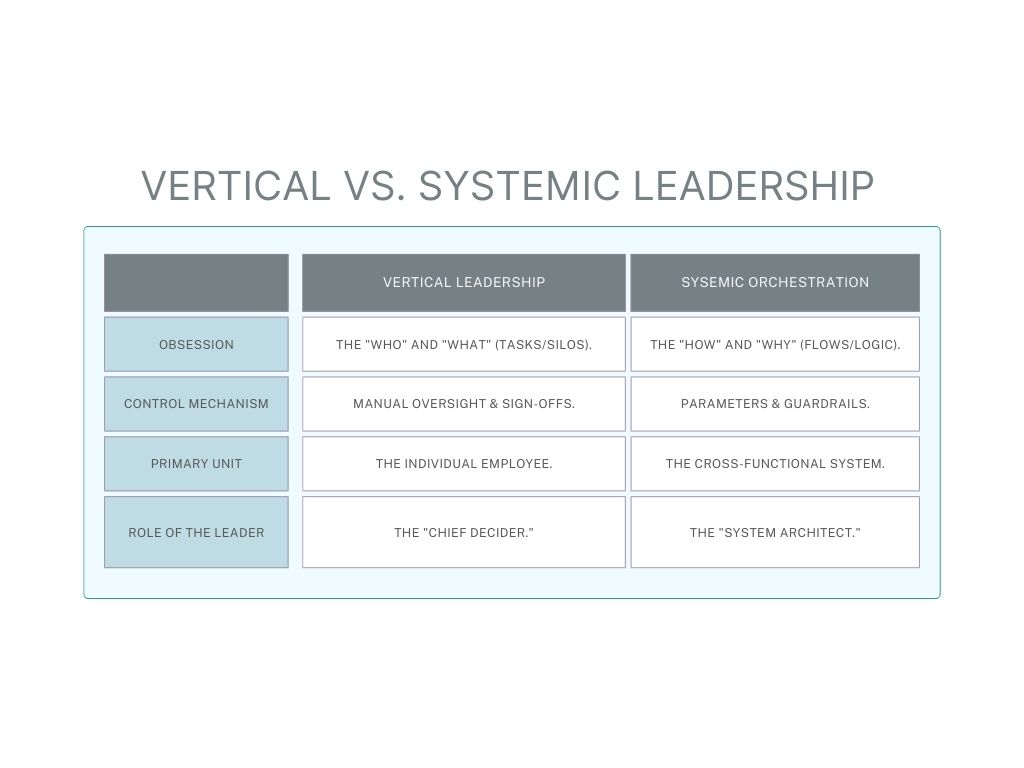
Success no longer belongs to the manager who makes the best individual calls, but to the one who builds the most resilient system. The shift is uncomfortable because it requires leaders to trade the ego-gratification of being the decider for the sophisticated, behind-the-scenes work of systemic design.
The next chapters go in the psychological and structural friction points where AI value often becomes obsolete. They address the “why” behind the active, yet often subconscious, resistance within leadership tiers.
The Power Paradox: Transparency vs. The Ego Tax
The most uncomfortable reality of AI is that it thrives on objective truth. In a legacy enterprise, however, truth is a political commodity. This creates a power paradox: the data clarity leadership claims to want is the same clarity that threatens their established influence.
The Auditor’s Threat
Traditional leadership often relies on the ability to manually curate reports and move the KPIs. AI removes this part, identifying exactly where a supply chain is leaking or which strategy is mathematically unsound. For a leader whose value is built on the ambiguity of information, AI doesn’t feel like an asset but more like an automated auditor. “Cultural resistance” is often just a euphemism for leadership protectionism which is the resistance of the machines not because it is wrong, but because maybe it is too right.
From “Headcount” to “Influence”
Historically, prestige has been a numbers game: “I manage a team of 1000” is a status symbol. AI-driven efficiency disrupts this metric, creating ego tax.
To a weak leader, a lean, AI-augmented squad feels like a demotion compared to an inefficient human army. They may quietly sabotage integration to maintain their “control” because they feel threatened, preferring a large budget over a high-performing system because the former validates their corporate standing. This is worsened by a technical literacy gap. Leaders often treat AI like a broken calculator and are deterministic rather than a reasoning engine or probabilistic. The moment a machine makes a non-linear choice, they retract authority, pulling the plug on transformation to regain a sense of personal control.
At the end of the day, AI doesn’t just automate tasks; it automates accountability. In a structure designed to distribute blame and hide failure, precision is a threat, not a feature.
The New Leadership Requirement: Architectural Governance
To survive the AI transition, the modern executive must undergo a fundamental identity shift: moving from being the “chief decider” to the “system designer”. In the legacy model, leaders took pride in being the smartest person in the room who personally reviewed every high-stakes move. In the AI era, this is no longer a sign of strength, but a sign of a bottleneck. Success now requires leaders to design the rules of the game rather than making every play. This is the essence of Architectural Governance.
The Delegation of Logic and The Requirement of Courage
The most difficult part of this shift is the delegation of logic. For a century, leaders have been comfortable delegating tasks to humans, knowing they could reprimand or correct a subordinate if a mistake occurred. Delegating logic to a machine is different. A machine requires defining the parameters, ethical guardrails and objective functions upfront, and then stepping back.
True scaling requires a rare form of executive courage: the willingness to let the system work without manual interference. When a leader “re-checks” an AI’s output simply because they feel a lack of control, they are introducing a latency tax that destroys the very ROI they are chasing. Architectural governance means trusting the system you built enough to let it move at its native speed.
The Survival of the Adaptive
AI scaling is the ultimate diagnostic tool for organizational health. If the AI initiatives are stalling, crashing, or failing to move the needle at an enterprise level, the model isn’t the problem, but the leadership structure is. AI amplifies the already existent organizational flaws, it does not create new ones and this is making the hidden inefficiencies and leadership fragilities visible to the entire market.
The window for treating AI as a “bolt-on” tool is closing. To unlock the future, leaders need to stop asking the passive question: “What can AI do for us?” and start asking the transformative one: “How must we change our authority, our hierarchy, and our ego so that AI can actually work?” The enterprises that survive won’t necessarily be those with the most advance, but those with the most adaptive leadership and those willing to trade the comfort of control for the power of orchestration.