

By early 2026, a bitter irony has settled over the corporate world: the more powerful our AI becomes, the more stagnant our organizations seem to feel. While the frontier models of this year can reason, plan, and execute complex workflows with a precision that was science fiction just twenty-four months ago, the average enterprise is still stuck in the “Pilot Purgatory” of 2024. The excuse is always the same: the AI is too unpredictable, the hallucinations are too risky, or the ROI isn’t clear. But look closer, and the truth is far more uncomfortable. Enterprise AI is not failing; it is being mismanaged.
The models are ready for the future, but our leadership models are hopelessly tethered to the past. We are attempting to guide a lightning-fast, agentic revolution using a playbook written for the industrial age, and until we stop trying to bolt on intelligence to broken hierarchies, we will continue to confuse a management crisis for a technical one.
By January 2026, the “Golden Age” of AI experimentation has officially collided with the cold reality of the balance sheet. Despite over $110 billion in global investment last year, the most recent MIT research delivers a staggering verdict that 95% of enterprise generative AI pilots have failed to deliver a measurable financial return. But to call this a “failure of AI” is to fundamentally misread the moment. The models themselves have never been more forceful. They are now capable of superhuman reasoning, complex coding, and zero-shot medical diagnosis and yet are not reaching the full potential.
The failure is in the operating model, not in the silicon. Organizations are attempting to bolt 21st-century “agentic” brains onto 20th-century skeletons, burying high-octane intelligence under mountains of legacy data debt, fragmented workflows, and a management culture that still treats AI as a science project rather than a fundamental business redesign. Enterprise AI isn’t failing; it is being mismanaged by leaders who are chasing “AI magic” while ignoring the boring, essential work of AI readiness.
The “Command and Control” Fallacy
For over a century, the corporate ladder has been built on a “Command and Control” philosophy: information flows up, and instructions flow down. In this model, managers are the gatekeepers of knowledge and the arbiters of every decision. It is a rigid, predictable system designed to minimize variance.
The problem? AI is the ultimate variance engine. When leadership tries to manage a 2026 agentic workforce through traditional top-down hierarchies, they create a “reasoning bottleneck.” AI agents are designed to iterate, pivot, and find non-linear solutions. However, when these agents are forced to wait for human approval at every “if-then” junction, the speed of the technology is struggling by the latency of the hierarchy. 
From “Manager of People” to “Orchestrator of Agents”
Mismanagement occurs when leaders treat AI as a digital version of a human subordinate. They assign a task, demand a specific format and punish deviations. But an AI-driven enterprise requires a shift to orchestration. In that case, the Traditional Leader asks “Did you follow the manual?” And the AI Orchestrator asks “Did the agentic squad achieve the outcome within the defined guardrails?”
The “Shadow Workflow” Crisis
Because traditional leadership models are so slow to adapt, we are seeing the rise of “shadow workflows”. Employees are secretly using unmanaged, personal AI tools to bypass “command and control” bottlenecks. Management views this as a security failure; in reality, it is a leadership failure. People are choosing the path of least resistance because the “official” management model has become a barrier to productivity.
Building a “Mesh” Instead of a “Ladder”
To stop mismanaging AI, leadership must replace the “Ladder” (vertical silos) with a “Data Mesh” (horizontal autonomy). In this model, the leader’s job is no longer to micro-manage the process, but to define the Intent and the boundaries. Once the guardrails are set, the AI agents and the humans who guide them must have the autonomy to move at the speed of the market, not the speed of a committee.
The ROI Obsession vs. The Value Reality
The quickest way to mismanage a transformative technology is to measure it with an obsolete yardstick. Currently, many C-suites are stuck in an “efficiency trap”, where the only metric for AI success is headcount reduction. This is a 1990s approach to a 2026 reality. When leadership demands that AI justify its existence solely through cost-cutting, they inadvertently force the organization to focus on small, low-risk automations rather than large-scale value creation.
The “Headcount” Fallacy
Mismanagement occurs when a CFO asks, “How many people can we fire if we buy this model?” In a high-velocity economy, the true value of AI isn’t in reducing the number of thinkers; it’s in increasing the volume of thought.
Instead of cutting a marketing team of ten, an AI-driven leader uses agents to allow those same ten people to launch 1 000 personalized campaigns instead of ten. The ROI isn’t in the “savings”, it’s in the massive revenue generated by the increased output, which can also be called – the ROI of capacity.
Measuring “Velocity” over “Efficiency”
In 2026, the most mismanaged metric will be “time to completion.” Traditional models focus on making a task cheaper. Modern models focus on making a decision faster.
If we assume that an AI agent can analyze a supply chain disruption and re-route shipments in 30 seconds, as a task that previously took a committee three days, the value isn’t found in the “hours saved.” It is found in the competitive advantage of being three days ahead of the market. This is “time-to-value”, and it is often invisible on a traditional profit and loss statement, also known as “income statement”.
From “Cost Center” to “Growth Engine”
Leaders who are mismanaging AI treat it as an IT expense to be minimized. Leaders who are “orchestrating” AI, treat it as a capital investment in organizational intelligence. By shifting the focus from saving to scaling, management can move past the “AI hangover” and start seeing the compounding returns that come from an autonomous, agentic enterprise.
Data Governance as a Wall, Not a Guardrail
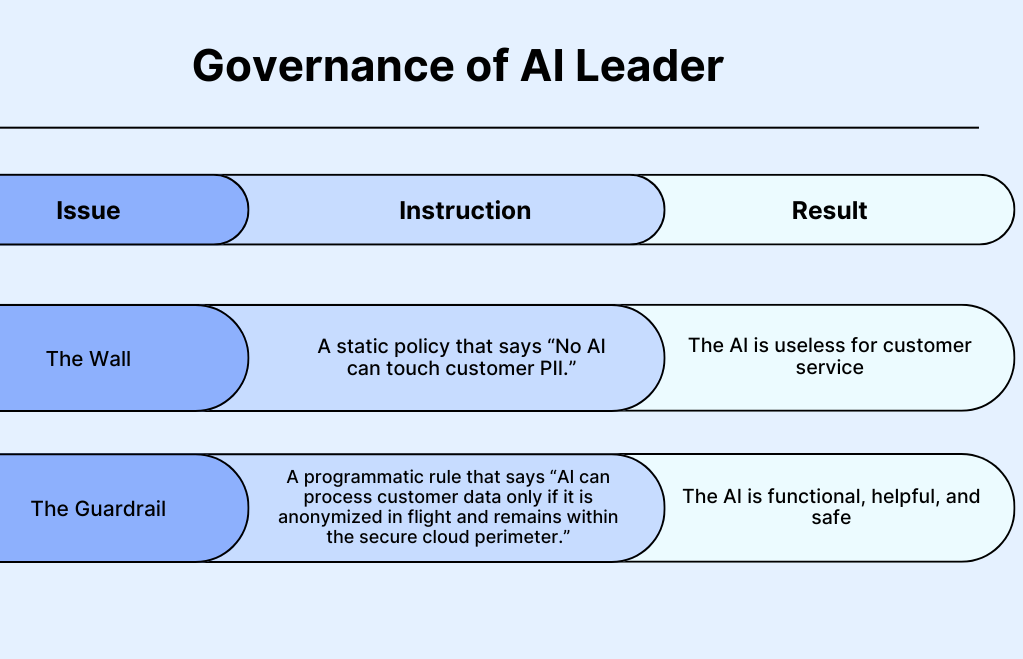
One of the most common ways leadership mismanages AI is by allowing the legal and compliance departments to build a “wall of no.” In many legacy organizations, data governance is still practiced as a protectionist discipline, which is a set of barriers designed to keep data “locked away” to prevent risk. While well-intentioned, this model is fatal to Agentic AI, which requires fluid, real-time access to cross-functional data to provide accurate reasoning.
The “Bureaucratic Paralysis” Trap
Mismanagement occurs when every AI prompt or tool-call must pass through a manual “risk review board.” We are seeing the rise of bureaucratic paralysis, where a company’s AI strategy is effectively held hostage by 19th-century liability models. When governance is a “Wall,” it creates a massive “Latency Tax.” By the time an agent is cleared to access a specific dataset, the business opportunity has often already passed.
From “Protectionist” to “Enablement” Governance
A true AI-ready leader shifts the mindset from blocking access to enabling it through guardrails-as-code. How would that work:
Active vs. Passive Metadata
The mismanaged enterprise relies on passive governance, meaning that it is auditing what went wrong after the agent makes a mistake. The orchestrated enterprise uses active metadata.
The reality is that the leadership must invest in a data architecture where the governance is “baked in”. If the data itself “knows” its own privacy rules, the agent can navigate the ecosystem autonomously without hitting a wall. This allows the organization to move from a culture of “permission” to a culture of “performance.”
The “Skills” Misdiagnosis
A common symptom of AI mismanagement is the frantic push to train every employee in “prompt engineering.” Lately, this has proven to be a massive strategic distraction. By treating AI as just another software skill like Excel or PowerPoint, leadership is missing the deeper structural shift. The problem isn’t that employees don’t know how to “talk” to the AI; it’s that their job descriptions haven’t changed to account for the fact that the AI is now doing the “doing”.
The “Faster Horse” Problem
Mismanagement occurs when leadership uses AI to make employees faster at tasks that shouldn’t exist in the first place.
If a company trains a junior analyst to use AI to write a report in 10 minutes that used to take 10 hours, but that report still just sits in an unread inbox, the company hasn’t gained value – it has automated waste. The failure comes when the management is training “doers” to do more, rather than empowering “designers” to rethink the workflow entirely.
From “Prompting” to “Orchestration”
The most critical skill gap isn’t technical; it’s architectural.
As AI agents become more autonomous, the human role moves from performing the task to orchestrating the outcome.
Leaders are spending millions on “How to use ChatGPT” workshops, while they should be training their managers on “Agentic Workflow Design”. The workforce doesn’t need to know how to whisper to a chatbot; they need to know how to manage a “squad” of digital agents and audit their outputs for quality and intent.
The “Added Work” Paradox
When AI is mismanaged, it often feels like “extra work” for the employee. They still have their 40-hour-a-week job, plus the new burden of “managing the AI.”
True AI leadership requires role redefinition. You cannot simply add “AI Supervisor” to someone’s existing plate without removing the manual tasks the AI has taken over. Failure to redefine these roles leads to burnout and “quiet rejection” of the technology, where employees secretly revert to old ways because the “AI way” feels like a double workload.
The New Leadership Archetype
The era where leaders could simply pilot a few chatbots and call it a strategy is over. As we have seen, enterprise AI is not failing – it is being suffocated by leadership models that were designed for a static, human-only world. To survive the next decade, the “manager” must be extinct so that the orchestrator can live.
The new leadership archetype focuses on the intent, the guardrails and the outcome, and not on the process. They understand that their primary job is to curate a high-performance ecosystem where humans and agents collaborate seamlessly.
If people what to stop mismanage their AI investment, the blueprint is clear:
- Redesign the Workflow: Stop bolting AI onto broken processes.
- Modernize the Metrics: Measure capacity and velocity, not just headcount reduction.
- Code the Governance: Turn your “Walls of No” into “Automated Guardrails.”
- Rebuild the Roles: Move your workforce from “Doers” to “Designers.”
The “AI Revolution” was never actually about the technology. It has always been a mirror, reflecting the agility of our organizations. The frontier models of 2026 are ready to transform the businesses today. The only remaining question is whether the leadership models will be a bridge to that future or a barrier.