

Building on our previous article “Enterprise AI Is Not Failing, It Is Being Mismanaged” in which we argued that today’s enterprise AI setbacks are not caused by limitations in the technology itself, but by outdated leadership and management models attempting to graft agentic AI onto legacy organizational hierarchies, we now address a critical catalyst for this mismanagement. In this article, we turn to a closely related issue: why AI maturity models are becoming increasingly misleading and, in many cases, actively counterproductive to enterprise AI efforts. It develops a deliberately contrarian position.
While AI maturity models and their frameworks promise a roadmap to transformation, they have become a dangerous distraction. Organizations are checking methodological boxes and reporting “maturity” on paper, but failing to generate tangible business impact. The fundamental problem is that measuring procedural readiness has replaced measuring operational reality.
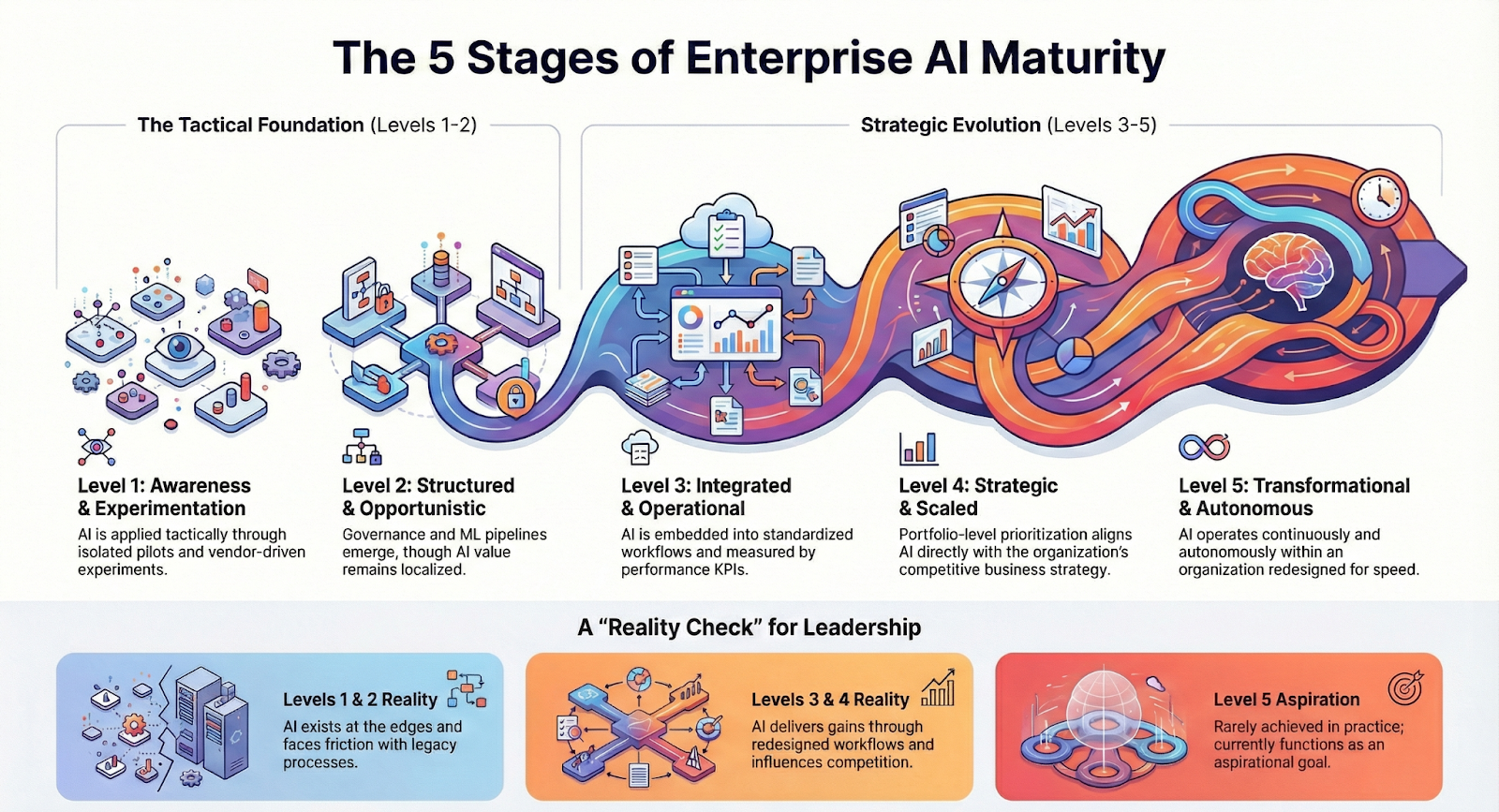
There are more than a dozen AI maturity models publicly available today, developed by research firms, advisory organizations, solution providers and industry practitioners. As there is not a single general one, which is also part of the problem, for the purposes of this article, we reviewed the models we could identify and combined them into an “average” enterprise AI maturity model. This model is not presented as prescriptive, but as a representative example reflecting the common structure and assumptions shared across most frameworks.
The answer to why this approach breaks down in practice lies in examining the organizational levels at which AI maturity models are typically applied and where they systematically fail to reflect operational reality.
Why AI Maturity Models Exist and Why Executives Love Them
To understand why AI maturity models continue to dominate enterprise conversations, we must first acknowledge the problem they are trying to solve. These models persist not because they work, but because they are emotionally, politically and organizationally convenient.
In an environment where executives are under intense pressure to “do something” with AI, while the technology itself evolves faster than most leadership teams can realistically comprehend, maturity models offer a way to cut through the noise and produce a seemingly objective answer. They provide structure in a moment of uncertainty. They translate ambiguity into levels, scores, and stages that can be discussed in boardrooms, documented in strategy decks, and approved in steering committees. 
This is why maturity models feel immediately familiar. They inherit the logic of earlier digital, data, and BI transformation eras, presenting progress as a linear journey from “Level 1” to “Level 5.” For boards, procurement functions and finance teams – this framing is intuitive. It enables benchmarking against peers, comparability across business units, and a predictable cadence for funding and investment decisions. Progress can be tracked, reported and defended even when the underlying reality is far more complex.
Most importantly, maturity models provide executives with something AI itself does not: psychological safety. They reduce a fundamentally non-linear, probabilistic, and fast-moving technological shift into a controlled narrative of incremental advancement. They allow leaders to signal action without committing to irreversible organizational change. In this sense, maturity models are less about managing AI and more about managing the uncertainty surrounding it.
In short, AI maturity models are not designed to absorb or operationalize the true complexity of AI-driven systems. They are designed to absorb organizational anxiety. They help leaders feel in control of a transformation that, in reality, challenges existing hierarchies, decision rights, accountability structures and leadership identities.
This explains why they are so widely adopted. And why they remain largely unchallenged. They align perfectly with how enterprises prefer to govern change: through frameworks, assessments, and staged roadmaps that preserve existing power structures while signaling progress.
The Illusion of Progress
The most damaging effect of enterprise AI maturity models is the illusion of progress. Across industries, a widening gap exists between self-assessed maturity and actual business outcomes. Organizations confidently claim “Level 3” or “Level 4” status because they’ve hired data scientists and deployed MLOps pipelines. And still, when measured by profit, pricing power, or execution speed, the needle has barely moved.
This disconnect is inherent to how maturity is defined. Most models measure capability accumulation with the emphasis on more tools, roles and governance, rather than fundamental changes in decision-making or power structures. Each new layer of infrastructure reinforces the perception of forward movement while protecting the organization from the discomfort of actual change.
AI is typically wrapped around existing processes, constrained by legacy approval chains and human gatekeepers. The organization looks more advanced, but it does not behave differently. This is the “Integration Trap”: embedding AI into workflows never redesigned for autonomy increases complexity without improving results.
Ultimately, these models optimize for reassurance over results. They allow progress to be declared through structure rather than proven through value, treating the final “Transformational” stage as an aspirational horizon that legitimizes the comfort of the status quo.
The Hidden Assumptions Embedded in AI Maturity Models
To understand why AI maturity models so consistently fail to translate capability into advantage, we must look beneath their surface structure and examine the assumptions they quietly encode about how organizations function.
These assumptions are rarely stated explicitly. Yet they shape how progress is defined, how investments are justified, and most critically, what is not allowed to change.
Assumption 1: Organizations Improve Linearly
The first and most foundational assumption is that enterprises evolve in a linear, sequential manner. Maturity models imply that organizations move step-by-step from one level to the next, accumulating capability as they go. Each stage is presented as a prerequisite for the next, reinforcing the idea that transformation is orderly, predictable and cumulative.
AI does not behave this way.
AI systems improve non-linearly. Their impact emerges unevenly, often creating step-changes in performance in one domain while leaving others untouched. Decision quality may improve dramatically in narrow areas and not at all elsewhere. Even after that, maturity models force this reality into a smooth progression narrative, masking asymmetry and suppressing uncomfortable variance.
As a result, organizations are encouraged to optimize for completeness rather than leverage. Instead of asking where AI can most radically change outcomes, they ask where it can be uniformly deployed.
Assumption 2: Capability Equals Value
Most maturity models equate value creation with the presence of certain capabilities: data platforms, ML pipelines, governance frameworks, AI talent and ethics boards. The more boxes checked, the higher the maturity score.
But capability is not causality.
Enterprises can, and frequently do build sophisticated AI stacks without materially changing how decisions are made. Models can be accurate, pipelines reliable, and dashboards impressive, while decisions remain slow, escalated and politically negotiated. In these environments, AI becomes an advisory layer that informs humans who are structurally unable, or unauthorized, to act on it.
Maturity models rarely measure this gap. They assess what exists, not what is used.
Assumption 3: Existing Operating Models Are Fit for AI
Perhaps the most consequential assumption is that AI can be layered onto existing organizational structures without fundamentally challenging them. Maturity models treat hierarchy, approval chains, budgeting cycles, and incentive systems as neutral containers, all unchanged across levels.
They are not.
AI changes the economics of decision-making. It lowers the cost of prediction, accelerates feedback loops, and rewards speed, experimentation and delegation. Legacy operating models, by contrast, are optimized for control, predictability, and risk minimization. When these two logics collide, the operating model always wins.
The result is familiar: AI insights are generated faster than they can be acted upon, and autonomy is withheld precisely where AI would create the most value.
Assumption 4: Governance Can Precede Impact
Another embedded belief is that governance maturity must advance in parallel with operational impact. This leads organizations to front-load policy, oversight structures, and review processes long before AI meaningfully affects outcomes.
While governance is essential, premature governance often functions as a brake rather than a guardrail. It formalizes uncertainty, institutionalizes caution, and codifies constraints before value has been demonstrated. In doing so, it reassures leadership while discouraging operational experimentation.
The model remains intact. The results do not arrive.
Assumption 5: Leadership Can Remain Unchanged
Finally, and most subtly, maturity models assume that leadership roles, decision rights, and accountability structures can remain largely intact throughout the journey. Leaders sponsor AI initiatives, approve investments, and receive reports but are rarely required to relinquish control or redefine their own function.
This is the quiet bargain maturity models offer: transformation without personal disruption.
But still, AI’s true leverage emerges only when leadership shifts from approving decisions to designing systems that make decisions. This transition is absent from most models because it challenges the very audience they are built to serve.
When High Maturity Delivers Low Impact
Once the assumptions embedded in AI maturity models are put into motion, a predictable pattern emerges. Organizations score higher on maturity assessments, expand their AI capabilities, and report steady progress, but they still experience little to no improvement in how the enterprise actually performs. This is the moment where “high maturity” and “low impact” begin to coexist.
On the surface, these organizations appear advanced. They have centralized AI teams, standardized platforms, formal governance, and an expanding portfolio of use cases. From the perspective of the average enterprise AI maturity model, they are doing everything right. But when examined operationally, the organization behaves almost exactly as it did before.
Decisions are still escalated through hierarchical chains. Budget cycles remain slow and rigid. Risk ownership is diffuse. AI insights arrive faster, but action does not. The enterprise becomes better informed, not more effective.
Information velocity vs. decision velocity
This is the paradox maturity models fail to capture: information velocity is not the same as decision velocity.
In “Level 4” organizations, AI outputs are treated as recommendations rather than triggers. They are debated, contextualized and often overridden. This is not because they are wrong, but because the operating model remains human, centralized and political. AI is tolerated, but not trusted.
This creates a cycle of diminishing marginal value. Without changes to decision rights and accountability, AI becomes a redundant analytical overlay. The first models offer insight, but subsequent investments merely increase complexity which have more dashboards, more governance gates and more stakeholders, reinforcing inertia rather than accelerating execution.
Maturity scores rise, yet the metrics like revenue growth and margin expansion that actually matter, remain flat. Success is measured by “readiness” rather than performance, turning high maturity into a substitute for accountability. This is not an execution failure; it is the logical outcome of a model that rewards preparation over change.
Many enterprises have built the scaffolding for AI but never redesigned the structure it supports. They have become proficient at doing AI without becoming AI-driven.
The Vendor Gravity Problem
While most maturity models appear objective, their conclusions almost always pull the organization toward a predefined purchase.
In practice, “maturity gaps” are designed to map cleanly to a vendor’s catalog. Whether the diagnosis is weak governance or poor integration, the cure is invariably more consulting, licenses, or tooling. This creates a cycle of perpetual readiness, where progress is something purchased rather than structurally earned. The organization moves “up” the model while remaining stationary in how it actually creates value.
Over time, vendor gravity distorts strategy. Roadmaps devolve into procurement plans as enterprises optimize for compatibility with a vendor’s ecosystem rather than for competitive advantage. This reinforces the central illusion: that buying more capability is the same as becoming more capable.
So What Should Enterprises Do Instead?
To escape the maturity trap, organizations must shift their unit of measurement from readiness to behavior. Real progress is defined by how differently the enterprise operates because AI exists.
First, anchor AI to decisions, not initiatives
Stop tracking “implementation” and start tracking decision quality. If AI doesn’t change the outcome, timing, or confidence of a high-impact decision (pricing, risk, routing), it isn’t operational—regardless of the tooling.
Second, redesign for authority, not insight
Most enterprises are already “insight-rich” and “action-poor.” Transformation requires delegating authority to AI to trigger actions within defined boundaries. Until AI can bypass legacy approval chains, it remains an expensive advisory tool.
Third, measure value where economics move
Shift metrics away from technical capability toward P&L impact: cycle time, cost-to-serve, and working capital. Reporting readiness without economic movement isn’t a “phase”—it’s a failure.
Fourth, treat operating model change as the core work
AI transformation is a structural redesign, not a tech program. Roles must shift from “deciders” to “system designers,” and incentives must align with machine-augmented outcomes.
Finally, make autonomy concrete or remove it from the narrative
If “autonomous AI” remains a theoretical future, remove it from your strategy. True progress requires answering: Where does AI already act without human approval? Which risks are we accepting to gain speed? Without concrete answers, the organization is rehearsing, not progressing.
From Maturity to Reality: What to Measure Instead
The actions above only matter if they show up under pressure. The ultimate test of enterprise AI is not whether it conforms to a maturity model, but whether it changes how decisions are made when speed, risk, and accountability collide.
This is why measuring “maturity” fails. It captures preparation, not consequence.
Rather than asking how advanced the organization claims to be, leadership should measure whether AI is compressing the distance between prediction and action, insight and authority, capability and consequence. The dimensions below are not a new model and are not meant to be scored. They exist to expose reality.
They ask whether AI actually reduces decision latency or merely increases reading material. Whether value moves faster than planning. Whether ownership is visible when models fail. Whether AI removes friction or turns humans into babysitters. And whether the organization updates its logic quickly when assumptions prove wrong.
If an enterprise cannot answer these questions clearly, it is not early, emerging, or maturing. It is unchanged.
This is the distinction that matters. Maturity models tell a coherent story about progress. Reality rewards organizations willing to redesign how decisions are made.
That is the difference between appearing advanced and becoming competitive.