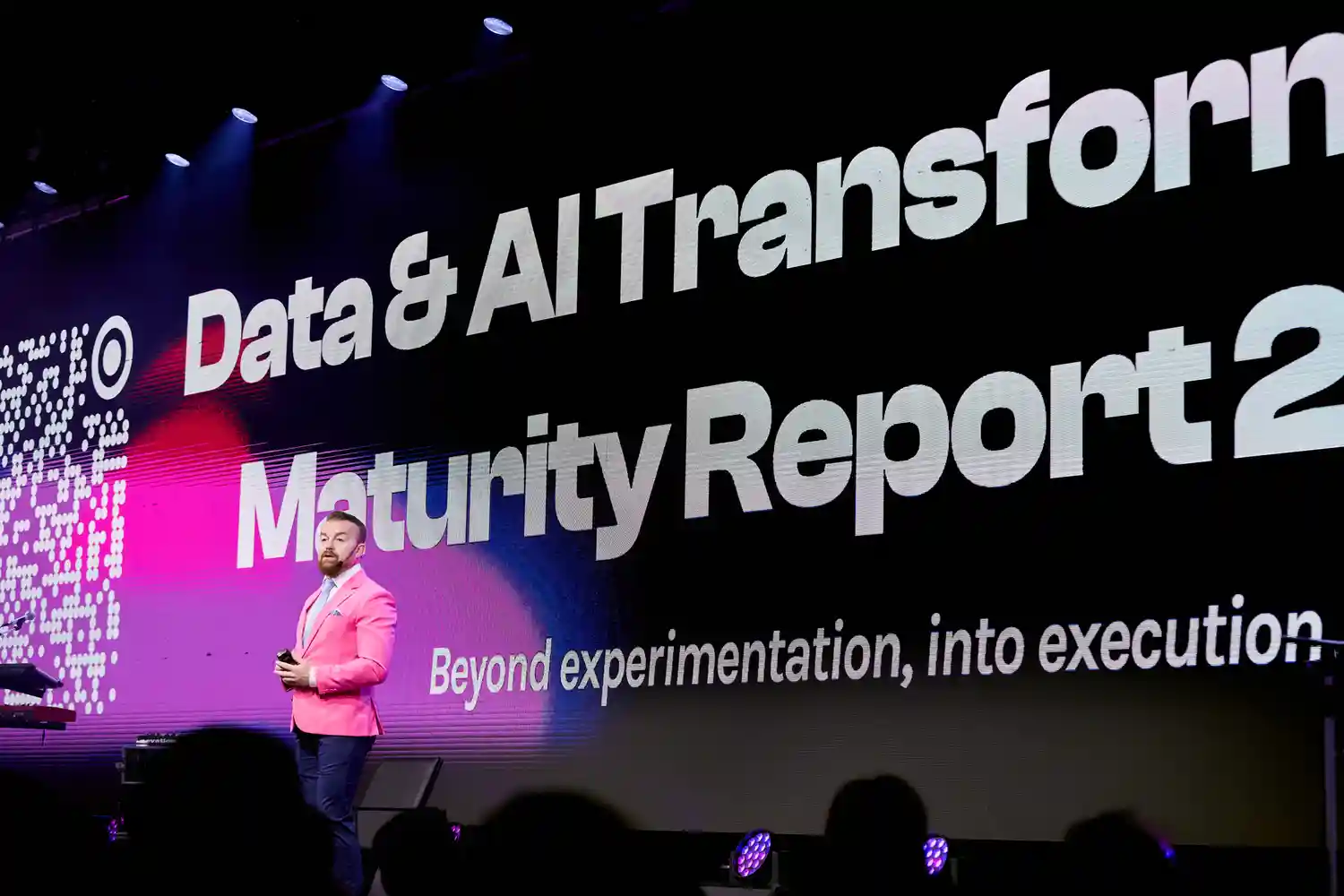
Most industry maturity reports are built from a single instrument: a survey sent to a self-selected list of respondents, asking them to rate their own organization’s progress. The results are useful, but they measure perception, not behavior. The Data & AI Transformation Maturity Report, first published in 2026 and now intended to run as an annual report produced alongside every future edition of the Data Innovation Summit, was built differently. Rather than relying on a single survey, it cross-references six independent datasets drawn directly from the summit’s own ecosystem, which means its conclusions are checked against what people actually said, submitted, built, bought, and asked, not only what they claimed about themselves.
A dataset built to be cross-checked against itself
The report’s methodology is its most distinctive feature. It combines pre-event maturity self-assessments from senior Data and AI leaders with delegate-submitted questions for panels and roundtables, a Call for Speakers dataset of 405 submissions from 270 organizations across 63 countries, a final validated agenda of 392 sessions selected from those submissions by editorial review, a vendor and exhibitor landscape covering 94 organizations, and a delegate profile drawn from 3,010 participants representing 936 companies across 51 countries. Each dataset was normalized against a shared five-stage maturity model, ranging from Foundational to Visionary, but interpreted differently depending on the source: self-perception in the assessment data, market positioning in the speaker submissions, validated practice in the final agenda, commercial supply in the vendor data, and inferred maturity in the delegate profile based on role and seniority.
That structure lets the report do something a single survey never can: separate what the market says about itself from what independent, cross-referenced evidence actually supports. And the gaps between those two pictures turn out to be the most interesting finding in the entire report.
The market is concentrated in “Established,” not “Visionary”
Across every dataset, the dominant maturity stage is neither early-stage experimentation nor advanced, visionary transformation. It is a stage the report labels Established: organizations that have moved past isolated pilots and are actively trying to scale AI and analytics across the enterprise, align data platforms with business processes, and build real governance discipline. In the validated agenda specifically, the stage that matters most because it reflects content that passed editorial scrutiny rather than aspirational self-positioning, 71.7 percent of sessions aligned with Established maturity, compared with only 12.0 percent at Leading and just 4.8 percent at Visionary. Foundational-stage content was nearly absent. In plain terms: the Nordic and international enterprise market the summit serves has, on the whole, already built the basics. Its real challenge now is coordination, integration, and follow-through at scale, not getting started.

The gap between what the market says and what actually gets validated
The report’s most useful contribution may be how clearly it documents the distance between market narrative and validated practice. Within the Call for Speakers dataset, the raw pitch of what organizations and vendors want to talk about, 47.9 percent of submissions were categorized as AI-related, with Generative AI appearing in 45.2 percent of submissions and agentic AI concepts appearing in roughly 30 percent, evidence that AI dominates how the market currently chooses to present itself. But once those same submissions passed through editorial review into the final, validated agenda, the picture shifted. Generative AI’s share dropped to 33.9 percent of sessions, and topics like data governance, quality, and trust, which appeared in 51.9 percent of speaker submissions to begin with, rose to 48.7 percent of the validated agenda, the single most represented theme in the entire program, ahead of operational efficiency at 46.9 percent and data platform and architecture work at 43.9 percent.
The takeaway isn’t that AI interest is fake. It’s that the unfiltered version of the market’s own story overstates how much of the real work is actually about AI models themselves, and understates how much of it is about the unglamorous foundational work, governance, data quality, platform architecture, that determines whether any AI initiative built on top of it can actually be trusted and scaled. Roughly half of all validated use cases across both the speaker submissions and the final agenda touch on governance, quality, or trust in some form, a signal that foundational capability, while broadly present across the market, remains unevenly and incompletely implemented even inside organizations that consider themselves advanced. 
A structural mismatch between what vendors sell and what enterprises need
The vendor and exhibitor dataset surfaces a second, more structural gap. Of the 94 vendors represented, 62.8 percent are pure software providers, and when their offerings are mapped against the same maturity model, 55.3 percent are positioned to help organizations at the Developing stage, essentially, building and connecting the basic pieces of a data and AI environment. Only 27.7 percent of vendor offerings are built for the Established stage, where the validated agenda shows the market actually operating. That mismatch means the tools currently being built and sold are, on average, one stage before or after where the enterprises buying them already are. It isn’t a failure on either side so much as a natural lag between what solution providers can package and sell as a discrete product and what enterprises need, which is usually integration and orchestration across systems that already exist, a much harder thing to sell as a single tool.
The people actually doing the work
The delegate profile dataset adds a human dimension that most maturity research skips entirely. Of the 3,010 delegates surveyed, only 4.5 percent hold strategic, C-level positions. The remaining 88.6 percent sit at operational or tactical levels: CDOs, CAOs, CAIOs, department heads and managers, data engineers, data scientists, architects, analysts, and managers, the people directly responsible for building, deploying, and maintaining the systems everyone else is theorizing about. Sweden alone accounted for 1,362 of the delegates, with Finland, Norway, and Denmark forming the rest of the regional core, alongside meaningful representation from Germany, the United Kingdom, and North America.
That distribution matters for how the report’s other findings should be read. The gap between confident self-assessment and the harder, governance-heavy reality documented in the validated agenda isn’t primarily a story about executives overselling their own progress in a boardroom. It’s a story about an overwhelmingly practitioner-heavy audience, the people closest to the actual friction of implementation, consistently steering the conversation back toward foundational, unglamorous work, regardless of how the broader market prefers to talk about AI.
Consistent with, and more granular than, global research
The report’s conclusions align closely with major independent research from McKinsey, the Stanford AI Index, Deloitte’s Nordic-specific AI research, and Boston Consulting Group, all of which describe a similar pattern: rapid AI adoption, uneven distribution of realized value, and execution, not technology access, as the binding constraint on further progress. Deloitte’s Nordic findings in particular describe a region with strong digital infrastructure and institutional trust that nonetheless struggles to scale AI initiatives into core business processes, a pattern the summit’s own delegate and agenda data reproduces almost exactly. What the Data Innovation Summit’s report adds that broader global studies typically can’t is granularity: because it’s built from actual submitted use cases, validated session content, and a fully profiled delegate base rather than aggregated survey responses, it can show not just that a gap exists between AI narrative and enterprise reality, but precisely where that gap sits, who’s describing it, and what they’re asking for instead.
Why an annual version of this matters
As a one-off snapshot, the 2026 report is already one of the more methodologically rigorous pieces of applied Data and AI market research published anywhere in Europe this year. As the first edition of what Hyperight now intends to produce annually alongside every future Data Innovation Summit, it becomes something more useful still: a longitudinal instrument capable of showing, year over year, whether the market’s concentration in the Established stage is actually resolving into Leading and Visionary maturity, or whether the same governance and integration bottlenecks persist. That kind of repeatable, cross-validated benchmark, checked against real submissions, validated agendas, and delegate composition rather than a single annual survey, is rare enough in this industry that its recurrence alone will make each future edition worth reading against the last.