Can public sector institutions adopt generative AI without sacrificing sovereignty or falling into single-vendor dependency? Ahead of the NDSML Summit, Intric CEO and Co-Founder David Wallén explains how over 80 public organizations across the Nordics and Germany are deploying thousands of active agents under strict governance.

For the public institutions that uphold healthcare, education, and democratic society, adopting artificial intelligence comes with a strict prerequisite: keeping absolute control over sensitive data and model choice. Recognizing that public sector bodies cannot afford lock-in with a single country or proprietary vendor, David Wallén and Jonatan Cerwall co-founded Intric – a sovereign AI platform engineered specifically for governments and heavily regulated environments.
Today, more than 80 public sector institutions across the Nordics and Germany use Intric to run over 10,000 active AI agents. Ahead of David’s session at the upcoming NDSML Summit, he shares how ground-level adoption, strict tenant isolation, and architectural independence are turning sovereign AI into sustainable public infrastructure.
In your session at the NDSML Summit, you share how Intric now powers over 10,000 AI agents across 80+ public institutions. What main driver triggered these organizations to move from cautious trial to active deployment at scale?

Proving value early. We don’t start with an IT project. We start with the people who do the work: social workers, teachers, zoning officers. Together we set up assistants around tasks they already do, and they see the difference in their own day. At Stockholm City’s Planning Department, which handles detailed development planning, tasks such as summarising statements and drafting service memoranda used to take up to three months.
With an assistant they can now be completed in around one week, and the case officers keep control over the assessments and quality assurance. When people experience that, the question changes from “should we try AI?” to “where else can we use it?”
Why are data sovereignty and architectural independence so critical when deploying AI in these highly regulated environments? 
Because in these organisations, dependency is the risk. A school, a care provider or a regional authority cannot be left at the mercy of one supplier, or one country, changing its terms, prices or availability. When that happens, the services people rely on are at stake, not just a software contract. So independence has to be part of the foundation. The organisation should decide how its AI works and be able to change direction without starting over. That is what we work for: AI that public institutions can rely on for years, under their own control.
Sovereignty is not about closing the door to the best technology. It is about the institution keeping the right to decide which technology it uses, where its information is handled, and who has access to it.
When operating thousands of live agents across public sector workflows, how do you enforce strict tenant isolation and access controls without adding friction for end users?
Through layers that users rarely see. The organisation sets the rules once, and the platform applies them every time someone works. People only reach the information and tools they are allowed to use, and that boundary holds as more departments and assistants are added. For the end user, the safety is largely automatic. They don’t need to be security experts to work safely.
When expanding AI across multiple departments with different risk levels, how do you manage permissioning and guardrails so one failure doesn’t compromise the entire institution?
With Spaces and classifications. A Space is a shared work area, for example for one department or project, with its own members and roles. Each Space has a security classification. A team working with the most sensitive material can be placed in a classification that allows only on-premises models, while another team uses hosted models with European data residency. Roles exist both across the organisation and within each Space, and a person’s effective permissions are the combination of the two. The platform keeps an audit log of events, so administrators can trace what was managed and changed.
A person only reaches what their roles and Space memberships allow, and searches never return results outside that scope.
How does deploying durable, accountable AI transform a public sector’s ability to deliver core services?
Sweden’s welfare faces its biggest test yet: demographics. Fewer people of working age have to maintain the same level of service for more people. AI can give time back from administration and slow systems, so that experts spend more of their day on what they are trained for: analysing, deciding, and being with the patient, the student, or the citizen.
It doesn’t happen automatically, though. It works when professionals keep the judgement and quality control, and when the organisation can check and account for what the AI produces. That accountability is why we care so much about governance and traceability. We founded Intric because we believe AI can be part of a sustainable welfare state, but only if it is built to be trusted.
Looking ahead as AI regulations evolve across Europe, how do you see the role of sovereign AI platforms developing over the next few years?
I think more and more organisations, not only in the public sector, are realising that sovereignty has to be addressed. We recently started working with customers in the defence sector, who have similar needs for control and security, and I expect more sectors to follow.
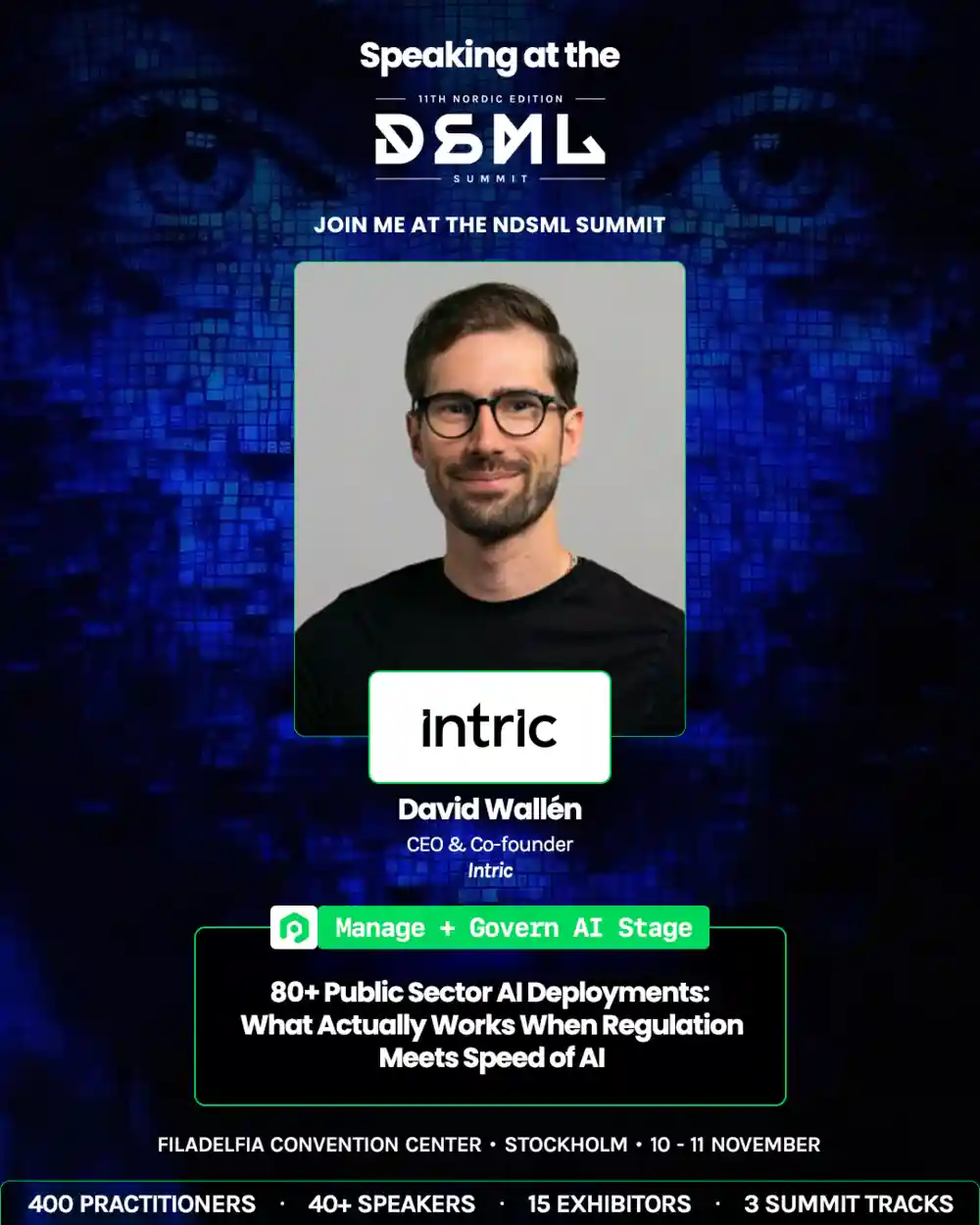
At the upcoming NDSML Summit, David will present “From Caution to Confidence: Sovereign AI at Scale in the Public Sector.” Drawing on Intric’s work powering 10,000+ assistants across 80+ institutions, his session explores how built-in compliance, infrastructure control, and governance create the foundation for resilient public-sector AI. Join his session to learn how complex organizations can safely transition from small pilots to large-scale, durable deployment.