Can an enterprise tighten data governance while simultaneously cutting platform operational costs by 90%? Sandvik AI Lead William Smedberg breaks down the agentic architecture that made it possible.

What happens to an engineering team when 90% of its operational workload is handed over to software?
At Sandvik, AI Lead William Smedberg decided to find out. Managing the company’s enterprise Databricks environment and AI tool portfolio across a decentralized organization, his team tested whether autonomous agents could take over the daily churn of monitoring, data quality checks, and pipeline fixes. Ahead of his session at the upcoming NDSML Summit, he shares what they learned.
In your session at the NDSML Summit, you share how Sandvik shifted from a traditional platform team to using AI agents to run your Databricks platform. What was the tipping point where traditional operations stopped scaling?

The tipping point was where we started to rely on agents for all ”operative” work. Meaning agents would handle all our monitoring, data quality checks, pipeline improvements etc. We had so much more time for innovative work and platform improvements, which scaled into other effects.
So when we had gained enough efficiency to lift our heads and could turn our efforts to enhancing the services rather than just operating them, we saw the true uplift in productivity. 
Why is making this shift toward agentic platform operations becoming so critical for enterprise teams right now?
AI is currently the worst it will ever be. Meaning AI Agents and tools will only become better. If we stick with our traditional approaches, it would in the end only be ourselves in the way of additional performance.
The best use cases to start with are where you can clearly define an ”end” or done handover point. Platform operations are therefore great cases to start with, as they often follow a process and therefore have a ”done” state.
When looking back at years of operational logs and support tickets, what key patterns emerged that helped guide how you designed these agentic workflows?
We saw that (as most patterns follow) most tickets and previous improvements fall into a few major buckets. So just the analysis gave us value since we could focus our efforts. We also realised how much time we spend on actions that we could automate.
Once you identified those patterns, why was building parallel agentic workflows faster than trying to refactor legacy platform code?
We often build inefficiencies into the processes themselves. So when it was time to rebuild, AI has made it faster to make a completely new process and testing it in parallel, rather than repairing an inefficient process one small step at a time. We could also spend time designing the process in the way we want it to work, which feels a lot more fun.
Which were the concrete steps taken, and in which order?
We started by rebuilding our roughly 300 data pipelines so they are defined and managed by AI, beginning with the least complex ones and ending with 300 pipelines bundled into six. Agents also added quality checks, tags and descriptions, so the result was higher quality than what we began with, and refreshed faster.
Next, we analyzed and bucketed our previous tickets. Most were low-complexity requests, such as data access, network changes or light modifications, so we built end-to-end agentic workflows that implement them, with human approval. For more complex scenarios, we added feedback loops where agents ask and guide users in their usual channels, so people get help defining what they need. Agents can then implement even complex requests like provisioning, new features and infrastructure changes, and anything they cannot handle goes into a structured backlog.
Once most of the platform operations were covered, we tied everything together with orchestrator agents. Finally, we added a simple real-time interface showing what the agents are working on whenever someone submits a request.
Moving to automated self-service is often a cultural shift for teams. How did bringing gamification into the platform help change user habits and drive adoption across Sandvik?
Gamification was a final step, where we started to think of a way of showing the new agentic team that helps on platform operations, rather than humans. We wanted to showcase what the agents are doing, and the idea came to make a game out of it. So bringing a sense of fun into development, making something we had no idea of how to do, and showing our agentic process at the same time.
That shift delivered a 90% cost reduction for the platform team while tightening governance. How do agentic workflows keep central policies from slowing teams down?
We often think agentic development is a way of bypassing policies and circumventing governance. But agents are actually the perfect way of truly governing your platform, as agents can be the driving force to actually implementing the policies you set. Since we can show what policies we enforce, and add additional layers of governance extremely efficiently, it actually puts us in a driving position to make better policies.
As agents take over routine operations, how do you see the daily role of platform engineers changing over the next few years?
I think the roles would fundamentally shift. Platform engineers would focus a lot more on orchestrating and being the true bridge to technology. Next generation of tools would not only be able to run platform operations, but even automating end user work. This means ”platform” operations would likely not only operate the platforms, but truly run them.
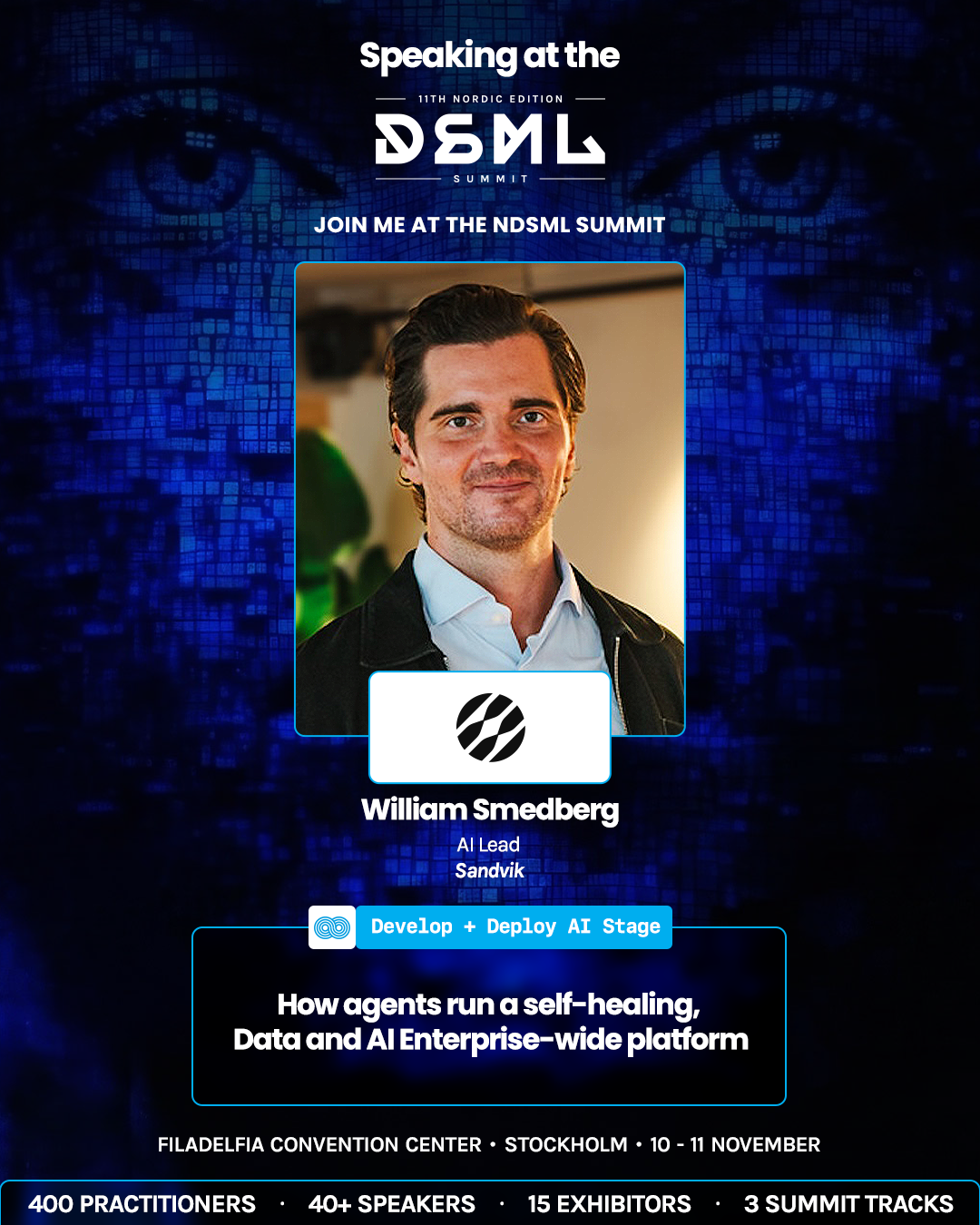
To learn more about implementing parallel agentic workflows and automated platform governance, join William Smedberg’s session at the NDSML Summit.