

We started this series with our first argument that the “Enterprise AI Is Not Failing, It Is Being Mismanaged“ and identified that the models aren’t weak, but the leadership remains to the same vertical command-and-control hierarchy that views AI as a faster version of a human employee. The real crisis is a leadership failure to transition from “doing” to “orchestration”, dismantled in the second instalment about Why AI Maturity Models Are Misleading Most Enterprises and the 5 arguments towards that claim. While it pictured the metrics (Maturity Models), this article will show the execution gap, in which we will see the difference between strategy vs. reality.
This mismanagement has now evolved into two secondary symptoms that are currently paralyzing the enterprise:
- The Reliance on False Maps: Because leaders feel out of control, they have retreated into the “psychological safety” of AI Maturity Models. As we explored in our previous piece, these models allow executives to report “readiness” while ignoring the fact that their organizational behavior hasn’t changed.
- The Strategy-Reality Gap: This brings us to the present crisis. Even when a leader thinks they have a strategy, they are usually ignoring the “organizational physics” of their firm. They are attempting to run a “Data Mesh” strategy on a “Siloed” reality.
In the first article, we saw leaders bonding AI onto old roles. In the second, we saw them bonding maturity frameworks onto stagnant cultures. Now, we see them bonding “Visionary AI Strategies” onto 19th-century Liability Models. When we say “Enterprise AI is being mismanaged,” we specifically mean that we are prioritizing Information Velocity (getting AI to give us answers faster) while completely ignoring Decision Velocity (allowing the organization to act on those answers).
AI doesn’t fail because the power source is insufficient; it fails because the organizational wiring cannot handle the voltage. Attempting to run autonomous AI through a legacy hierarchy is like trying to power a modern city through a 19th-century telegraph line – the system will intentionally trip its own breakers to keep from burning down.
By the time an enterprise formally publishes its AI strategy, the hardest work is seemingly over. Priorities have been defined, budgets secured, and the “Level 3” or “Level 4” maturity milestones have been proudly announced to the board. From the outside, the organization looks ready for transformation. But even then, we notice that this is precisely the moment where AI value creation begins to stall. The failure is rarely found in the technical roadmap or the choice of LLM. Instead, it lies in the fact that the strategy assumes an organization that does not exist.
Agile, data-driven, and autonomous – this is how an enterprise should behave according to the strategies, but the organizational reality remains anchored in legacy hierarchies designed to preserve control and distribute blame. Salim Ismail has an interesting take on this: the gap between this strategic fiction and the operational truth is where AI value quietly dies, as the organization’s “immune system” inevitably rejects a technology it is structurally unwilling to let matter.
Key takeaways:
- The Transplant Failure: Enterprise AI is stalling not due to technical limitations, but because organizational “immune systems” reject machine autonomy. Grafting agentic AI onto 19th-century command-and-control hierarchies creates friction, not transformation.
- The Velocity Gap: Most firms have optimized for Information Velocity (getting answers faster) while ignoring Decision Velocity (the authority to act on those answers). The result is an “insight-rich, action-poor” enterprise where AI speed is neutralized by steering-committee latency.
- The Structural Shift: To unlock ROI, leadership must pivot from being “Chief Deciders” to “System Designers.” Success is no longer measured by how advanced your AI stack appears, but by how much authority you are willing to delegate to it.
The Decision Deadlock: Velocity vs. Latency
AI strategies are almost universally built on a single premise – better prediction leads to better decisions, and faster insight leads to faster action. The logic suggests that by incorporating real-time data into the enterprise, the organization will naturally accelerate. However, this assumes that the bottleneck is a lack of information. In reality, most enterprises are designed to slow decisions down.
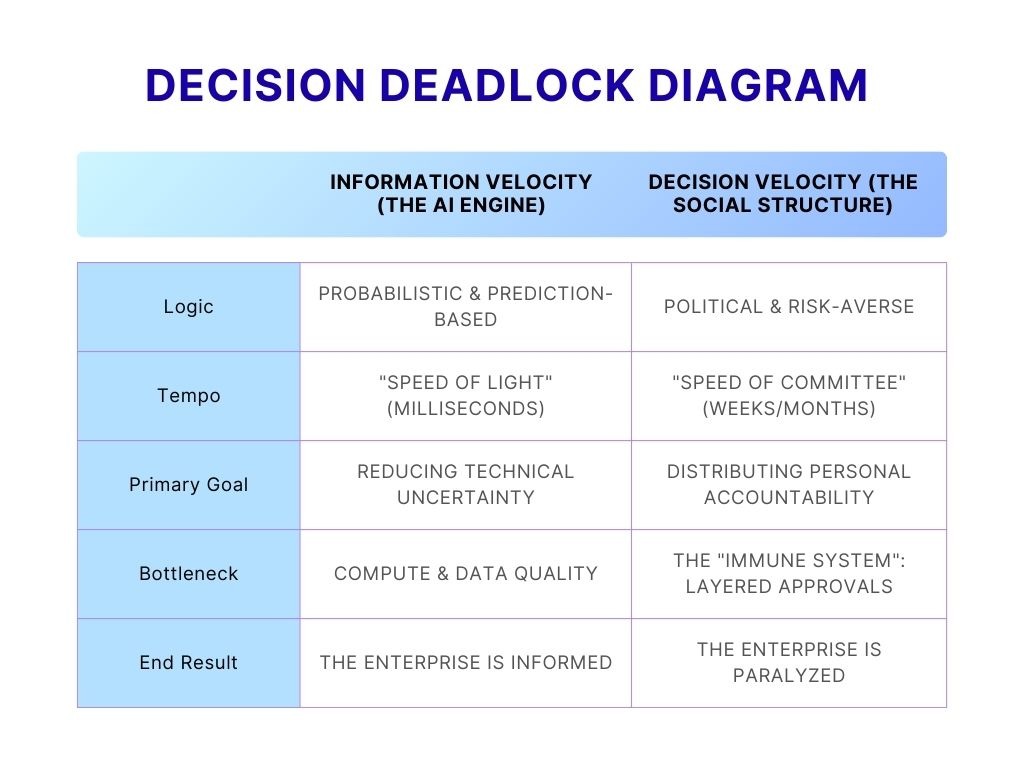
Decision latency is the defence mechanism, not an organizational accident. It is the byproduct of layered approvals, diffused accountability, and a culture of political risk management where “checking with stakeholders” is a euphemism for avoiding individual blame. AI can reduce technical uncertainty with staggering speed, but it cannot override a social structure designed to preserve the status quo. The result is a frustrating paradox: AI insights now arrive at the speed of light, but the decisions they are meant to trigger still move at the speed of a steering committee. The organization becomes significantly more informed, but not one bit more effective.
According to Dan Mapes and The VERSES AI Team, the the table from their “Spatial Web” and “Active Inference” looks something like this:
Decision Rights Are the Real AI Architecture
While CTOs and CDOs obsess over their technical stacks like debating data lakes, vector databases, and MLOps pipelines, they routinely ignore the only architecture that dictates ROI: the “decision rights” architecture. According to MIT Sloan Management Review and HBR: One can build the most sophisticated predictive engine in the industry, but if the output of that engine is forced to wait forty-eight hours for a human manager to “contextualize” (and likely ignore) it, the technical advantage is neutralized.
The unspoken rule in the modern enterprise is that AI may advise, but only humans can make the decision. This creates a structural ceiling on AI value. When AI is treated as a glorified research assistant rather than an autonomous actor, it becomes a decorative layer on top of legacy processes. Until an organization is willing to redefine “who” or “what” is allowed to act without an escalation chain, the “AI-driven enterprise” remains a strategic fiction.
Incentives Are Actively Aligned Against AI Value
AI strategies frequently call for “bold transformation,” but the internal incentive structures of most enterprises are optimized for a completely different outcome: risk avoidance. In the corporate hierarchy, managers are rarely promoted for delegating critical decisions to an algorithm. They are mostly promoted for maintaining a large domain, exercising “executive judgment” and, above all, avoiding visible failure.
In this environment, resistance to AI is not a culture problem but a rational career choice. Delegating authority to an AI system introduces a significant personal downside (if the model fails, the manager is responsible) with almost no personal upside (if the model succeeds, the credit goes to “the technology”). Consequently, teams participate in AI initiatives performatively. They deploy models in low-stakes environments or wrap them in so many human exceptions that the automation becomes meaningless. No strategy document can overcome a payroll system that punishes the very autonomy the strategy claims to seek.
Accountability Vanishes the Moment AI Is “Enterprise-Wide”
There is a strange phenomenon in AI scaling from Deloitte: early pilots usually have clear owners and high energy, but as soon as AI becomes “enterprise-wide”, responsibility begins to evaporate. It dissolves into a mist of committees, AI councils and shared mandates.
When a specific use case improves margins, the success is claimed by everyone. But when a model drifts in production or an automated pricing strategy erodes brand equity, the blame is abstracted. It’s blamed on data quality issues, governance gaps, or the ever-reliable edge cases. When a model underperforms, AI strategies rarely specify who is economically accountable when it comes to profit and loss. Without a single problem in sight, the system defaults to extreme caution. This leads to value stagnation: the enterprise is so afraid of a mistake that was made by a machine that it ignores the massive, invisible cost of human-led inertia.
The Middle Management Crunch (Where Vision Goes to Die)
If leadership provides the vision and the technical teams provide the tools, it is the middle layer of the organization that provides the reality.
In most enterprises, middle management is the “shock absorber” of the hierarchy. Their primary function has historically been to filter information and mitigate risk. AI, by its nature, does the opposite: it demands a higher tolerance for probabilistic outcomes. This creates a fundamental conflict of interest.
- The Translation Error: Leadership issues a “Top-Down” mandate for AI integration. Middle management translates this into “Bottom-Up” reporting requirements that add friction rather than value.
- The Survival Instinct: If a strategy promises that AI will “streamline operations”, a manager hears “your department is redundant.” The result is almost always a form of passive-aggressive compliance with implementing the tool but ensuring it remains subservient to existing human-led workflows.
The Integration Trap: Redecorating the Status Quo
As we argued in our previous critique of maturity models, the most common execution failure is the integration trap. This occurs when an organization embeds AI into workflows that were never redesigned for machine-augmented speed.
We are essentially trying to put a jet engine on a horse-drawn carriage. The engine is powerful (the AI model), but the carriage (the organizational reality) cannot handle the velocity.
Why “Integration” Isn’t “Transformation”
When legacy approval chains remain untouched, the results are predictably stagnant. For instance, embedding a generative AI tool into a content workflow that still mandates five stages of manual legal review inevitably results in a 0% increase in operational speed. This stagnation is further reinforced by human gatekeepers who treat AI purely as an advisory input while continuing to make final calls based on “gut feel”, effectively reducing transformative technology to a mere corporate decoration rather than a strategic driver. Ultimately, this creates a complexity tax where adding AI to a fundamentally broken process fails to fix the underlying issues, instead merely ensuring that the failure occurs faster and at a much higher price point.
The Illusion of “Doing AI”
The gap between vision and execution is best measured by the distance between prediction and authority. Most enterprises are currently “insight-rich” and they have more dashboards and AI-generated reports than they know what to do with. But they remain without action because the authority to act on those insights is still locked in a centralized, hierarchical safe.
Governance Expands Where Authority Is Missing
When an organization is unwilling to do the hard work of redesigning decision authority, it overcompensates with governance. This is why we see a proliferation of review boards, ethics frameworks and multi-stage approval gates before a single line of code moves a business metric.
Governance, in this context, is not a guardrail, it is a substitute for decision-making. It allows leadership to feel a sense of control without actually having to change how the business operates. The irony is that the governance is often strongest in the very areas where AI impact is weakest. By the time a project passes every review board, the original window of opportunity which was the speed that AI was supposed to provide – has often closed. The enterprise feels safe, but it has effectively governed itself into irrelevance.
The Uncomfortable Reality
The gap between AI strategy and organizational reality is not a technical problem, nor is it a “maturity” problem. It is a structural refusal to let AI actually matter. Most strategies describe a future the organization is structurally incapable of reaching because they ignore the political reality of power and authority.
AI does not fail because it is too advanced or because the data is messy. It fails because organizations are unwilling to let machines make choices that were previously the exclusive domain of human ego. Until leadership is willing to shift their role from “deciders” to “system designers”, the strategy will remain a high-priced fiction.