Nordic Business Journal, Stockholm Edition, February 10, 2040
By our Enterprise & Society correspondent
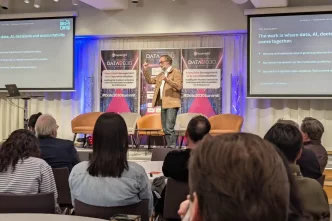
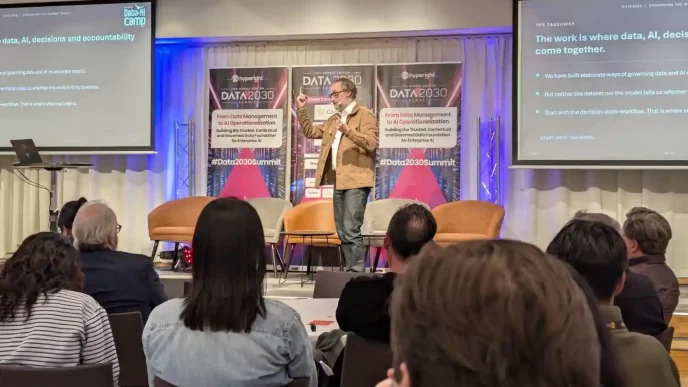
Thirteen years ago today, on the closing afternoon of the very first Vision 2040 Summit at Stockholmsmässan in Stockholm, a room full of Nordic business leaders made a choice that would quietly reshape everything that came after. They did not choose a piece of technology. Technology was never really the question. What they chose, on that stage, on February 10th, 2027, was a way of thinking about the future. And on this anniversary, it is worth stepping back and simply describing, in plain terms, what that choice grew into.
An Ordinary Morning in 2040
Picture an ordinary Monday morning in a mid-sized Nordic company today, in 2040. Nothing dramatic happens. That is rather the point.
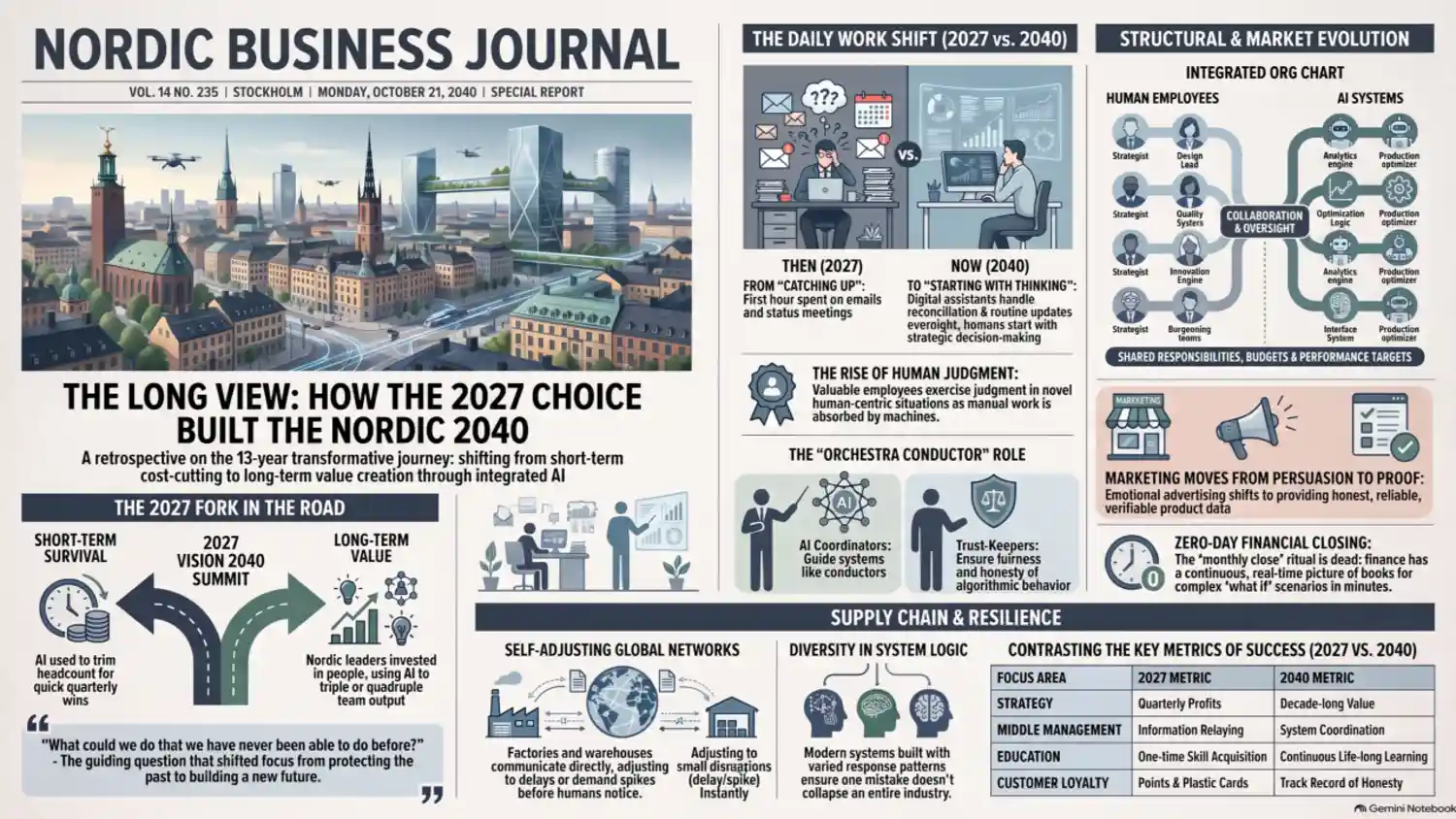
An employee arrives at the office, or logs in from home, and does not spend the first hour of her day catching up on emails, chasing colleagues for updates, or sitting through a status meeting to hear things she could have read in two minutes. That work simply does not exist anymore. Overnight, while she slept, dozens of digital assistants across her company quietly did the small, repetitive parts of the job: reconciling numbers, checking orders, answering routine customer questions, flagging the handful of things that actually need a human decision. By the time she sits down, she already knows what matters today. Her morning starts with thinking, not with catching up.
She is not managing a spreadsheet. She is managing a small team of people and a handful of AI systems that work alongside them, each with its own responsibilities, its own budget, and its own targets to hit. Some of those systems have been with the company for years and have become very good at their jobs. Others are new and still learning. She reviews their work the way a good manager once reviewed a junior colleague’s work: not by checking every detail, but by asking whether the judgment behind it makes sense. 
Down the hall, a product team is testing an idea that would have been unthinkable in 2027: a new service, dreamed up two weeks ago, already built, tested with real customers, and ready to launch by Friday. Nobody waited a year for a committee to approve a budget. The company simply has the capacity now to try more things, faster, because so much of the manual, repetitive work that used to slow everything down has been absorbed by the machines.
This is what people in 2040 mean when they say AI has disappeared into the background. It is not gone. It is everywhere. It runs quietly inside every product, every process, every decision. Nobody talks about “using AI” anymore, any more than someone in 2027 talked about “using electricity.” It is simply how things work.
The Choice That Made the Difference
Here is the part of the story that this newspaper believes deserves the most attention on this anniversary, because it is the part most easily forgotten.
In 2027, when the technology first became powerful and reliable enough to genuinely reshape a company, most business leaders faced a very simple choice. And most of them, if we are honest, chose the easy answer first. They looked at these new tools and thought: here is a way to cut costs. Here is a way to do the same work with fewer people. Here is a quick win for this year’s results.
That instinct was understandable. It is also, in hindsight, the instinct that separated the companies that merely survived the following decade from the ones that came to define it.
A smaller number of leaders, gathered that week at Stockholmsmässan, asked a different question. Instead of “how do we do the same with less,” they asked “what could we do that we have never been able to do before.” Instead of shrinking their companies to protect this year’s profit, they invested in the people they already had, gave them powerful new tools, and asked them to aim higher. A team of ten people, amplified by the right AI systems, could suddenly produce the work of thirty or forty. The leaders who understood this did not use that extra capacity to send people home. They used it to build new products, enter new markets, and serve customers in ways that had simply not been possible before.
It sounds like a small difference in thinking. It was not. Cutting costs makes a company look good for a year. Building new value makes a company matter for a decade. The businesses that chose the second path spent the following years not just surviving change, but shaping it: asking who their customers would be in five or ten years, and building toward that future rather than defending the past.
That is the real meaning of this anniversary. February 2027 was the year enough Nordic organizations stopped thinking only about next quarter and started thinking about the next decade. They stopped asking only “how do we protect what we have” and started asking “what could we build that did not exist before.” That change of heart, more than any single piece of software, is what built the world we live in today.
How Work Changed
The clearest evidence of that shift is in how companies are organized today.
In 2027, an organization chart was a chart of people: who reported to whom, who managed which team. Today, that chart also includes the AI systems working inside the company, each one given a clear job, a budget, and a way of measuring whether it is doing that job well. When one of these systems is no longer needed, or a better one comes along, it gets replaced, the same way a role might once have been redesigned. This sounds strange to describe, but it feels completely ordinary to the people who live it.
What has actually shrunk is the amount of time humans spend passing information back and forth. The old middle layer of a company, whose main job was collecting updates from one team and reporting them to another, has mostly disappeared, because the systems now do that automatically and continuously. Nobody misses it.
What has grown is something harder to measure but easy to feel: judgment. The people who matter most inside today’s companies are the ones who can make good decisions when something genuinely new or difficult happens, something no system has seen before. They are the ones willing to take responsibility when a decision affects real people, not just numbers on a screen.
New kinds of jobs have appeared to support this. There are people whose entire role is to guide and coordinate the AI systems working across a company, much like a conductor guides an orchestra. There are people whose job is to be the calm, capable human who steps in exactly when a system reaches the edge of what it knows and needs a person to take over. There are people who check the fairness and honesty of how these systems behave, a kind of internal trust-keeper that simply did not exist as a career in 2027.
And there is one more thing that has changed, quietly but completely: nobody expects to learn a skill once and use it for the rest of their career. Learning new things regularly is no longer a special program offered by a company. It is simply what having a job means now. The people and companies who accepted that early are the ones who are thriving today.
How Customers Buy and Companies Sell
If work looks different today, so does the simple act of buying something.
Many households in 2040 have their own personal AI assistant that genuinely handles a lot of shopping and decision-making on their behalf: comparing options, checking prices, remembering preferences, and often completing routine purchases without a human even looking at the details. Businesses do the same thing when they buy from other businesses. A meaningful share of everyday buying decisions is now made, or at least filtered down to a shortlist, by these assistants before a human ever gets involved.
This changed marketing more than almost anything else. In 2027, companies spent enormous energy trying to catch a person’s attention and persuade them with a good story, a clever advertisement, an emotional appeal. That still matters for the big, meaningful purchases in life: a first home, a wedding, a gift for someone you love. But for the everyday, routine purchases that fill most of our lives, persuasion matters much less than proof. If a customer’s assistant is doing the choosing, what matters is whether a company’s product is genuinely good, honestly described, and reliably delivered. Companies that tried to exaggerate or mislead found, fairly quickly, that assistants stopped recommending them at all. Trust became something you could not fake your way around anymore.
Prices today often adjust in real time, shaped by an ongoing back and forth between what a buyer’s assistant is looking for and what a seller can offer. Loyalty is no longer a plastic card with points on it. It is something closer to a track record: has this company been honest and reliable every time before. Nordic companies, who were already used to being transparent and straightforward with customers, found this new world came a little more naturally to them than to some of their competitors elsewhere.
How Companies Manage Their Money
The finance department has perhaps changed the most, while being noticed the least.
In 2027, closing the books at the end of each month or quarter was a stressful ritual: teams working late nights to pull together numbers that were, by the time anyone saw them, already a little out of date. That ritual is gone. Today, a company’s financial picture updates continuously, all the time, so there is no such thing as waiting for the end of the month to know how things stand.
This has freed finance teams to spend their time differently. Instead of mostly reporting on what already happened, they now spend much more time asking “what if.” What happens to our costs if a key material becomes more expensive next quarter. What happens to our plans if a competitor changes their pricing. These questions used to take weeks to answer properly. Now they can be answered in minutes, because the systems already understand the shape of the business in detail.
Much of the routine buying and paying that companies do with each other now happens directly between systems, following rules that people set up in advance and check on regularly, rather than every single transaction needing a person’s approval. This has brought real benefits in speed and accuracy. It has also brought new risks that companies have had to learn to manage carefully, particularly the risk of many systems across an industry reacting the same way to the same piece of bad information all at once. Nordic regulators worked closely with businesses to build careful checks for exactly this kind of risk, and that early, careful work is a big part of why the region’s financial systems are trusted today.
How Goods Move Around the World
The fourth big change is the one most people never see, but everyone benefits from: how products actually get made and delivered.
In 2027, when something went wrong in a supply chain, a delayed shipment, a factory problem, a sudden spike in demand, a human planner usually found out about it late and then scrambled to fix it. Today, the networks connecting factories, warehouses, shipping companies, and stores talk to each other constantly and adjust on their own, often before a human would even have noticed a problem was forming. The result is far less waste, far fewer empty shelves, and products that reach people faster and more reliably than ever before.
This did not happen without a few hard lessons along the way. When every company in an industry builds its systems to respond to problems in a similar way, there is a risk that they all respond incorrectly to the same piece of bad information at the same time, making a small problem into a bigger one. The companies and industries that learned this lesson early built in enough variety in how their systems think and respond, so that one shared mistake does not spread everywhere at once. That lesson, learned the hard way in the early 2030s, made the whole system stronger.
People still play a central role here too. They decide what these networks are allowed to prioritize, they set the boundaries the systems must work within, and they step in personally whenever something happens that has genuinely never happened before.
A Word of Thanks
It would be easy, looking back from 2040, to assume that all of this was inevitable, that of course the technology would improve and of course companies would eventually reorganize around it. That is not how it felt at the time, and it is not fair to the people who made the choice.
In February 2027, nothing about today’s world was guaranteed. The technology was promising but still young. Most of the world’s business leaders were still thinking in terms of quarters, not decades. It would have been easy, and understandable, for the leaders in that room at Stockholmsmässan to choose the safe, familiar path: use these new tools quietly to trim costs, protect this year’s numbers, and wait to see what everyone else did first.
Instead, enough of them chose something harder. They chose to believe that the biggest opportunity was not in doing the same things more cheaply, but in doing entirely new things well. They invested in their people instead of replacing them. They asked who their customers would need them to be in ten years, not just this year. And they said so, publicly, at that first Vision 2040 Summit, at a moment when it would have been far easier to stay quiet.
That decision was not free of difficulty. Some early attempts failed, expensively and publicly, before anyone fully understood how to do this well. Many people had to learn new skills and take on unfamiliar roles, and that transition was not always smooth or comfortable for the people living through it. This newspaper does not want to pretend the last thirteen years were painless. They were not.
But the choice to look further ahead, to invest rather than only cut, and to build a shared vision of what a better future could look like, is the reason the Nordic region enters 2040 as one of the most trusted, resilient, and forward-looking economies in the world. Tomorrow, the fourteenth Vision 2040 Summit opens at Stockholmsmässan, on the very same stage where this all began. It seems fitting to end where we started: with simple thanks to the leaders of 2027, who chose to look past next quarter, and in doing so, helped build the world we now live in.
This article is part of the fictional Nordic Business Journal’s ongoing “Vision 2040” anniversary series, published on the eve of the 13th annual Vision 2040 Summit, 10th of February 2040.