

By now, you have probably seen or read at least one media outlet raising concerns about an AI Bubble and potential repetition of the dot-com crash that happened at the beginning of this millennium.
In this article, we address some of the possible signs pointing to such a scenario and analyze what that would mean for the business and future investments in the area.
To understand what this would mean for anyone, we will start with a closer look at what the AI Bubble is.
The term AI bubble refers to the idea that the current enthusiasm, investment, and sky-high stock market valuations associated with Artificial Intelligence technology, particularly Generative AI, may have become disconnected from the underlying commercial returns and proven profitability of the sector.
It represents a period of speculative frenzy where the valuation of AI’s future potential far exceeds current financial fundamentals, posing the risk of a sharp price correction when market expectations fall short of reality. 
Recognizing bubble patterns
Market momentum plays a central role in the formation of bubbles. The increase in asset prices encourages further purchasing, thereby creating a self-reinforcing feedback loop. Even participants who recognize potential overvaluation may engage in investment, relying on their ability to liquidate positions before a correction occurs.
While anecdotal signs exist, a more fundamental analysis questions whether AI assets have intrinsic value or if their worth relies solely on future price speculation.
Historical precedent shows that major innovation cycles, such as railways, electricity, and the internet, frequently coincide with speculative booms, leading to spectacular gains and losses. Though such eras are beneficial for society and highly profitable for a few investors, the majority often suffer large losses.
The dot-com bubble offers a stark lesson: Yahoo!, valued at $128 billion in 2000, ultimately saw its stock decline by 96%. Conversely, Amazon, which also collapsed by over 90% in two years, rewarded long-term investors nearly fifty-fold. This demonstrates that while early success is often extrapolated into unsustainable perpetual growth, long-term investors in the true market winners can still see remarkable returns. The pattern repeats: every generation finds its Yahoo!s and its Amazons.
Why the Term is Gaining Traction
After the concern from some experts, other entities are sounding the alarm. The U.K. central bank states that the risk of a sharp market correction has increased.
Just before that, the IMF chief economist Pierre-Olivier Gourinchas projected that a systemic event capable of cratering the US or global economy would be a low-probability outcome.
Some experts go so far and are comparing it with the real estate bubble from the early 2000 as they compare the increase of searches about the AI bubble. For the IMF, Gourinchas has stated that there are many similarities between the late 1990s internet stock bubble and the current AI boom, with both of them significantly changing the stock valuations and the capital gains wealth. In the latest
As explored by Deutsche Bank in their latest research paper on this topic, bubbles are not linear processes. They usually come in waves and are followed by a sharp decline.
What AI Bubble means to different entities

The prospect of an AI bubble holds different implications and concerns for various stakeholders:
Financial Institutions like IMF, Bank of England, Investment Banks would have the biggest load as being responsible for global financial stability. They warn that AI-related stocks now constitute a large and concentrated portion of benchmark indices (like the S&P 500). If they stay this way, there is no fear of any bad outcome. But If these valuations correct sharply, it could trigger a “sharp market correction” that spills over. That spill can potentially lead to a broader economic destabilization.
Risk of wasting the investments: Investment bank leaders acknowledge that while AI is a “real” and transformative technology, a significant amount of the money invested now will be “wasted” on overvalued companies or poor business models.
Risk of debt: A growing concern is that Big Tech companies are increasingly relying on borrowing (taking on debt) to fund massive capital expenditures on chips and data centers. This shifts the risk of a bubble bursting from shareholders’ cash piles to the financial system itself, as debt exposure increases.
Experts and Academics (Economists, Researchers) would face critique or/and importance depending on their previous evaluations. Most experts distinguish the bubble from the technology itself. They believe AI remains genuinely transformative; the risk is simply that the market has priced in decades of growth overnight, leaving valuations vulnerable to slower-than-expected adoption.
Experts cite reports, highlighting the disconnect between market valuation and actual business fundamentals. The latest one is the report from MIT citing that despite enterprise investment in Generative AI (GenAI) reaching $30–40 billion, the report reveals a surprising finding: 95% of organizations are currently achieving zero return. This dramatic disparity, named the GenAI Divide, is evident across both technology buyers (enterprises, mid-market, SMBs) and builders (startups, vendors, consultancies). While only 5% of integrated AI pilots are extracting millions in value, the vast majority have failed to demonstrate any measurable P&L impact. The report suggests this divide is driven by differences in implementation approach rather than model quality or regulatory hurdles.
Some technical experts suggest the impressive performance of Large Language Models (LLMs) might be nearing a plateau – slowdown in the growth rates of key indicators of economic activity, such as gross domestic product (GDP), employment, and consumer spending. Another fear is that current models’ abilities are exaggerated due to data contamination (where training data accidentally contains test answers). A slowdown in technological breakthroughs could immediately deflate valuations.
Tech Companies and Executives (OpenAI, Meta, Nvidia) generally downplay the “bubble” framing, arguing that the current boom is an “industrial” rather than a purely financial one. They stress that companies like Nvidia are profitable and that the large capital expenditure is building tangible, necessary infrastructure (data centers, chips).
CEOs like Sam Altman have acknowledged that investors will likely “make some dumb capital allocations” and that there will be short-term cycles of over- and under-investment.
Hyperscalers – large, established, and profitable tech giants that operate massive cloud data centers—are driving the bulk of current AI investment. This gives them a significant advantage over the unproven startups that fueled the dot-com bubble, as their immense financial stability acts as a potential cushion against a market correction.
What a Bursting AI Bubble Would Mean
The fallout of an AI bubble bursting would depend heavily on whether it resembles the dot-com crash (2000) or the 2008 housing crisis. Experts generally predict that, if it happens, it would be closer to the former, leading to a shallow economic downturn but leaving valuable technology behind.
For the Financial System and Global Economy would mean that a sharp and sudden stock market correction (more known as “market plunge”) would occur, centered on the tech sector. This would erase billions or potentially trillions in global household wealth, which could quickly strangle consumer spending and impact economic growth.
If the high debt levels used to finance AI infrastructure are not manageable, the bursting bubble could have a ripple effect, damaging the balance sheets of banks and financial institutions, similar to the 2008 crisis. According to some sources, this is not very likely to happen as it is the worst case scenario.
Banks and investors would become highly risk-averse, leading to a drying up of financing for startups, businesses, and possibly even households, prolonging the economic pain.
For the Tech Industry and Startups can mean that there will be less and less startups. Linked to the banks and investors not willing to invest, companies that were overvalued, lacked clear profitability, or were focused purely on speculative ideas would vanish rapidly. This is compared to the dot-com crash as thousands of startups disappeared not long after.
The cost of essential AI technology (models, APIs) would become radically cheaper and more abundant. The market would suddenly recognize that model capabilities are converging, leading to a swift correction in value for model-makers.
The industry’s focus would shift from “technology acquisition” to “integration capability.” Surviving companies would shift their focus on the unattractive, necessary work of redesigning workflows and standardizing data to actually extract value from the now cheaper AI tools.
The lasting positive “residue” of the bubble would be the infrastructure built (data centers, fiber optics) and the core useful technologies (LLMs, generative models) that would continue to operate and form the foundation of future, more sustainable innovation.
Relevance of the search term
To find out if there is still relevance, we’ve included the data from Google Trends which shows that not much was talked about this, up until recently. The search term was “AI Bubble”. The location is set to “worldwide”.
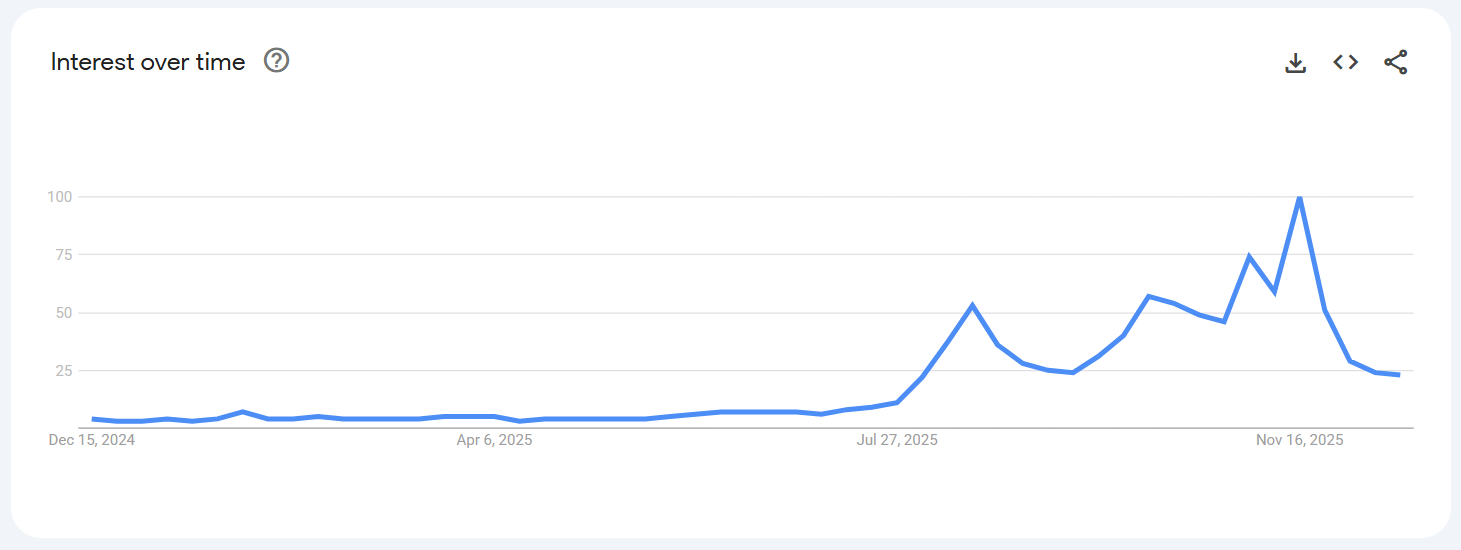
Image source: Google Trends
On this graphic, it is shown data from the past 12 months, starting from December 2024. We see a spike in August and another, slightly bigger one in November. Even after the announcements from two of the biggest institutions, the trend shows a plunge.
Looking forward
The latest news and analysis regarding the AI bubble debate, shows the market is at a critical juncture, focused less on speculation and more on the high cost of AI infrastructure and the need for tangible profitability.
Many analysts believe the technology’s potential is real.
The consensus among some of the biggest institutions is not that the AI trend is entirely a bubble, but that the valuation premium, the debt-fueled infrastructure build-out, and the lack of profitability for the majority of smaller players are creating a bubble risk. This risk can lead to a correction in specific, overcapitalized parts of the market
For long-term tech survivors, the lesson from the dot-com era is clear: Focus on integration capability over raw technology acquisition. Those who will thrive are the enterprises prepared to shift their resources toward the “unattractive” work of redesigning workflows and standardizing data, ensuring they are positioned to capture value from AI when the tools become cheap and abundant.