
There is a comforting version of enterprise AI transformation in which organizations buy access to the best models, give employees copilots, run training programs, build a few agents, establish an AI governance committee and gradually measure adoption. It is a familiar technology transformation playbook because it leaves the fundamental structure of the organization intact. People continue doing essentially the same jobs, applications continue organizing the work, management continues coordinating people through familiar hierarchies, and AI becomes another increasingly powerful layer of technology supporting the existing operating model.
Mikko Alasaarela, Co-Founder and Executive Chairman of Agion, guest of the AI After Work (AIAW) Podcast season 13 premiere, believes this framing misses the more consequential transformation. Having spent more than 15 years working with AI, algorithms and digital products, from early algorithmic systems and conversational interfaces to autonomous agents, he has arrived at a different conclusion: AI should no longer be understood primarily as a tool that helps humans perform work. It is becoming an organizational capability capable of performing work itself. Once that distinction is accepted, many of the assumptions behind the modern enterprise begin to look unstable, including organizational charts designed around human execution, software architectures built around employees operating applications, governance systems based on periodic human decisions, and the idea that a company’s most important knowledge resides primarily in the heads of its employees.
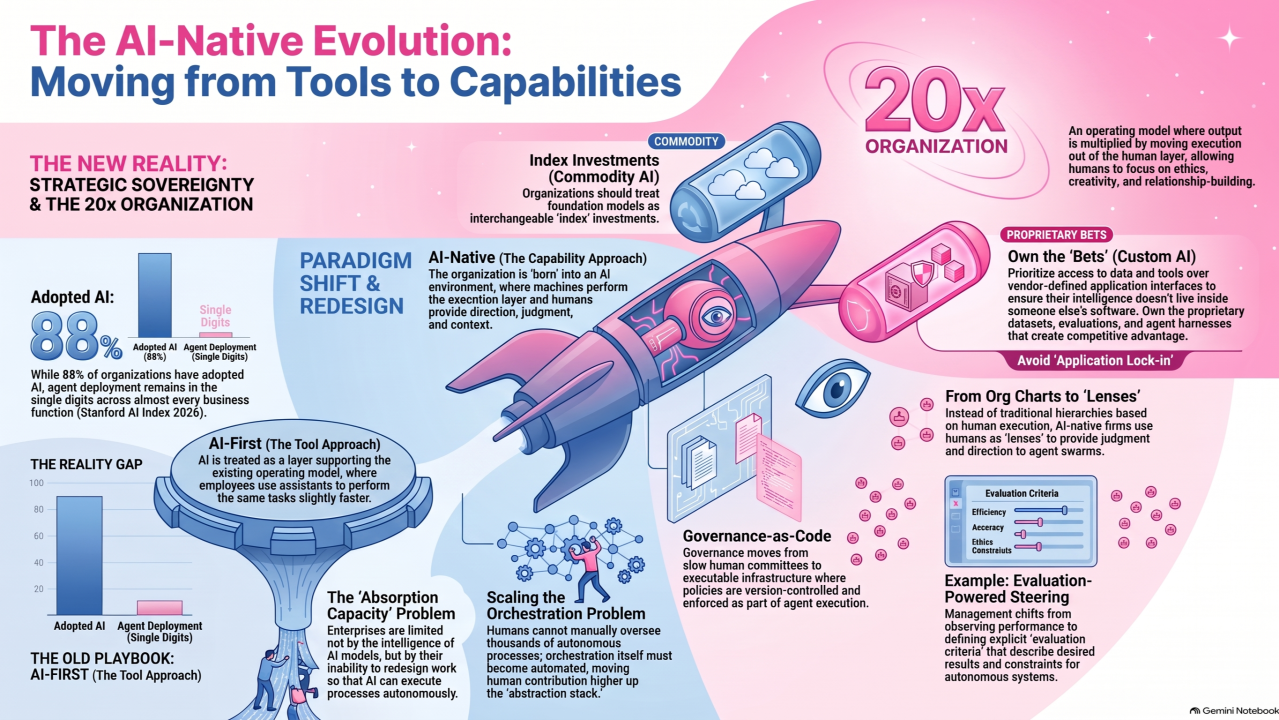
This is why Alasaarela prefers the term “AI-native” to “AI-first.” Native implies something more fundamental than prioritization: it means being born into a different environment and designing accordingly. His thought experiment for leadership teams is therefore not to ask how more AI can be added to the company they already have, but to imagine that human-level AI is a normal organizational resource and ask how they would design the company from scratch under that assumption. It is deliberately provocative because nobody knows exactly when, or in what form, artificial general intelligence will arrive. Yet as a strategic exercise, it forces leaders to stop optimizing yesterday’s organization and begin examining what an organization designed for increasingly capable machine intelligence might actually look like.
The Absorption Problem
The AI industry spends enormous amounts of attention on the frontier: which model is smartest, which benchmark has moved, which laboratory is ahead and how close the industry may be to some definition of AGI. Alasaarela believes most enterprises face a more immediate constraint. They are not primarily limited by the capabilities of frontier models; they are limited by their ability to absorb capabilities that already exist. During our conversation, Henrik Göthberg summarized the issue as an “absorption capacity problem,” and that framing helps explain why widespread AI adoption has not yet produced an equivalent transformation of enterprise operating models.
Stanford’s 2026 AI Index illustrates this gap. Organizational AI adoption continued rising during 2025, reaching 88 percent among surveyed organizations, while generative AI was being used in at least one business function at 70 percent of organizations. Yet deployment of AI agents remained in the single digits across nearly every business function. The implication is not that organizations are ignoring AI, but that access is spreading much faster than operational transformation. Enterprises have become reasonably effective at putting AI into employees’ hands, while remaining much less mature at redesigning work so that AI can become part of the organization’s execution layer. Stanford AI Index 2026
Alasaarela describes this as the difference between AI as a tool and AI as a capability. When an employee uses an AI assistant to draft a presentation, summarize a document or accelerate analysis, the employee may become meaningfully more productive, but the underlying operating model remains largely unchanged. The employee still owns the task, the organizational structure remains intact, the same applications often remain in place and the same approval processes govern the outcome. The more significant transformation begins when an organization can define an objective, translate that objective into policies and evaluation criteria, and allow agents to perform the work, call tools, coordinate activities, evaluate results and escalate meaningful exceptions to people. At that point, AI is no longer merely helping someone execute a process; it has become part of the process itself. 
This distinction also changes the productivity discussion. If the objective is a modest improvement in individual efficiency, copilots and better tools may be enough. If the ambition is to produce several times more output with the same number of people, the work itself has to be redesigned. Alasaarela’s central argument is that transformational productivity does not come from asking humans to perform the same activities slightly faster. It comes from moving increasing amounts of execution into an agentic layer while reconsidering what humans should contribute when execution is no longer their primary function.
Designing for the World You Expect
Alasaarela’s approach begins with an unusual thought experiment: assume AGI exists. This does not require executives to believe that AGI will arrive next year, nor does it require agreement on exactly what qualifies as AGI. Instead, the assumption functions as a design constraint. If AI could perform work at approximately human capability across a broad range of activities, leaders would need to decide where people should still deliberately be used, where machines would be preferable, what humans should own, what should become autonomous, which capabilities genuinely differentiate the organization and which capabilities should simply be purchased from the market.
These questions produce a very different transformation agenda from asking employees to identify AI use cases. They also expose why the traditional organizational chart may be the wrong starting point. Most enterprises are constructed as collections of roles that become teams, departments and reporting hierarchies because people have historically been the principal units of execution. Alasaarela argues that an AI-native organization should increasingly think in terms of what he calls “lenses,” representing perspectives through which humans contribute judgment, direction and context to a much larger system of machine execution.
This matters because the popular idea that humans will simply become orchestrators of AI agents eventually runs into a scaling problem. A person may be able to coordinate several agents and perhaps maintain meaningful oversight of dozens under the right circumstances, but the idea becomes increasingly implausible when an organization operates hundreds, thousands or eventually tens of thousands of autonomous processes. Humans cannot inspect every action, understand every dependency and approve every decision in real time, which means orchestration itself must increasingly become automated. The human contribution consequently moves higher in the abstraction stack, toward defining intent, establishing boundaries, expressing judgment, deciding what constitutes a good outcome, investigating important exceptions and changing the system when its behavior diverges from organizational objectives.
This is a much more consequential interpretation of “human in the loop” than simply placing an approval button at the end of an automated process. The objective is not to require human participation in every action, because doing so would eliminate much of the value of autonomy. Instead, the organization needs to determine where human judgment adds distinctive value and where machine execution can safely operate within clearly defined boundaries.
When Agent Swarms Make Governance Infrastructure
As soon as organizations begin thinking in hundreds or thousands of agents, governance stops being primarily a documentation problem and becomes an infrastructure problem. This may be one of the strongest ideas emerging from the conversation because traditional governance assumes relatively slow organizational processes: policies are written, employees are trained, controls are implemented, audits happen periodically and committees investigate exceptions. Agentic systems operate at a fundamentally different speed, potentially retrieving information, calling APIs, modifying records, generating analyses, communicating with other systems and initiating subsequent workflows before a person could meaningfully review the first action.
At sufficient scale, governance cannot depend on people inspecting everything an agent does. It has to become executable, which is why Agion describes its approach in terms of governance-as-code, with policies that can be version-controlled, tested and enforced as part of agent execution while higher-risk decisions are routed toward appropriate human review. The important conceptual shift is that policy is no longer merely something an employee is expected to remember and interpret. It becomes part of the environment within which autonomous action occurs.
The wider AI ecosystem is converging on the same problem. In February 2026, the U.S. National Institute of Standards and Technology launched an AI Agent Standards Initiative focused on interoperable and secure agentic systems, noting both the growing autonomy of agents and the importance of security and interoperability for broader adoption. The Linux Foundation’s Agentic AI Foundation is simultaneously developing neutral infrastructure around technologies including Model Context Protocol, goose and AGENTS.md. These initiatives indicate that agentic AI is moving beyond isolated demonstrations toward an environment in which interoperability, identity, permissions, observability and security become shared infrastructure concerns. NIST AI Agent Standards Initiative Linux Foundation Agentic AI Foundation
The implication is a new enterprise governance stack in which organizations move from documents describing what AI should do toward technical systems determining what AI is allowed to do. Counterintuitively, this does not necessarily make organizations slower. Properly designed governance can make greater autonomy possible because systems can act without waiting for manual approval whenever they remain within established policies, while unusual or high-risk situations receive additional scrutiny. Governance, in this model, is not the brake applied after autonomy has been introduced; it is part of the mechanism that allows autonomy to scale.

Evaluation Becomes a Management System
Moving work from people toward autonomous systems has another important consequence: management itself begins to change. Managers have traditionally evaluated people by observing performance, reviewing outputs, setting objectives, providing feedback and intervening when results are unsatisfactory. In an agentic organization, an increasing amount of that steering can be expressed through evaluation criteria that describe the desired result, the constraints that must be respected and the conditions under which an output should be accepted, rejected or escalated.
Alasaarela’s experience building early versions of Agion illustrates this principle. He describes running multiple agent “farms” and surrounding the underlying models with harnesses containing tests, documentation procedures, task management and evaluation criteria. The model was important, but it was only one component of the working system. What made the agents useful was the infrastructure around them that translated an objective into manageable tasks, monitored progress and evaluated whether the result satisfied the intended outcome.
This becomes increasingly important as autonomous task horizons expand. METR’s research tracks the length of software-oriented tasks that frontier agents can complete with specified levels of reliability, and its updated measurements show rapidly increasing task horizons. METR is also careful to warn against interpreting these results as evidence that agents can simply automate entire jobs, because benchmark tasks are cleaner, more clearly specified and more measurable than much of real organizational work. METR research on AI task horizons
That caveat points toward a deeper organizational challenge. Enterprise work is messy because goals conflict, information is incomplete, customers behave unpredictably, organizational politics exist and success is often subjective. The important question is therefore not simply whether an agent is intelligent enough to perform a task, but whether the organization can express what it wants clearly enough for autonomous systems to act on it reliably. As models improve, the bottleneck may increasingly move from machine intelligence toward organizational clarity. Companies that cannot define their objectives, processes, policies, quality criteria and acceptable risk will struggle to automate them, regardless of how capable the underlying models become.
Evaluation-powered steering therefore places an unusual discipline on leadership teams because it requires them to articulate what “good” actually means. Many organizations have historically been able to tolerate ambiguity because experienced employees interpret vague objectives using context and tacit knowledge. Autonomous systems make those ambiguities visible, forcing organizations to convert assumptions into explicit rules, evaluations and escalation mechanisms.
Your Competitive Advantage Cannot Live Entirely Inside Someone Else’s Application
Perhaps the most strategically interesting part of Alasaarela’s thesis concerns enterprise architecture. For decades, organizations have operated within an application-centric model in which they purchase systems for finance, customer relationships, HR, service, analytics and thousands of specialized processes. Employees work through these applications, while organizational information becomes distributed across vendor-defined schemas, interfaces and workflows. AI agents challenge this arrangement because agents do not necessarily need applications in the same way people do; what they need is access to data, tools, permissions and clearly defined interfaces.
This creates the possibility of moving from an application-centric organization toward a more data-centric one, and for Alasaarela the strategic issue is ultimately ownership of organizational intelligence. Historically, a significant portion of a company’s competitive advantage existed in people through their experience, tacit knowledge, relationships and accumulated understanding of how the organization actually works. As more work becomes machine-executable, increasing amounts of that knowledge need to become accessible to machines, raising an important strategic question about who controls the data, context and learning loops through which organizational intelligence develops.
Alasaarela uses an investment analogy to distinguish between what organizations should own and what they should consume from the market. Some capabilities can be treated like index investments, where the objective is not to outperform the entire technology market but to remain close to the best broadly available capability and retain the ability to switch when something better emerges. Foundation models are an obvious example: in a rapidly changing environment, an enterprise architecture should ideally allow organizations to benefit from improving models without rebuilding the company around a single provider.
Other capabilities represent what Alasaarela calls the organization’s own bets. These are the proprietary processes, datasets, evaluations, agent harnesses and organizational knowledge that make the company meaningfully different from competitors, and they should be designed to compound internally rather than disappear into vendor-controlled platforms. The traditional build-versus-buy question therefore evolves into something more strategic: is this capability simply infrastructure that should track the market, or is it part of the intelligence through which the organization differentiates itself?
This also offers a useful way to think about the future of SaaS. If the valuable interface gradually moves away from humans navigating applications and toward agents accessing interchangeable services, then software lock-in becomes increasingly expensive. Applications will not disappear, but their strategic role may change as organizations become more concerned with preserving access to their data, evaluations, policies and proprietary workflows than with maintaining a particular user interface.
AI Sovereignty Is Also an Organizational Capability
This architecture debate connects directly to another theme Alasaarela cares deeply about: European AI sovereignty. Europe’s AI discussion is often framed around whether European companies can build frontier foundation models comparable with those emerging from the United States and China, but Alasaarela proposes a broader definition of participation. Europe does not necessarily need to win every frontier-model race to retain meaningful agency, but it does need the capability to understand, deploy, adapt and govern increasingly powerful AI systems rather than remaining primarily a consumer and regulator of technologies developed elsewhere.
As he argues in the conversation, regulation alone cannot determine the future direction of AI if Europe lacks the capability to participate in its development and deployment. His concern is not that regulation is unnecessary, but that regulation without technical capability provides only limited strategic leverage. A region that wants meaningful influence over AI needs infrastructure, skills, organizations capable of implementing advanced systems and enough architectural independence to choose among providers rather than becoming structurally dependent on one technological ecosystem.
European policy is increasingly moving in this broader direction. The European Commission’s AI Continent Action Plan combines regulation with investments in infrastructure, adoption, data and skills, while the InvestAI initiative aims to mobilize €200 billion for AI investment, including €20 billion intended for AI gigafactories. Meanwhile, the AI Act is moving from legislation toward operational enforcement, requiring organizations to connect regulatory obligations with the actual systems through which AI is deployed. European Commission AI Continent Action Plan European Commission AI Act enforcement overview
This creates an opportunity for European organizations to treat trustworthy AI not merely as a compliance obligation but as an architectural property. If governance is encoded into infrastructure, data access is controlled, models remain replaceable and autonomous actions are observable, then regulatory requirements can become part of the operating model rather than a layer added after deployment. In this interpretation, sovereignty does not mean technological isolation or refusing foreign models. It means retaining the ability to choose which models to use, where data resides, which capabilities are purchased, which intelligence remains proprietary and how autonomous systems are governed.
The strategic opposite of sovereignty is therefore not foreign technology. It is dependency without optionality.
The Nordic Productivity Paradox
The sovereignty discussion becomes particularly interesting in the Nordic context because much of the public debate around AI begins with the possibility that automation will eliminate jobs, whereas Alasaarela looks at the demographic problem from almost the opposite direction. Nordic societies face aging populations and low birth rates, which means maintaining public services, healthcare, welfare systems and economic productivity with a smaller working-age population will become increasingly difficult. From this perspective, dramatically higher productivity is not simply an ambition for private companies but potentially a societal requirement.
This idea played an important role in Agion’s origin story. Alasaarela describes conversations about Finland’s welfare system and the possibility of automating significant amounts of administrative work, including an early discussion with the CIO of Finland’s Social Insurance Institution about how much benefit processing could theoretically be automated through statistical methods and AI. The provocative question was therefore not simply whether AI could reduce administrative costs, but whether dramatically more efficient administration could help preserve the Nordic welfare model in a demographic environment where fewer working-age people will be expected to support growing societal needs.
That framing changes the ethical discussion around automation. Automation is frequently presented as something that organizations do to workers, yet a society can also reach a point where there are simply not enough workers to deliver all the services citizens expect at an acceptable cost. In that environment, the question becomes how people and machines should divide the work required to maintain those services, while still protecting accountability, dignity and appropriate human judgment.
None of this eliminates the social risks associated with automation. Productivity gains will not automatically be distributed fairly, professions will be affected differently and some groups may experience disruption well before aggregate labor shortages become visible. Stanford’s 2026 AI Index already identifies uneven labor-market effects, particularly among younger workers in AI-exposed occupations, even though the broader evidence does not yet support a simple narrative of economy-wide employment collapse. The challenge for governments and enterprises is therefore to avoid both extremes: assuming AI will automatically solve demographic problems or refusing to develop the capabilities that may be necessary to address them. Stanford AI Index 2026 economy chapter
For Alasaarela, the responsible strategy is participation because organizations learn about both capability and risk through implementation. Building systems exposes where models fail, where governance is insufficient, where humans remain essential and where autonomous execution can genuinely improve outcomes. A society cannot meaningfully shape a technology it does not understand, and it cannot develop that understanding exclusively through observation.
Building the 20x Organization
Agion has attempted to embody this thesis internally through an early ambition to build a company populated by what the founders call “20x AI natives.” The phrase does not mean finding people prepared to work twenty times harder, nor does it assume that every individual naturally possesses extraordinary productivity. It describes an operating model in which human capability can be multiplied through autonomous execution because the person is not personally performing every task required to produce the final result.
Alasaarela describes pushing this idea to an extreme while building the first version of Agion’s platform. He ran multiple coding agents in parallel and continuously monitored and steered them because the autonomous task horizons available at the time were considerably shorter than they are becoming today. He estimates that this approach allowed him to achieve output far beyond what conventional individual development would have produced, although his experience also demonstrated the limits of the technology at that stage: coordinating so much machine activity demanded enormous human attention and ultimately became unsustainable.
The lesson he drew was that transformational productivity does not come simply from giving each employee an AI assistant. If the target is a 10 or 20 percent improvement, that approach may be perfectly reasonable. If the target is several times the productivity of a conventional organization, some execution has to move out of the human layer altogether. The organizational question then becomes what people should do when machines perform much of that execution.
Alasaarela’s answer is not that people become irrelevant. Instead, their leverage changes as they take greater responsibility for direction, judgment, context, ethics, relationships, creativity, objectives and the perspectives through which autonomous systems understand what they are trying to accomplish. This is also why “AI-first” is the wrong description of his model. An AI-native organization is not designed to maximize the amount of AI used; it is designed to find a fundamentally different division of intelligence, execution and responsibility between humans and machines.
What Leaders Should Build Now
The most useful aspect of Alasaarela’s perspective is that leaders do not need to agree on an AGI timeline to act on it. Nobody can reliably tell an executive team exactly when human-level general intelligence will arrive, but organizations can still prepare for a world in which machine capabilities continue improving rapidly by making architectural and organizational choices that remain useful across multiple future scenarios.
This means asking whether the organization can switch between models without redesigning critical workflows, whether agents can access necessary data without gaining unnecessary access to everything else, whether policies can be expressed in forms that machines can enforce, whether autonomous actions can be observed and audited, whether systems can evaluate outputs before they reach customers, whether human intervention occurs at meaningful boundaries rather than after every machine action, and whether the organization’s learning accumulates inside infrastructure that it actually controls. Underneath all of these questions sits an even more strategic one: which forms of organizational intelligence genuinely create competitive advantage and therefore need to remain owned by the enterprise?
The surrounding ecosystem is already beginning to form around these requirements. Standards bodies are working on agent interoperability and security, open protocols are reducing some forms of dependency, regulation is moving toward enforcement, European compute infrastructure is expanding, agent task horizons are improving and enterprise adoption of AI continues to broaden. At the same time, operational deployment of autonomous agents remains comparatively immature, which creates an important period in which organizations can still determine what their agentic operating models should look like before those models harden around another generation of dominant platforms.
Organizations that treat this transition primarily as software procurement risk repeating an old enterprise technology pattern in a much more consequential domain: adopting someone else’s architecture, allowing that architecture to define how the organization works and discovering later that switching has become extremely difficult. Organizations that treat AI as capability building have an opportunity to make more deliberate choices about what they want to own, what they are comfortable commoditizing and where they want organizational learning to accumulate.
Participation Is Strategy
There is an apparent contradiction running through Mikko Alasaarela’s view of AI because he takes the risks of increasingly capable systems seriously while simultaneously arguing that organizations and societies should become more active builders. In his framing, however, these positions are not contradictory at all. The reason to build is precisely that understanding, governance and sovereignty cannot be developed entirely from the sidelines. Organizations discover what needs to be governed by operating systems, observing failures, evaluating behavior and progressively determining where autonomy is appropriate.
The transition toward more autonomous AI will create genuine problems. Agents will fail, systems will behave unexpectedly, new security vulnerabilities will emerge, organizations will automate processes they do not sufficiently understand, and some businesses may discover too late that they outsourced the intelligence that should have become part of their competitive advantage. Yet passivity does not eliminate these risks because the underlying technology will continue developing elsewhere; it simply reduces an organization’s ability to understand and influence how that technology enters its own operating environment.
The AI-native organization is therefore best understood not as a particular technology architecture but as a strategic posture built around the assumption that machine intelligence will continue improving. Such an organization designs for optionality, owns the intelligence that differentiates it, treats commodity capabilities as replaceable, turns governance into executable infrastructure, uses evaluation to steer autonomy and places humans where judgment, accountability and context create the greatest value.
If Alasaarela is right, the organizations that thrive in the next phase of AI will not necessarily be those that happen to secure access to the smartest model at any particular moment. Powerful models will increasingly become available to many organizations, and today’s leader may be displaced by another model surprisingly quickly. The more durable differentiator will be the organizational capability built around those models: proprietary knowledge, evaluation systems, governance, data architecture, agentic workflows and, perhaps most importantly, the accumulated experience of knowing how to combine human and machine intelligence effectively.
That brings the argument back to Alasaarela’s central point. Becoming AI-native is not about using more AI. It is about preparing the organization for a world in which intelligence itself is becoming an abundant operational resource, then reconsidering the organization from that starting point. The companies and public institutions that begin doing this now will not have every answer, but they will be developing something potentially more valuable than another AI use case: the capacity to learn how an increasingly autonomous organization should actually work.
Listen to the entire episode here: www.aiawpodcast.com
*This article was enhanced with the help of AI tools, drawing on the podcast transcript and complementary online research. To go deeper into the source material, I encourage you to listen to the full episode and make your own learnings.