
Popular culture painted a picture of artificial intelligence: machines were purely logical entities, while humans held the exclusive domain of intuition and creativity. From sci-fi icons like Data to classic robot tropes, artificial cognition was envisioned as a massive series of rigid, explicit rules.
Today, that paradigm has been completely flipped.
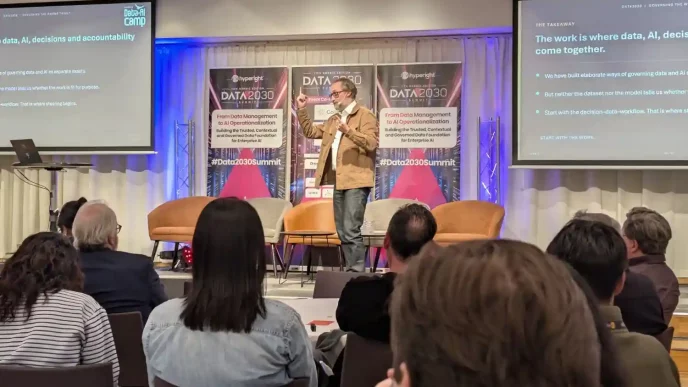
In a compelling keynote presentation that happened at the previous edition of the NDSML Summit, Rohit Patel from Meta Superintelligence Labs explored the evolving nature of artificial intelligence, challenging traditional assumptions about machine cognition and outlining how engineering teams can rigorously evaluate modern models in production.
From Pure Logic to Machine Intuition
Early AI development focused heavily on deliberate reasoning: what psychologist Daniel Kahneman termed “System 2” thinking. These early expert systems, built on extensive logical loops and handcrafted rules, were effective within strictly bounded environments. The collective assumption was that artificial intelligence would continue advancing purely along this trajectory of higher, more complex symbolic logic.
However, the rise of modern deep learning produced an unexpected outcome. Instead of brittle, rule-based logic, deep neural networks function far more like “System 1” cognition: fast, intuitive, and pattern-driven. Modern generative models compose art, draft prose, and recognize complex subtle relationships, performing tasks once believed to be uniquely human.
This change raises a fundamental question: if machines can simulate creativity, what truly defines human intelligence? Rather than relying solely on pure logic or pure intuition, human cognition excels at seamlessly transitioning between both modes depending on the context. Modern frontier models are now through emerging reasoning traces and step-by-step thinking tokens attempting to simulate deliberate logic on top of intuitive foundations. 
The Jagged Frontier and the Need for Robust Evals
While modern models exhibit impressive capabilities, their intelligence frontier remains non-convex or “jagged”. A model might execute remarkably sophisticated tasks while failing unexpectedly at seemingly trivial ones. Relying on superficial checks or assuming broad competence based on isolated successes can lead to major vulnerabilities in real-world applications.
To build dependable AI applications and particularly autonomous agents, establishing robust evaluation frameworks (evals) is one of the most important things. Rather than treating model performance as a mysterious variable, systematic evaluation transforms qualitative outputs into measurable metrics tailored directly to specific domain tasks.
Key elements of an effective evaluation strategy include:
- Real-World Grounded Datasets: Constructing benchmark sets from authentic operational cases rather than synthetic edge cases.
- Golden Standard Baselines: Establishing high-quality, verified benchmark answers to serve as definitive reference points.
- LLM-as-a-Judge Architectures: Utilizing specialized prompt structures and scoring rubrics to evaluate model accuracy efficiently and scalably.
By implementing systematic evaluations prior to agent development, teams create a stable feedback loop that eliminates surprises and provides clarity on whether system adjustments need true performance improvements.
Building the Future of AI Agents
Much like the invention of the transistor sparked the personal computing revolution, modern neural networks represent a foundational “kernel” of intelligence. When recombined, stacked, and orchestrated into autonomous agents, these underlying capabilities promise to unlock entirely new classes of complex problem-solving across every industry.
The full presentation dives deeper into the technical mechanics of tokenization, probability scoring, and practical step-by-step blueprints for building custom LLM judge pipelines.
Gain exclusive access to the complete talk of Rohit Patel’s keynote, alongside dozens of expert-led sessions on cutting-edge machine learning techniques by becoming a member.
To experience these breakthrough insights live, network with top industry leaders, and stay ahead of the rapidly evolving AI landscape, secure your registration for the upcoming Nordic Data Science & Machine Learning Summit.