
The Strategic Blind Spot in the AI Conversation
Artificial intelligence is rapidly becoming the organizing framework for strategic conversations across governments, industries, and research institutions. Every major economy is developing national AI strategies, companies are reorganizing around data and automation, and technology leaders debate model capabilities, compute infrastructure, and regulatory guardrails. Yet within these debates, a foundational question often receives surprisingly little attention. If artificial intelligence will transform how societies reason, decide, and produce knowledge, what does that imply for how we teach human beings to think? This question surfaced clearly in a recent conversation with Henrik Appert, founder of Magma Math, whose work focuses on understanding how students actually reason through mathematical problems.
The discussion revealed a striking paradox. At the exact moment when societies are investing enormous resources into artificial intelligence capabilities, many policy conversations are neglecting the educational foundations that enable citizens to engage meaningfully with those systems. In particular, the role of mathematical thinking in the AI era remains underexplored, even though it may be one of the most important cognitive capabilities societies need to cultivate.
Mathematics as a Language of Reasoning
The deeper insight emerging from the conversation is that mathematics education is not simply about teaching students to calculate correctly. Mathematics functions as a structured language of reasoning that trains individuals to navigate complexity, build logical arguments, interpret evidence, and distinguish signal from noise. These cognitive capabilities increasingly overlap with the skills required to operate in an AI-mediated world. Whether evaluating algorithmic decisions, interpreting statistical claims, or collaborating with machine learning systems, citizens will need a level of reasoning literacy that traditional discussions of “digital skills” often underestimate. In this sense, mathematics education sits upstream of many of the capabilities societies now associate with artificial intelligence readiness. It shapes how individuals structure problems, evaluate solutions, and develop intellectual resilience when confronting uncertainty. The implications extend far beyond STEM careers. Mathematical thinking becomes a general cognitive infrastructure for navigating modern information environments.
The Invisible Problem in the Classroom
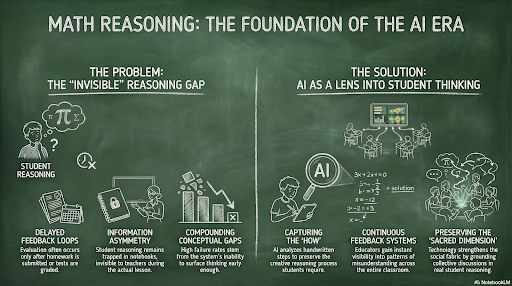
Yet when examining how mathematics is actually taught in most classrooms today, one quickly encounters structural limitations that have persisted for decades. Traditional teaching models operate with extremely limited feedback loops. A teacher introduces a concept, students attempt exercises, and evaluation often occurs only after homework is submitted or tests are graded. By the time misunderstandings become visible, the class may already have moved several topics ahead. Small conceptual gaps accumulate quietly until they reach a tipping point where students can no longer follow the lesson. What begins as a minor misunderstanding evolves into a persistent belief that mathematics is inherently difficult or inaccessible. In many education systems this dynamic manifests in striking statistics. Failure rates in mathematics remain significantly higher than in other core subjects, not because mathematics is inherently less teachable but because the system struggles to surface student thinking early enough to intervene effectively. The problem is therefore less about student ability and more about information asymmetry within the classroom.
Turning Learning into a Feedback System
This insight led Appert to frame mathematics learning as fundamentally a data problem rather than purely a pedagogical one. During every mathematics lesson students produce a rich stream of cognitive signals while they attempt to solve problems, draw diagrams, and structure equations. However, in traditional classrooms most of this information remains trapped in notebooks or worksheets, invisible to anyone except the individual student and perhaps briefly the teacher during grading. Without systematic visibility into how students reason, teachers are forced to rely on intuition and delayed evaluation rather than real-time insight. Modern organizations in almost every industry have moved away from such delayed feedback systems. Manufacturing operations monitor quality metrics continuously, digital platforms analyze user behavior instantly, and logistics systems adapt dynamically to operational data. Education, by contrast, has historically lacked the infrastructure to capture and interpret the learning process as it unfolds. The result is a structural blind spot in the system’s ability to adapt instruction to student understanding.
AI as a Lens into Student Thinking
This is precisely the gap that new AI-enabled educational tools attempt to address. Platforms such as Magma Math allow students to solve mathematical problems digitally while still writing by hand, preserving the creative reasoning process that mathematics requires. Artificial intelligence systems then analyze those handwritten steps, interpret the reasoning patterns behind them, and provide immediate feedback both to the student and to the teacher observing the classroom. The technological novelty is not simply the use of machine learning models but the ability to capture the reasoning process itself rather than only the final answer. In mathematics the most important signal is rarely whether the answer is correct. What matters is how the student arrived at the answer and what that reasoning reveals about conceptual understanding. By capturing and analyzing this reasoning process in real time, the system transforms mathematics teaching from a delayed evaluation model into a continuous feedback system. Teachers gain visibility into patterns of misunderstanding across the entire classroom, enabling them to intervene at precisely the moment when conceptual clarification has the greatest impact. 
The Sacred Dimension of the Classroom
However, one of the most important insights from the discussion is that technology alone does not improve learning outcomes. Educational systems are fundamentally social environments, and the classroom remains a deeply human space. Appert described this dynamic through the notion of the “sacred dimension” of the classroom. Students do not only learn from teachers; they learn from one another through dialogue, disagreement, explanation, and shared discovery. The classroom functions as a micro-society where individuals practice expressing ideas, listening to alternative perspectives, and refining arguments collaboratively. These experiences shape not only academic knowledge but also social intelligence and intellectual confidence. The introduction of AI into classrooms must therefore strengthen rather than weaken this social fabric. The goal is not to isolate students in individualized digital learning paths but to create richer collective discussions grounded in real student reasoning. When teachers can visualize how multiple students approached the same problem, the classroom conversation can shift from abstract textbook explanations to authentic exchanges about different ways of thinking.
Individual Learning, Collective Intelligence
This balance between individual insight and collective learning reflects a broader pattern observed in high-performing teams across many domains. Whether in sports, science, or business, the most effective groups combine individual specialization with collaborative synthesis. Each participant contributes a distinct perspective, but progress emerges through interaction. The same principle applies in education. Personalized feedback allows students to address their individual challenges, while collaborative discussion enables them to see how others approach the same intellectual problem. Technology that reveals thinking processes can therefore strengthen both dimensions simultaneously. It supports individual progress while enriching the collective dialogue that defines the classroom experience.
Designing AI for Productive Struggle
Another powerful idea emerging from the conversation concerns the role of productive struggle in learning. Mathematics is inherently a discipline where mistakes and revisions are essential to progress. Students develop deeper understanding when they attempt solutions, encounter obstacles, and gradually refine their reasoning. If educational technology provides answers too quickly, it risks eliminating this productive struggle and replacing thinking with passive consumption. Effective AI systems must therefore guide rather than replace the reasoning process. Instead of presenting solutions immediately, they can ask questions, highlight inconsistencies, or suggest alternative approaches that encourage the student to continue thinking. In this way artificial intelligence becomes a cognitive partner rather than a shortcut. The design challenge lies in calibrating the level of support so that students remain engaged in reasoning without becoming overwhelmed by frustration.
The Hard Part Is Not Technology
Despite these possibilities, the most difficult challenge often lies not in building the technology but in integrating it into real educational environments. Schools operate within deeply embedded cultural and institutional traditions. Teachers develop personal teaching styles over many years, parents carry expectations based on their own educational experiences, and administrative systems evolve slowly. Introducing new tools therefore requires more than technical training. It demands a process of unlearning established assumptions about how teaching and learning should function. This pattern mirrors digital transformation challenges observed in other sectors. Organizations frequently adopt new technologies while leaving underlying workflows unchanged, resulting in limited impact. Real transformation occurs only when institutions rethink how work is organized around the new capabilities that technology enables.
Mathematical Thinking as Civic Infrastructure
The broader societal implications of these developments extend far beyond mathematics education alone. As artificial intelligence systems become embedded in everyday life, the ability to reason about algorithms, probabilities, and evidence will become a form of civic literacy. Citizens will increasingly encounter decisions influenced by machine learning models in domains ranging from healthcare to finance to public policy. Understanding how such systems operate does not require everyone to become an AI researcher, but it does require a population comfortable with structured reasoning and critical evaluation. Mathematical thinking therefore becomes an essential component of democratic resilience in an algorithmic society. It equips individuals with the intellectual tools needed to question claims, interpret data, and participate meaningfully in complex policy debates.
The Compounding Effect of Early Education
This perspective reframes education as a long-term strategic investment rather than simply a social service. Improvements in early mathematical reasoning can compound over decades, shaping how individuals approach learning throughout their lives. Just as compound interest magnifies small financial investments over time, cognitive foundations established during school years influence future intellectual growth across many domains. Strengthening mathematics education therefore represents one of the most powerful levers societies possess for building adaptive, resilient populations capable of navigating technological change.
Illuminating the Classroom
Looking ahead, the most likely future of education is neither a fully automated AI tutoring system nor a return to purely traditional classrooms. Instead, the emerging model blends human teaching with intelligent infrastructure that reveals the learning process in unprecedented detail. Classrooms will remain physical communities where students interact, debate, and develop social understanding. Teachers will continue to serve as guides, mentors, and interpreters of complex ideas. But beneath this familiar structure, a new layer of data and insight will allow educators to respond to student thinking more precisely than ever before. Artificial intelligence will not replace the classroom. It will illuminate it.
The Real Foundation of the AI Era
In that sense the most important lesson from this conversation is surprisingly simple. The success of the AI era will depend not only on the intelligence of machines but also on the quality of human thinking. If societies want citizens who can collaborate with intelligent systems rather than passively follow them, the journey begins long before individuals encounter advanced technologies in the workplace. It begins in classrooms where students learn how to reason, question, and persist through complex problems. Mathematics education, often treated as a narrow academic discipline, may ultimately prove to be one of the most important foundations of the AI age.
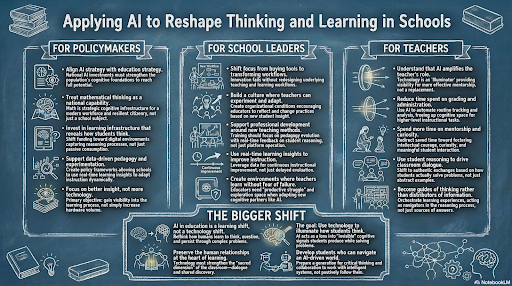
What This Means for Policymakers, School Leaders, and Teachers
If mathematical thinking is indeed foundational to the AI age, then the conversation must move beyond technology enthusiasm and toward practical transformation in education systems. For policymakers, the first step is to recognize that AI strategy and education strategy cannot be developed in isolation. Investments in AI infrastructure, research, and regulation will only reach their full potential if societies simultaneously strengthen the cognitive foundations of their populations. This means treating mathematical thinking not simply as a subject in the curriculum but as a strategic capability for the future workforce and citizenry. Governments should therefore prioritize educational environments that allow teachers to understand student thinking in real time, support experimentation with data-driven pedagogy, and ensure that schools have access to digital infrastructures designed for learning rather than generic screen usage. The objective is not more technology in classrooms, but better insight into learning.
For school leaders, the challenge is less about procurement and more about culture. Educational innovation rarely fails because of a lack of tools. It fails because institutions attempt to introduce new tools without redesigning the learning workflow around them. School leaders must therefore create conditions where teachers are encouraged to experiment, reflect, and adapt their teaching practices based on new forms of insight into student understanding. This requires professional development that focuses not only on how to use a platform but on how teaching itself evolves when real-time feedback about student reasoning becomes available. Teachers need space to learn, just as students do. When schools create environments where educators can explore new pedagogical approaches without fear of failure, technology becomes an enabler rather than a disruption.
For teachers, perhaps the most important shift is conceptual rather than technical. AI-supported learning environments do not diminish the role of the teacher; they amplify it. When routine tasks such as grading, tracking progress, or analyzing student work become partially automated, teachers gain time and visibility to focus on the aspects of education that matter most: curiosity, discussion, mentorship, and intellectual courage. The teacher becomes less of a distributor of information and more of a guide in the learning process, orchestrating classroom conversations around real student thinking rather than predetermined textbook examples. In this sense the future classroom is not one where technology dominates learning, but one where teachers are better equipped than ever to understand how their students think.
Ultimately, the transition toward AI-supported education should not be seen as a technological shift but as a learning shift. The most successful systems will be those that use technology to illuminate the learning process while preserving the human relationships that make education meaningful. When policymakers align strategy, schools foster experimentation, and teachers embrace insight into student thinking, the result is not simply improved math performance. It is a generation of learners better prepared to think critically, collaborate intelligently, and navigate a world increasingly shaped by artificial intelligence.
*This article was enhanced with the help of AI tools, drawing on the AWAI podcast transcript and complementary online research. To go deeper into the source material, we encourage you to listen to the full episode and make your own learnings.