While isolated models test technical possibilities, Epiroc’s Peter Malmberg and Luba Weissmann argue that sustainable impact links back to connecting individual applications into end-to-end workflows. Ahead of the NDSML Summit, the Epiroc leaders discuss how architecture, cross-functional teams, and operating model adjustments help move technology from pilot stages into daily operations.
At Epiroc, digital transformation pairs strategic business design with pragmatic technical execution. Peter Malmberg, Vice President Innovation & Digital, leads value-driven innovation and technology development grounded in operations and supply chain leadership. Luba Weissmann, Group AI & Data Director, leads Epiroc’s AI and data agenda with a focus on building solutions that solve problems genuinely worth addressing. Ahead of their joint session at the NDSML Summit, Peter and Luba discuss moving into the post-use-case era, embedding governance into architecture, and connecting data across functional boundaries.
In your upcoming session at the NDSML Summit, you point out that we are entering the ‘post-use-case era.’ What do you mean by that, and why is this critical to talk about now?

Peter Malmberg: Use cases are pointing at a specific problem and are often technology driven to prove that technology works. The initiative normally ends after a solution is delivered and the scope is normally too narrow to actually change ways of working or operational model. To get the full business value of a transformation you need to start with, define what value you want to create by changing your operating model, it’s not about the technology! It’s about the ability to change. Today companies have structures and sequential business processes. Now, they need to rethink how future operating models and business models are AI ready to get the full value.
Luba Weissmann: The use-case approach suited AI that performed a bounded task: predict demand, classify a document, recommend an action. AI can now contribute across connected steps, interpreting information and acting through systems within defined limits. That opens up more of the workflow to redesign. Use cases remain useful delivery increments, but they are no longer enough to organize transformation. If we define each task in isolation, we may preserve boundaries we no longer need.
Multi-step workflows cross boundaries between systems. How do you govern that flow without creating friction for product teams?
Peter Malmberg: The short answer is, you need to give the product teams full empowerment to work across functions, ability to change ways of working and close to C-levels. This will bring speed in delivery, development and change. Equally important is to make data available and have a strong focus on designing architecture for future models. From a performance perspective, targets, incentives and KPIs need to be redesigned for end-to-end.

Luba Weissmann: Teams need clarity about what data they can use, what actions a system may take and when a person must intervene. Those decisions should shape the architecture from the beginning. Common standards let teams reuse those foundations instead of renegotiating them for every solution. Cross-functional workflows also need clear accountability at the handovers, where one team’s responsibility ends and another’s begins. 
Looking at day-to-day operations, what actually separates a standard point solution from a fully integrated workflow?
Luba Weissmann: It’s what happens after the AI produces its answer. Does someone still have to interpret it, chase an approval and enter the result into another system? If so, much of the work remains unchanged. An integrated workflow connects the output to an operational action, handles exceptions and captures the result. The performance measure then becomes the business outcome, including the waiting time and effort between individual steps.
Rethinking supply chain workflows reshapes daily jobs. How do you drive adoption when system decisions alter how teams work?
Peter Malmberg: The base for adoption success is simply that it solves the problem, delivers expected value and that users clearly can see the improvement. Value creation comes by bringing more content, not more transactions to our teams, as well as connecting teams that normally do not work closely. Connecting systems and teams will provide new insights and new ideas to further develop solutions and models.
Looking back at Epiroc’s supply chain transformation, what core capability proved most essential for connecting these end-to-end workflows?
Peter Malmberg: We are in the middle of the journey and the most critical capability is dedicated product teams with mandate to work end-to-end and across functions and processes.
For leaders evaluating their roadmaps, what single mindset shift moves an organization from point solutions to full transformation?
Peter Malmberg: Look at your business end-to-end and decide which is the most critical data to be able to unlock the value you are after. Digging close to where you stand, is not a game changer. Keep in mind that changing something end-to-end requires a change of the operating model, and if you are not ready to change the operating model then it’s better to not make the investment.
Luba Weissmann: Stop treating the current process as a fixed requirement. Asking AI to improve an activity already assumes that activity should exist. Leaders need to question which steps still serve the outcome and which compensate for limitations that technology can now remove. That changes what belongs on the roadmap. Some of the most valuable decisions may involve eliminating work we were about to automate.
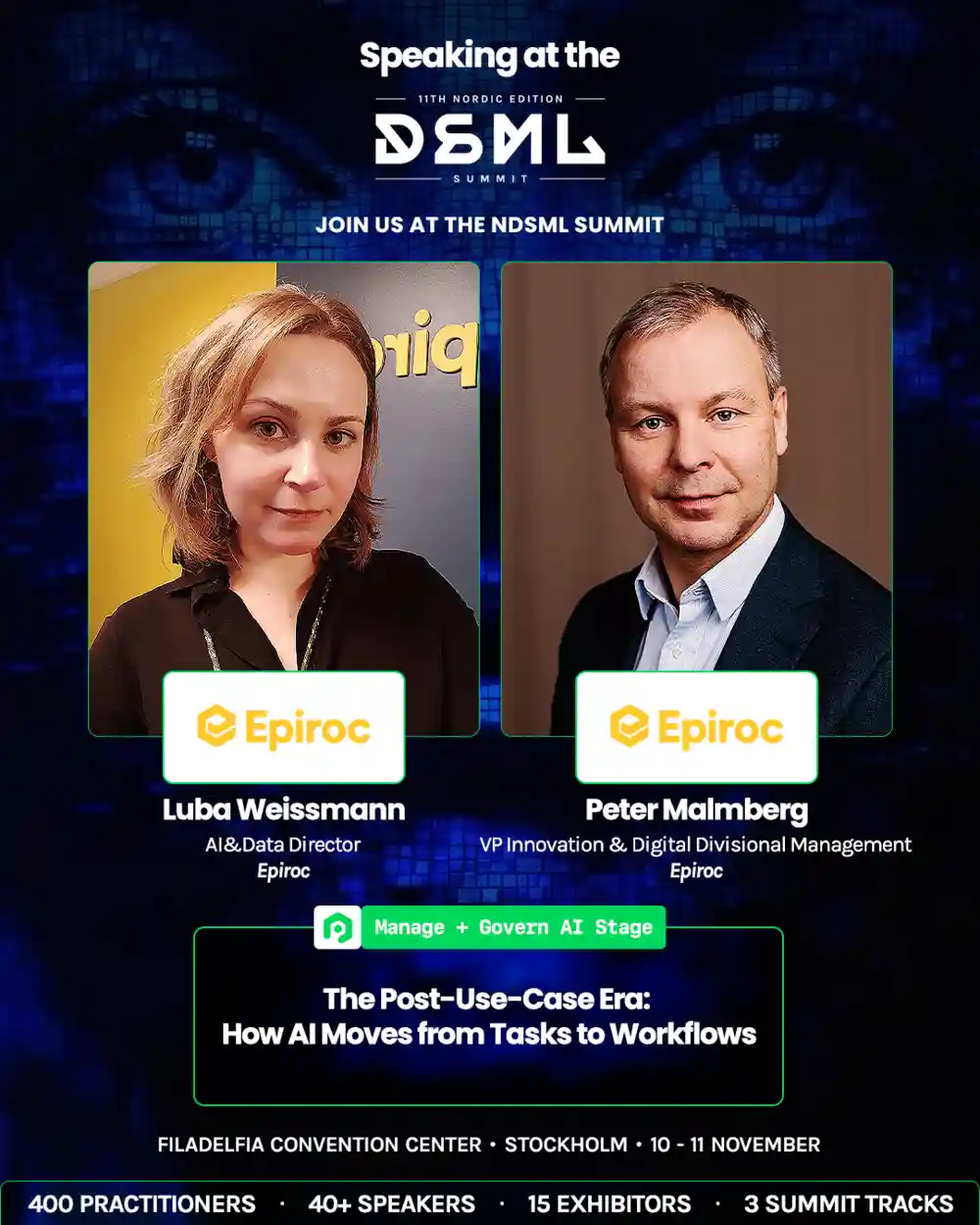
At the upcoming NDSML Summit, Peter Malmberg and Luba Weissmann address deeper why enterprise AI transformation depends on redesigning end-to-end workflows rather than accumulating isolated pilots. Their session provides practical insight into how global organizations can connect systems, data, and teams to build sustainable, scalable operations.