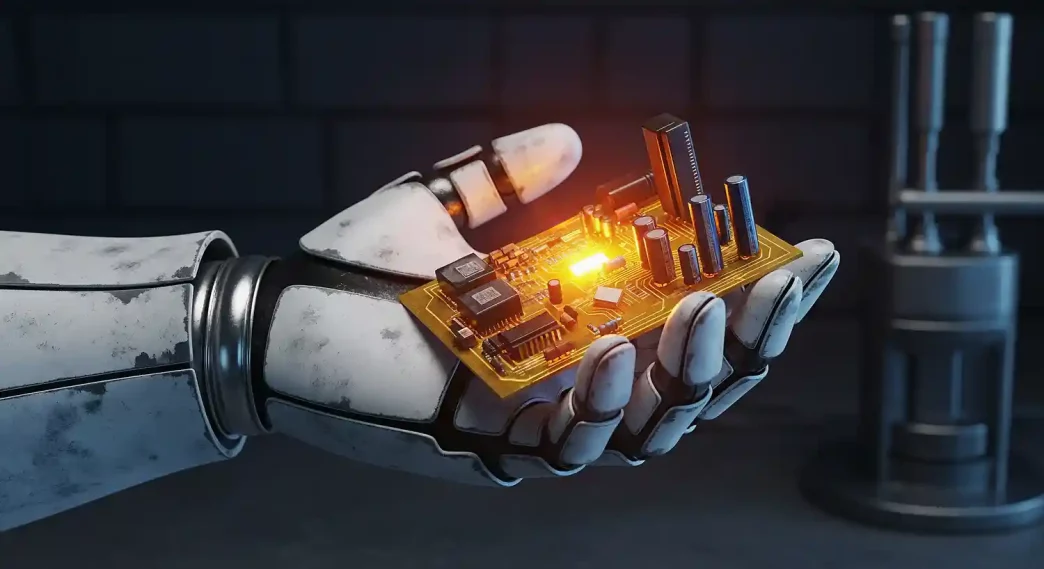
For years, the conversation around Artificial Intelligence has been dominated by what exists behind the screen. Large language models, generative text, and the digital ingestion of the internet’s collective knowledge, all part of that. But as we look toward the horizon of 2026, a fundamental shift is occurring. The next wave of innovation isn’t just about how AI speaks but more so about how AI moves, perceives, and interacts with the physical world.
This transition from the data center to the “real world” was a cornerstone of the discussions at previous Data Innovation Summits, and it sets the stage for what promises to be the most transformative gathering yet: the 11th Data Innovation Summit, returning to Stockholm from 6–8 May 2026.
The Three Computers of Physical AI
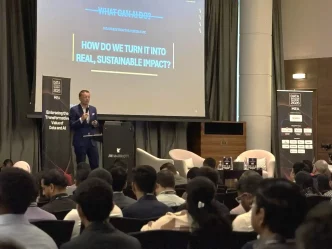
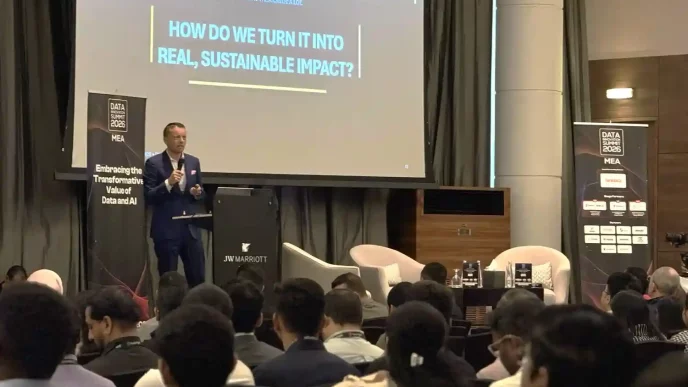
In this session, Alexander Young from NVIDIA shares how to move past the chatbots and explore the possibilities for Physical AI.
The challenge of “Physical AI” which is the intelligence powering humanoid robots, autonomous vehicles, and smart infrastructure, is that it requires a different kind of architectural thinking. Traditionally, we think of the computer inside the robot. However, as industry leaders like NVIDIA have demonstrated, true physical AI requires a tri-part ecosystem:
- The Edge Computer: The “brain” inside the machine, executing commands in real-time.
- The Training Infrastructure: The massive supercomputers required to build the initial models.
- The Virtual World: A digital proving ground where AI can learn without the constraints or the dangers of the physical realm.
As explained by Alexander Young from NVIDIA, this third pillar is where the most exciting breakthroughs are happening. How one teaches a car to react to a child running into the street without ever putting a human at risk? How one teaches a robot to navigate a bustling warehouse it has never seen? The answer lies in World Foundation Models (WFMs).
Bridging the “Sim-to-Real” Gap
One of the greatest hurdles in robotics has always been the “sim-to-real” gap which is the discrepancy between a clean, mathematical simulation and the messy, unpredictable reality of the world. At the last summit, we saw the introduction of the Cosmos toolkit, a framework designed specifically to solve this. 
Unlike standard models trained on “videos of cats” from the internet, these new foundation models are trained on tens of millions of hours of physics-based data. They focus on spatial awareness, hand manipulation, and the laws of motion.
Key components of this toolkit are already redefining development:
- Physical Prediction: Generating “physically accurate” futures where objects don’t simply vanish or jump randomly, but follow the laws of gravity and momentum.
- Environmental Transformation: The ability to take a digital twin of a warehouse and instantly simulate it under different conditions like rain, darkness, or cluttered floors, ensuring the AI is ready for anything.
- Visual Reasoning: Moving beyond “see and react” to “plan and verify,” where the AI can describe the steps of a complex task (like loading a dishwasher) before it ever moves a mechanical limb.
By grounding foundation models in high-fidelity physics rather than just visual patterns, the Cosmos toolkit effectively bridges the sim-to-real gap, transforming robotics from simple “see-and-react” machines into spatially aware systems capable of complex reasoning and reliable real-world execution.
The full session ”Accelerate Physical AI Development with World Foundation Models” by Alexander Young from NVIDIA is from our Data Innovation Summit 2025 edition. It includes the deep-dive about the Cosmos toolkit and it’s available now for premium members.
About The Newest Edition of Data Innovation Summit
The 11th edition of the Data Innovation Summit arrives at a critical juncture. In 2026, we are no longer asking if AI can work; we are asking how we can industrialize it. The summit has grown into the most influential applied data and AI event in the Nordics, and for good reason.
This year’s event at Kistamässan will feature over 300 speakers across 15 stages, moving the needle from theoretical models to “Industrial-Scale Execution”. Attendees will move into the heart of global operations, exploring everything from Blackwell-powered data pipelines to the ethics of autonomous decision-making.
How to join this year’s Data Innovation Summit
The Data Innovation Summit is a glimpse into the next decade of human-machine collaboration. Whether you are a data scientist looking to master video curation pipelines or a business leader aiming to navigate the shift toward physical automation, the insights shared here are the blueprints for the future.
Stockholm in May is where the digital and physical worlds converge. Will you be there to see the blueprints come to life?
Event Details:
- What: 11th Data Innovation Summit
- When: 6–8 May 2026
- Where: Stockholm, Sweden (In-person & Online)
- Focus: Applied AI, Data Engineering, Physical AI, and Generative AI for Enterprise.
Follow along as Hyperight.com shares more deep dives into the technologies that will define the 2026 DIS Summit.