

The Year Organizations Are Forced to Change
There are years when technology evolves, and then there are years when organizations are forced to evolve, and 2026 is clearly the latter. After going through more than 300 sessions scheduled for the Data Innovation Summit, spanning industries, functions, and real enterprise implementations, one thing becomes very clear. The conversation has fundamentally shifted from what AI can do to how organizations actually make it work in practice. This is not a subtle evolution. It is a structural shift.
The signal is not in the novelty of the topics, but in their repetition. The same use cases, the same architectural challenges, and the same organizational questions appear again and again across companies. This repetition is not a weakness. It is the strongest indicator that the market has moved beyond exploration and into convergence around a set of problems that must be solved in order to move forward.
The End of the Experimentation Illusion
For the past few years, AI has lived in a relatively safe space inside organizations, where innovation labs, pilot initiatives, and proofs of concept were allowed to operate without strong pressure for measurable outcomes. This phase created learning and momentum, but it also created a misleading sense of progress. Many organizations equated activity with impact and experimentation with transformation.
That illusion is now breaking. Across industries, companies have accumulated dozens of AI initiatives, yet only a small portion of them are delivering measurable business value. The most common use cases such as customer self service, internal knowledge assistants, document processing, fraud detection, and demand forecasting are widely implemented, yet even these struggle to scale consistently across the enterprise. This is not because the models are insufficient, but because the surrounding systems and operating models are not designed for scale.
Enterprise AI Maturity: What 300+ Sessions Reveal About Where the Market Actually Is
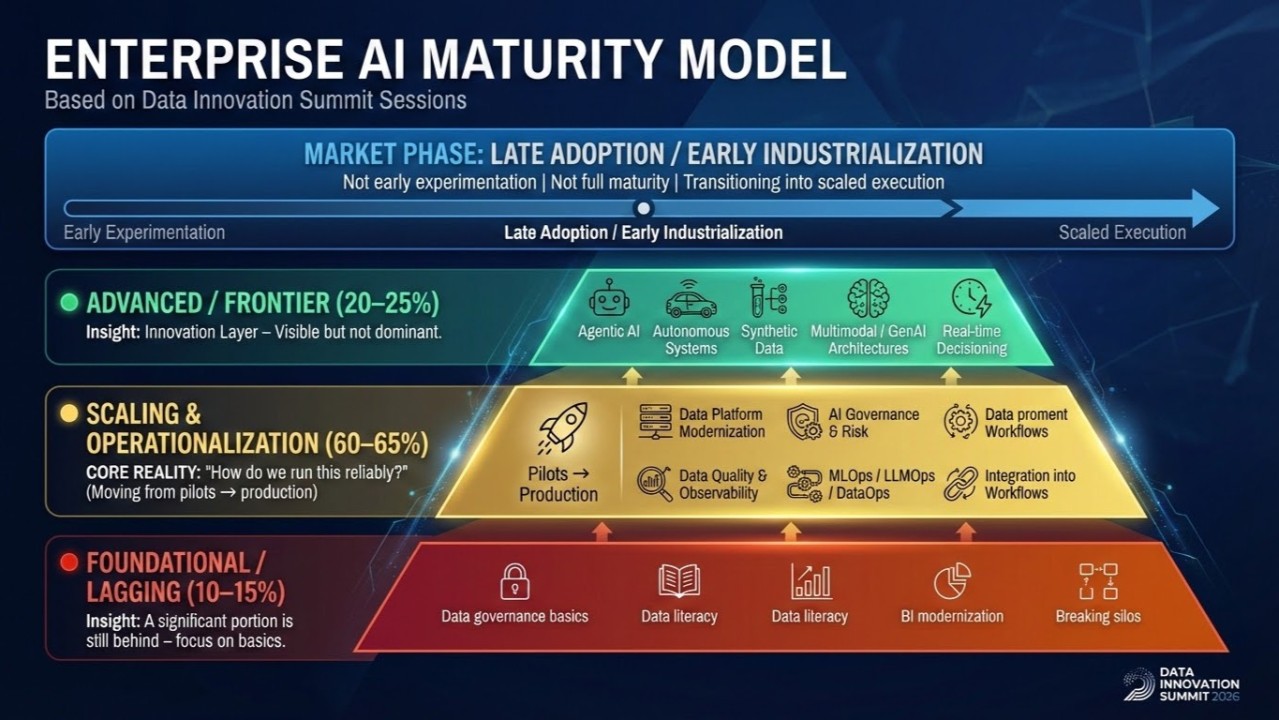
One of the most important insights from analyzing the full program is not just what companies are doing, but where they actually are in terms of maturity. When mapping the sessions across industries and capabilities, a clear distribution emerges that reflects the true state of enterprise AI.
Approximately ten to fifteen percent of organizations are still in the foundational layer. These organizations are focused on establishing basic capabilities such as data governance, data quality, data literacy, business intelligence modernization, and breaking down silos. For them, AI is not yet the primary challenge. The real challenge is creating a usable and trusted data foundation. 
Around sixty to sixty five percent of organizations are operating in the operationalization layer, which is the dominant reality reflected in the program. This is where the majority of sessions are concentrated. The focus here is on moving from pilots to production, modernizing data platforms, improving data quality and observability, implementing MLOps and LLMOps, establishing governance frameworks, and integrating AI into real business workflows. This is the layer where AI either becomes operational or fails to deliver value.
The remaining twenty to twenty five percent of activity sits in the advanced and frontier layer. This includes agentic AI, autonomous systems, synthetic data, multimodal architectures, and real time decisioning. These topics are highly visible and strategically important, but they are not yet the dominant reality of enterprise execution. They represent the innovation edge rather than the operational core.
This distribution reveals a critical imbalance. While much of the external narrative is focused on advanced capabilities, the majority of organizations are still working through the challenges of operationalization. The gap between what is possible and what is actually scalable remains significant.

What the Use Cases Actually Tell Us
When analyzing the use cases across the sessions, a clear concentration emerges. Enterprise AI activity is focused on a relatively small set of repeatable use cases that are being implemented across industries.
The most frequent use cases include customer support automation, internal knowledge assistants, process automation, demand forecasting, fraud detection, recommendation systems, and document processing. These use cases dominate because they have clear ownership, direct links to value, and relatively manageable implementation complexity. They represent the entry point into operational AI.
A second layer of use cases appears with lower frequency but significantly higher complexity. These include predictive maintenance, real time decisioning, workforce scheduling, supply chain optimization, and sales intelligence. These are deeply embedded in business operations and require strong data foundations, integration across systems, and organizational alignment. They are harder to implement, but they are also where long term competitive advantage is built.
A third layer of use cases such as agentic workflows, synthetic data, and digital twins appears less frequently. These represent emerging capabilities and future differentiation rather than current mainstream adoption.
This distribution confirms that enterprises are not lacking use cases. They are focusing on a narrow set of high impact applications while struggling to scale them across the organization.
AI Is Not a Model Problem
One of the clearest signals from the sessions is that AI success is not determined by model capability, but by data and systems. The industry has effectively reached a consensus that AI success is a data problem rather than a model problem.
The most discussed topics reinforce this. Data foundations and architecture, including data platforms, data engineering, data quality, and pipelines, dominate the agenda. AI operationalization, including deployment pipelines, monitoring, observability, and lifecycle management, follows closely. Governance, risk, and compliance are no longer optional and are now treated as design constraints. Business value and return on investment are becoming central, with a clear shift from capability to accountability.
Generative AI is present and important, but still evolving and not fully standardized in enterprise environments. Agentic systems and real time architectures are gaining attention, but remain fragmented and early in adoption.
The conclusion is straightforward. The challenge is not building intelligence. The challenge is building systems that can support and sustain it.

The Most Discussed Challenges
The dataset also reveals a consistent set of challenges that organizations are facing. The most dominant issue is the transition from pilot to production. Many organizations have multiple pilots but very few scaled deployments, often due to lack of standardization, fragmented ownership, and unclear accountability. This is the central problem of the current phase.
Data quality and accessibility represent the second major challenge. Inconsistent data, poor metadata, limited discoverability, and lack of trust in data are recurring issues. AI is exposing these weaknesses rather than solving them.
Organizational misalignment is another critical factor. There is a persistent disconnect between business and technology, tension between compliance and innovation, and lack of clear ownership. This is not a technical problem, but an operating model problem.
The tension between governance and speed is also evident. Organizations need to innovate quickly while maintaining control, especially in regulated industries. This creates a balancing act that many organizations are still learning to manage.
In addition, there is a clear skills and leadership gap. The need for AI literacy, new leadership models, and cross functional collaboration is present across the dataset. Infrastructure and cost considerations are also emerging as important constraints.
From Building AI to Running the Business
What emerges from this analysis is a clear shift from building AI systems to running AI as part of the business. This requires moving beyond isolated use cases and toward integrated systems that operate continuously and reliably.
Use cases such as customer self service, fraud detection, and demand forecasting are no longer standalone applications. They are components of broader operational systems that require data pipelines, governance, monitoring, and integration into workflows. The focus is shifting from generating outputs to driving outcomes.
The Rise of the AI Industrial Stack
The increasing focus on infrastructure reflects this shift. Data platforms, pipelines, observability, and orchestration layers are becoming central to enterprise AI. Without this foundation, even the most common use cases cannot scale.
The concept of an AI industrial stack captures this evolution. It represents a system that continuously transforms data into decisions and actions, enabling organizations to operate AI reliably and at scale.
Governance Becomes a Design Principle
Governance is no longer an afterthought. It is embedded into the design of systems from the beginning. This is particularly important for high impact use cases such as fraud detection and customer facing applications, where trust and compliance are critical.
Organizations are recognizing that scalability requires control, and control requires understanding.
Operating Between Speed and Control
The tension between speed and control defines the current phase. Organizations must move quickly to remain competitive while ensuring that their systems are reliable, secure, and compliant. The ability to operate within this tension is becoming a key differentiator.
From Tools to Strategic Assets
Data and AI are increasingly being treated as strategic assets rather than tools. Proprietary data, internal models, and knowledge systems are becoming central to competitive advantage. These assets are continuously developed and leveraged across multiple use cases, creating compounding value.
The Leadership Gap Is Now Visible
The final and perhaps most critical insight is the role of leadership. Many organizations are still treating AI as a technical initiative rather than a business transformation. This limits their ability to scale and realize value.
What is required is leadership that can align business, technology, and governance, and that is willing to redesign operating models accordingly.
AI Becomes the Operational Backbone
The overall conclusion is clear. AI is no longer a capability that organizations experiment with. It is becoming an operational backbone that underpins how businesses function. This is why 2026 represents a true transformation year.
The Shift That Is Already Happening
The real story is not about what is new, but about what is changing. Organizations are being reshaped at every level, from technology and infrastructure to processes and leadership. AI is not just advancing technology. It is redefining the enterprise itself.
And that is the shift that matters.
Only a few weeks remain until this year’s Data Innovation Summit, where these shifts move from theory into real conversations, real use cases, and real decisions shaping how organizations operate with data and AI. If this is the moment where experimentation turns into execution, then this is the place where that transition becomes tangible. Secure your and your team’s place at www.datainnovationsummit.com and be part of the discussions that are defining enterprise AI in practice.