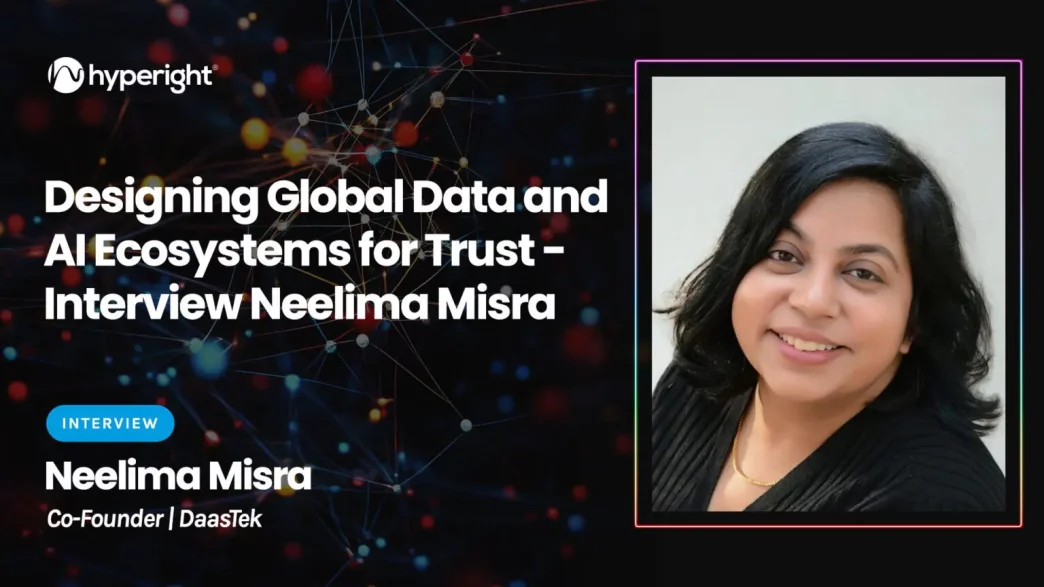
Recently, we had the chance to sit down with Neelima Misra, Co-Founder of DaasTek and a seasoned expert in data, analytics, and AI, whose 25-year career has shaped the digital strategies of companies across more than 50 countries. From her early days at Microsoft to co-founding a company at the cutting edge of AI, IoT, and cybersecurity, Neelima brings a rare mix of technical depth and strategic foresight. In this interview, she unpacks what it really takes to build ethical AI, why data mesh and federated systems are more than buzzwords, and how courageous leadership can turn fresh grads into platform experts. Whether you’re leading a digital transformation or navigating the risks of generative AI, Neelima’s insights are both timely and actionable, especially for organizations across the Nordics and beyond.
To start with, can you tell us about your career journey so far? How did you get started, and what are you working on now in the areas of data, AI, and digital transformation?
I’ve spent over 25 years shaping data, AI, and digital strategies for global companies. I began my career as a developer in 2000, and by 2005, I had stepped into leadership as a Tech Lead at Microsoft. Since then, I’ve led transformative technology initiatives across 50+ countries, partnering with global organizations such as Pitney Bowes, Cognizant, and Accenture. Currently, I focus on building federated data ecosystems, driving ethical AI, and creating scalable digital platforms that deliver real business value.
In 2020, I co-founded DaasTek to help companies navigate complex tech like AI, IoT, and cybersecurity, making digital transformation simpler and more accessible. For me, technology should empower people, not just systems. I’m passionate about ethical, inclusive digital practices and mentoring, especially supporting women and underrepresented groups in tech, while staying involved in both strategy and hands-on delivery.
You’ve worked on large-scale, complex projects around the world. What are some common mistakes or misunderstandings you see when companies start using data or AI? How do you help them get on the right track?
Across industries, I see companies rushing into AI without solid foundations. A big one is treating data as just fuel, not a strategic asset. If the data is messy or biased, the model will be too. So I always say, get your data house in order first. 
Another common mistake is jumping to tech without defining the problem. AI isn’t one-size-fits-all. Without a clear ‘why’, you end up with impressive models solving the wrong thing.
A growing risk now is the lack of understanding around licensing, especially with agentic and generative AI. These tools accelerate delivery and scale but without clear awareness or training, but they are risky. One wrong use, and you can expose IP, break compliance, or damage trust.
And AI still can’t live in silos. Legal, ethics, product, and engineering all need to be in the room from day one. Without that, things fall through the cracks.
When I work with teams, we start with alignment: What’s the goal? Who’s impacted? What could go wrong? From there, it’s about building the right foundations governance, literacy, and collaboration.
It is equally important to build fast and responsibly. That’s where real impact and trust come from.
Neelima, you often talk about the importance of using AI in a fair and responsible way. What are the key things needed to build ethical AI? And how can companies include these ideas in the way they design and use their systems?
When we talk about building ethical AI, we’re really talking about building systems that are safe, fair, and trustworthy, not just technically sound. For me, it comes down to a few key principles:
First, fairness. AI systems reflect the data they’re trained on, and that data often carries human biases. If we’re not intentional about correcting for that, we risk reinforcing existing inequalities. Fairness has to be a design requirement, not a nice-to-have.
Second, transparency. People should understand how decisions are being made, especially when those decisions affect their lives. That doesn’t mean exposing every line of code, but it does mean being clear about how models work, what data they’re using, and where their limits are.
Third, accountability. There needs to be a human in the loop, not just during development, but all the way through deployment and monitoring. Who’s responsible if something goes wrong? That question should never go unanswered.
And finally, inclusivity. Diverse teams build better AI. If everyone in the room thinks the same way or comes from the same background, we’re going to miss important risks and perspectives. Inclusion isn’t just about representation, it’s about better decision-making.
For companies, this means weaving ethics into the product lifecycle, not bolting it on at the end. It means setting clear internal standards, testing for bias early and often, and making time for conversations that ask not just ‘Can we build this?’ but ‘Should we?’
Ethical AI isn’t a box you check. It’s a mindset.
You’ve been a big supporter of ideas like data mesh and federated data systems. Why do you think these approaches are important today? And what challenges should leaders keep in mind when trying to use them?
I support data mesh and federated data systems because they reflect how modern organizations really work. Data is spread across teams, tools, and locations, and trying to centralize everything into one giant platform just does not scale, especially when agility matters.
Data mesh changes the way we think about data. It treats data as a product with clear ownership and accountability at the domain level. This is powerful because it puts the people who know the data best in charge of making it useful and accessible, which leads to faster insights and better decisions.
Federated data systems take this further by enabling collaboration without moving or exposing sensitive data. With privacy and regulations front and center, this approach is not optional; it is necessary. It allows organizations to unlock value while maintaining control.
But it is not a simple switch. Leaders need to keep an eye on a few challenges. First governance decentralization does not mean chaos. You still need shared standards, strong metadata practices, and aligned incentives. Second, talent and culture teams need the right skills and mindset to own data like a product and that is a big shift from traditional IT ways. Third platform readiness the infrastructure must support discoverability, interoperability and trust across teams.
When done right, these models make organizations more resilient, scalable and responsible, but they require investment in people’s processes and platforms to truly succeed.
You describe your leadership style with the words Courage, Empathy, and Lifelong Learning. Can you give us an example of how this shows up when you’re leading teams—especially during big, challenging projects?
When I joined a major Nordic logistics company as an advisor to enterprise architecture team, the task ahead was to do a pre-study on migrating 7 legacy data platform to cloud data platform on Azure. A critical legacy system to SAS, was seen as nearly impossible to migrate. Scepticism was high, and the offshore team in India was made up entirely of fresh graduates with limited technical experience. But I saw an opportunity to lead beyond my title.
As challenges mounted, I stepped into multiple roles, enterprise architect, product owner, and project lead, validating my pre-study and target architecture while coaching the team on the job. We cross-trained them in DataOps, and ETL automation, and what began as raw talent quickly evolved. The team embraced cutting-edge technologies and delivered like pros.
Against the odds, we delivered a robust solution. Many of the practices this team built became best practices for future legacy platform transformations. Today, several of those young professionals have grown into top experts, even platform subject matter experts.
This experience reinforced for me that leadership isn’t just about strategy, it’s about empowering people, standing by your team, and turning doubt into measurable success. With the right mindset, even the toughest projects can set new standards.
Neelima, you were featured in the Nordic 100 List—congratulations! What does this recognition mean to you in the context of your work in responsible innovation and digital transformation across the Nordics?
Being part of the Nordic 100 List is a great honour, but I don’t see it just as recognition. To me, it’s about being part of a community of highly skilled and driven professionals. My hope is that this community grows stronger and supports one another, sharing knowledge and experiences in data and AI. Together, we can help many others overcome challenges and accelerate innovation. I’ve worked closely with amazing people who truly understand the journey, and I believe this network has the power to shape responsible innovation and digital transformation across the Nordics in meaningful ways. As data and AI continue to evolve, working together as a united community will become even more important.
Looking ahead, what trends or shifts in the data and AI landscape are you most excited about? What should practitioners and organizations be preparing for over the next 2–3 years?
I’m excited by how quickly AI is advancing, especially generative and agentic AI, which will lead to smarter, more adaptive systems. In the next few years, organizations should focus on building scalable cloud infrastructures that support these changes while strengthening cybersecurity and data governance. Automation will continue to improve efficiency across sectors. It is vital that practitioners prioritize responsible AI by putting transparency and ethics front and center to build trust and stay compliant. These developments will transform industries like manufacturing, finance, healthcare, and retail, creating new opportunities and competitive edges. Success will come from combining cutting-edge technology with solid data strategies and a clear digital vision.