
Most organisations do not have a shortage of data. They have a shortage of confidence.
Confidence that the number in front of them means what they think it means. Confidence that somebody is genuinely accountable for it. Confidence that the data being used to train, inform or operate an AI system can actually be trusted. And, ultimately, confidence that when a decision needs to be made, the organisation can make it and act on it.
That distinction, between having data and having confidence in it, is one I have watched matter more than almost any other over more than two decades of working with data across organisations, industries and countries. It is also what led me to write The Confidence to Act, and what this series sets out to explore.
The questions that keep returning
The technologies have changed almost beyond recognition during that time. We have moved through generations of data warehouses, business intelligence platforms, big data architectures, cloud migrations and now artificial intelligence. The vocabulary has evolved with each wave. Yet some of the most consequential conversations I encounter have changed remarkably little.
Can we trust this number? Why does this report say something different from that one? Who owns this data? Who has the authority to decide what we do about it?
These questions appear in leadership meetings and data quality reviews. They appear when two executives look at the same dashboard and reach different conclusions. They appear when a governance programme has been running for two years and somebody asks, reasonably, whether anything has actually changed. And they are appearing now in a new and more urgent form, as organisations try to establish what it means to be genuinely AI-ready. 
I keep returning to data governance not because frameworks and policies are inherently interesting, but because of what they reveal about an organisation’s actual capacity to act. A company can have sophisticated technology, extensive data assets and formally documented governance structures, and still hesitate at the moment a decision matters because the people involved cannot agree on which data to trust, whose interpretation takes precedence, or who is authorised to resolve the uncertainty.
More data has not automatically created more confidence
Over the past two to three decades, organisations have invested heavily in collecting data, moving it to the cloud, building dashboards, defining governance frameworks and, most recently, making it available to AI systems. We have all become remarkably good at producing more data, and at making it more accessible.
But having more data does not automatically make an organisation more confident in its decisions. Sometimes it does exactly the opposite.
One pattern I have encountered repeatedly is that when a leadership team questions a number, the conversation rarely stays with the number for long. It quickly moves to where the data came from, which definition was applied, why another system produces a different figure, who owns the data, and who can explain the discrepancy.
What initially looks like a data quality problem can turn out to be rooted somewhere else entirely. The real issue may be that nobody has the authority to decide between two competing definitions. Or that the process itself creates the inconsistency. Or that two parts of the organisation have been operating with different interpretations for years, and everyone assumed someone else was responsible for resolving it.
None of this is unusual. But it illustrates something important: trust in data is not created by fixing one thing. It emerges from a combination of clarity, accountability, quality, context and the ability to resolve uncertainty when it arises. That is where governance becomes genuinely interesting, not as documentation, but as an organisational capability.
AI is making the old questions harder to ignore
Artificial intelligence (AI) has not made these questions obsolete. It has made them more visible and more consequential.
Organisations are moving quickly from experimenting with AI to embedding it into products, processes and decisions. That creates new questions around transparency, explainability, bias, human oversight and accountability. But underneath many of those questions sit very familiar ones: What data is being used? Where did it come from? Is its quality appropriate for this purpose? Who is accountable for the outcome when something goes wrong? And, perhaps most importantly, who gets to decide when the answer is uncertain?
The list is far from exhaustive, but many of these questions will already be familiar to practitioners. AI has changed the context and the consequences, but not all of the underlying governance questions.
AI governance does not begin when a model appears. It begins with the data foundations an organisation already has, or discovers it does not have. The same unresolved questions around ownership, quality, context and accountability now follow the data into systems that can operate at greater speed and scale.
This is one reason data governance deserves another look, even from organisations that have been working on it for years.
From control to confidence
Governance is often introduced as a mechanism for control. Policies, roles, standards, committees and processes all have a role to play. But in my view, control is not the outcome worth measuring.
The real test is what happens afterwards. Can someone find the data they need and understand what it really means? Is it clear who can make a decision when interpretations diverge? Can problems be resolved without weeks of escalation? Can an executive challenge a number and receive an answer that creates confidence rather than another meeting? And what happens when the pressure is on and a decision has to be made?
When governance works well, it stops being something that sits alongside the business. It becomes part of how the organisation operates every day. People know what they can rely on, who can decide, and what happens when something goes wrong. That shift, from governance as a control layer to governance as an organisational capability, is what the confidence to act actually requires.
When I wrote The Confidence to Act: 30 Reflections on Data Governance – What Breaks and What Holds?, I kept returning to situations and patterns I had seen played out across organisations: governance that looked sound on paper but struggled in practice; data ownership without real authority; quality problems that kept returning despite repeated fixes; and people finding workarounds because the formal process did not help them get the job done.
Writing it did not make me feel the conversation was finished. Quite the opposite.
AI is putting new pressure on foundations that were already uneven. Organisations are experimenting with different operating models. Expectations around accountability are shifting, while responsibility for AI outcomes remains far from clear in many organisations. And problems that data professionals have been discussing for years now matter to a much wider audience.
That is why I wanted to continue the conversation through this series.
Over the coming months, I will explore the practical questions behind that idea: why data governance still fails despite sustained investment; what data ownership actually means in practice; why organisations continue to struggle with data quality; what genuine AI readiness requires; and what success looks like when we move beyond frameworks, maturity scores and policies.
Different organisations need different approaches, and context always matters. But one question is worth returning to regardless of where you are starting from: does what we are putting in place actually increase the organisation’s ability to make decisions and act with confidence?
If the answer is no, adding more governance is rarely the solution. Understanding why it is not working usually is.
And that is where this series will start: not with another framework, but with what happens when governance meets the reality of an organisation. Why, after years of investment, defined roles, policies and operating models, does data governance still so often struggle to deliver the value expected of it?
About the author
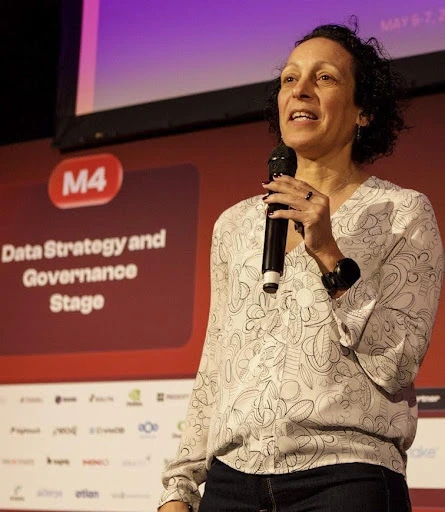
Karima Makrof is the Founder and Chief Adviser at AKLYON Consulting and Senior Manager, Data Governance at PwC Sweden, within the Chief Data Office. With more than 20 years of international experience across industries and countries, she works at the intersection of data governance, organisational accountability and decision-making, helping organisations move from having data to being able to act on it with confidence.
Her experience spans financial services, technology, manufacturing, automotive and professional services, including leadership roles with global organisations such as Volvo Group, Oracle, SKF, ESAB, Volvo Cars and Swedbank. This breadth gives her a perspective on how data challenges evolve as organisations, technologies and expectations change.
Today, her work focuses on the gap between governance as it is designed and how it functions in practice, taking a pragmatic approach to accountability, ownership, decision authority and how governance becomes part of the way an organisation operates.
Karima is a regular stage moderator at the Data Innovation Summit and Data 2030 Summit and speaks internationally on data governance, data leadership and responsible AI, bringing a practitioner’s perspective to questions often treated as primarily technical or procedural.
She is the author of The Confidence to Act: 30 Reflections on Data Governance – What Breaks and What Holds?, drawing on over two decades of experience to explore why governance falls short in practice and what enables organisations to act with confidence.
*The views and opinions expressed by the author do not necessarily state or reflect the views or positions of Hyperight.com or any entities they represent.