AI isn’t just about algorithms or data – it’s about how people use them. Organizations that understand AI empower their teams to experiment, learn, and innovate. Aline da Silva Souza, Business & Analytics Manager at Yara International, shows how focusing on the “human side” of AI can transform adoption and deliver the outcomes that truly matter.

In the global race to adopt artificial intelligence, many organizations are discovering that the primary barrier is rarely the technology itself-it is the “human factor.” From the fear of displacement to the lack of transparency in how models function, this cultural gap remains a significant hurdle to scaling innovation. Bridging it requires more than just technical deployment. It requires a fundamental shift in how teams understand and interact with the tools at their disposal.
Aline da Silva Souza, Business & Analytics Manager at Yara International, operates at the center of this transition. A Brazilian AI leader based in Oslo with a background in Data Science, she leads global initiatives that integrate artificial intelligence into critical functions like internal audit and risk management. By translating complex technical methods into the language of business strategy, she provides a pragmatic perspective on moving organizations beyond the initial stages of awareness toward meaningful, responsible application. In this interview, she shares her blueprint for turning AI literacy into a shared organizational muscle.
In your view, what does it mean for an organization to be “AI literate”? What capabilities or mindset should teams have before they can meaningfully innovate with AI?

Aline da Silva Souza: For me, being “AI literate” means an organization has moved past fear and hype and can use AI with clarity, confidence, and responsibility. Much of the resistance comes from people not understanding the “monster.” Teams don’t need to be experts; they need enough literacy to ask the right questions, judge outputs critically, and know when AI is-and isn’t-the right tool.
AI literacy doesn’t mean everyone becomes an AI expert. It means stakeholders feel safe to experiment, understand the basics of risk and value, and know they have support. The AI team’s role is to enable and guide. The business doesn’t need to know everything about AI, and AI teams don’t need to know everything about the business. The value is created in the middle: the business brings context and outcomes, AI brings methods and guardrails, and that shared language is what enables meaningful innovation. 
What are some effective ways you’ve seen teams move from basic awareness of AI to actively experimenting and applying it in their daily work?
Aline da Silva Souza: Curiosity is the best driver, but awareness only becomes action when there is a clear path. What I’ve seen work is starting from real business pain points rather than tools, then running small, low-risk experiments with a defined owner and a simple success metric. When teams document these experiments as repeatable use cases, share quick demos of wins and lessons learned, and embed what works into existing workflows, adoption accelerates naturally.
That’s when AI stops being a “tech topic” and becomes a business capability – visible in outcomes but integrated seamlessly into day-to-day operations, because it has been translated into business language and tied to measurable impact.
Can you share an example – from your own work or something you’ve observed – where AI literacy directly enabled meaningful experimentation or innovation?
Aline da Silva Souza: A practical example from my work is how hands-on AI literacy changes the way people experiment. In our workshops, we connect concepts to real situations and let teams practice with controlled scenarios. At Yara, for instance, a colleague asked me to review an agent he had built in Copilot. That’s just one of many similar moments I see day to day, and it is exactly where literacy turns into innovation: people don’t just talk about AI-they build something and ask the right questions about how it behaves, what can go wrong, and how to improve it.
What usually holds teams back isn’t a lack of enthusiasm. It’s the fear of making mistakes. Once stakeholders understand that errors are part of learning, and that AI professionals provide support and guardrails, experimentation speeds up. That’s why governance matters so much-clear guidelines, controlled user access, and safe environments allow people to test without putting the business at risk.
When I joined internal audit two years ago, most stakeholders knew “AI” only as a buzzword. Today, they understand it as a field of study, and that technology is simply the application of that field, like new crops development are the application of agricultural science. That shift in understanding made it easier for them to experiment with tools like generative AI and agentic workflows in a meaningful way, because they stopped treating AI as magic and started treating it as a discipline they can learn to use responsibly.
How should organizations approach AI literacy at scale – especially in environments with both global standards and regional or functional differences?
Aline da Silva Souza: AI literacy at scale needs to be driven top-down in a structured way, because there’s no opt-out anymore. Leaders who don’t treat AI as a fundamental shift in how work gets done risk obsolescence. At the same time, scale only works when global consistency is balanced with local relevance. Organizations need a global baseline: common language, standards, governance, and minimum capabilities, so everyone operates with the same guardrails. Regions and functions then translate that baseline to their own reality-their processes, risks, data maturity, and business priorities. The goal is one shared direction with multiple practical implementations-consistent in principle but adaptable in execution.
What are realistic indicators that an AI enablement program is making a difference – beyond metrics like tool usage or attendance?
Aline da Silva Souza: Real impact shows up when AI changes how decisions are made and workflows operate, not just how many people opened a tool. Realistic indicators I look for include teams bringing better questions to the table, with clear problem framing, success criteria, and risk awareness; managers actively sponsoring use cases rather than waiting for the AI team to push them; and people sharing lessons learned, including failures, without fear.
Over time, AI becomes embedded in processes, leading to faster cycle times, fewer manual handoffs, higher consistency in outputs, and clearer documentation of decisions. At a cultural level, the strongest signal is when AI becomes normal-not hype, not anxiety, just a practical capability people use responsibly, with governance strong enough to create safety and flexible enough to allow experimentation.
What kinds of resistance or hesitation have you seen when introducing AI tools or concepts, and how have you effectively addressed them?
Aline da Silva Souza: Resistance usually falls into a few human patterns: fear of looking incompetent (“what if I do it wrong?”), fear of consequences (privacy, compliance, auditability), fear of replacement (“is this coming for my job?”), and scepticism (“another hype cycle”). Sometimes it’s also simple overload-people already have too much on their plate, so AI feels like “one more thing.”
The most effective approach addresses both emotion and process. I make experimentation safe by setting clear guardrails, providing controlled environments, and normalizing that early outputs will be imperfect. I tie AI to real business problems so it feels like relief, not extra work. Consistent messaging helps: you don’t need to be an AI expert; you need enough literacy to use it responsibly, ask better questions, and know when to escalate. When leaders model this behavior and celebrate learning, not just “perfect results,” fear drops quickly.
Looking ahead, how do you see AI literacy fitting into broader AI governance frameworks? What role should it play in ensuring responsible, value-driven innovation?
Aline da Silva Souza: In practice, AI literacy should be embedded into governance through role-based capability expectations: what a user must understand before getting access, what a product owner must know before scaling a use case, what leaders must be able to evaluate before sponsoring investment. It should also be continuous-because tools evolve faster than policies. If you want responsible, value-driven innovation, literacy is the bridge between guardrails and real adoption. It enables speed with safety, experimentation with accountability, and outcomes that the business can trust.
AI literacy is not separate from governance; it’s a core layer of it. Governance defines what “responsible” means – policies, risk tiers, acceptable use, controls- but literacy is what makes those controls effective in daily life. Without literacy, governance becomes paperwork; with literacy, governance becomes a shared decision-making muscle.
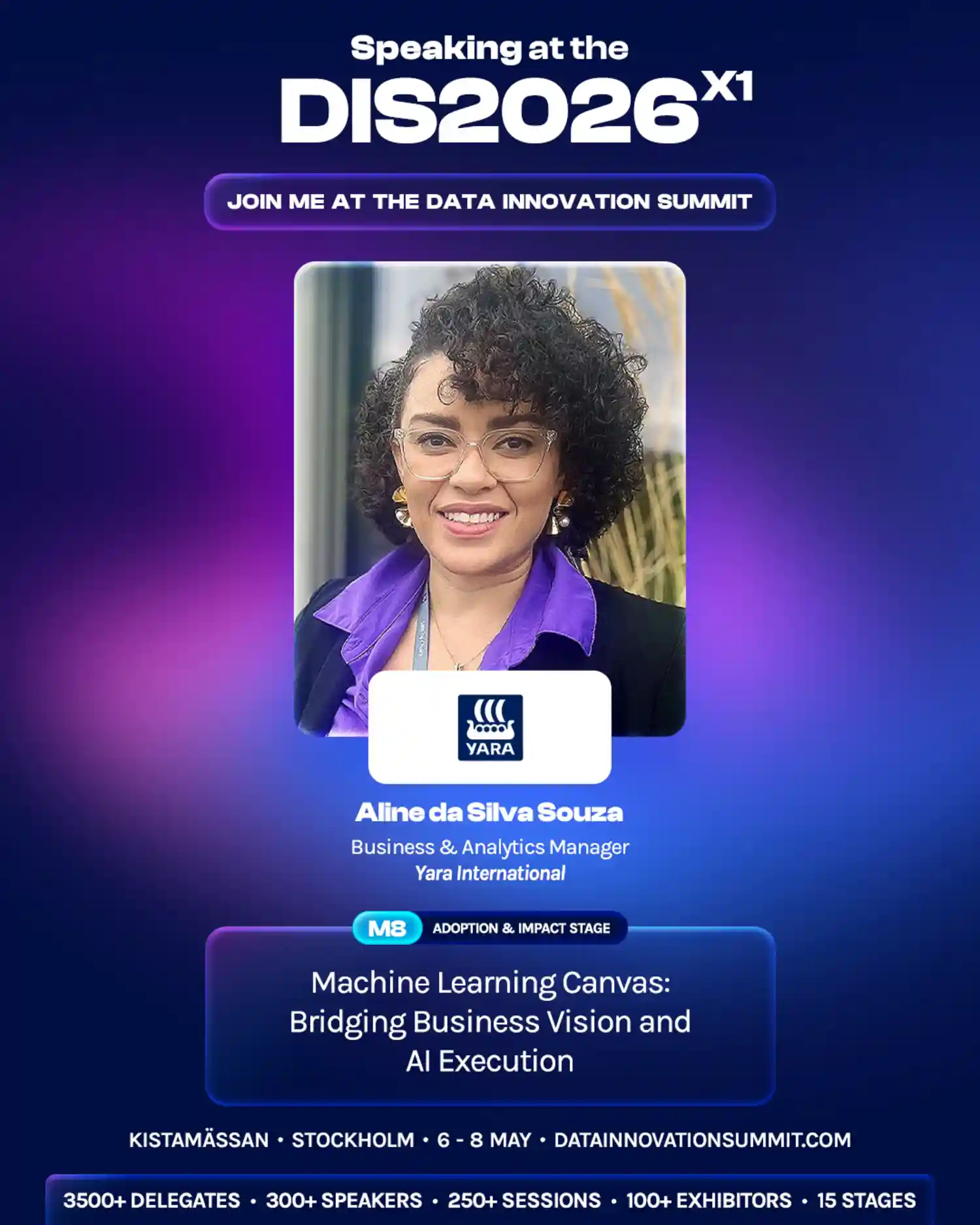
For those looking to move beyond theory and into structured execution, Aline Souza will be leading a featured session at this year’s Data Innovation Summit. She will dive deep into the Machine Learning Canvas, a strategic framework designed to connect business problems, data strategy, and AI implementation into a single, cohesive visual tool.
The session is a must-attend for leaders and practitioners focused on moving from ideation to impact-don’t miss the opportunity to learn how to turn AI insights into real, measurable results.