
An enterprise can build an accurate model, deploy a capable assistant and automate a sophisticated workflow without materially improving its business, because technical achievement and organizational progress follow different paths. The distance between them is where AI strategy becomes difficult, where investment loses direction and where impressive demonstrations struggle to become meaningful outcomes.
That distance also explains why the instruction to “start with business value” remains necessary despite sounding almost too obvious to repeat. Agreement around value is easy when it remains an abstract ambition, while the harder work involves connecting that ambition to specific decisions, operational changes, responsibilities and evidence that something has actually improved.
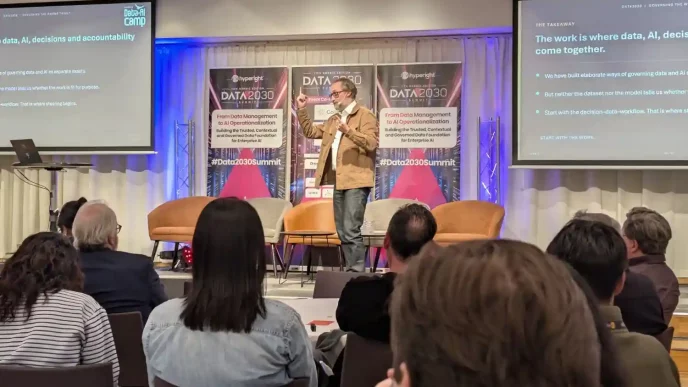
In Episode 191 of the AI After Work (AIAW) Podcast , Samir Sharma , CEO and Founder of datazuum and author of The Strategy Canvas: A Field Guide for Data & AI, explores this challenge through a framework that connects strategic objectives with the practical conditions required to achieve them. The discussion offers a useful proposition for enterprise leaders: value driven AI requires an organization capable of continuously connecting intent, execution and learning.
The Real Problem Behind the Strategy Execution Gap
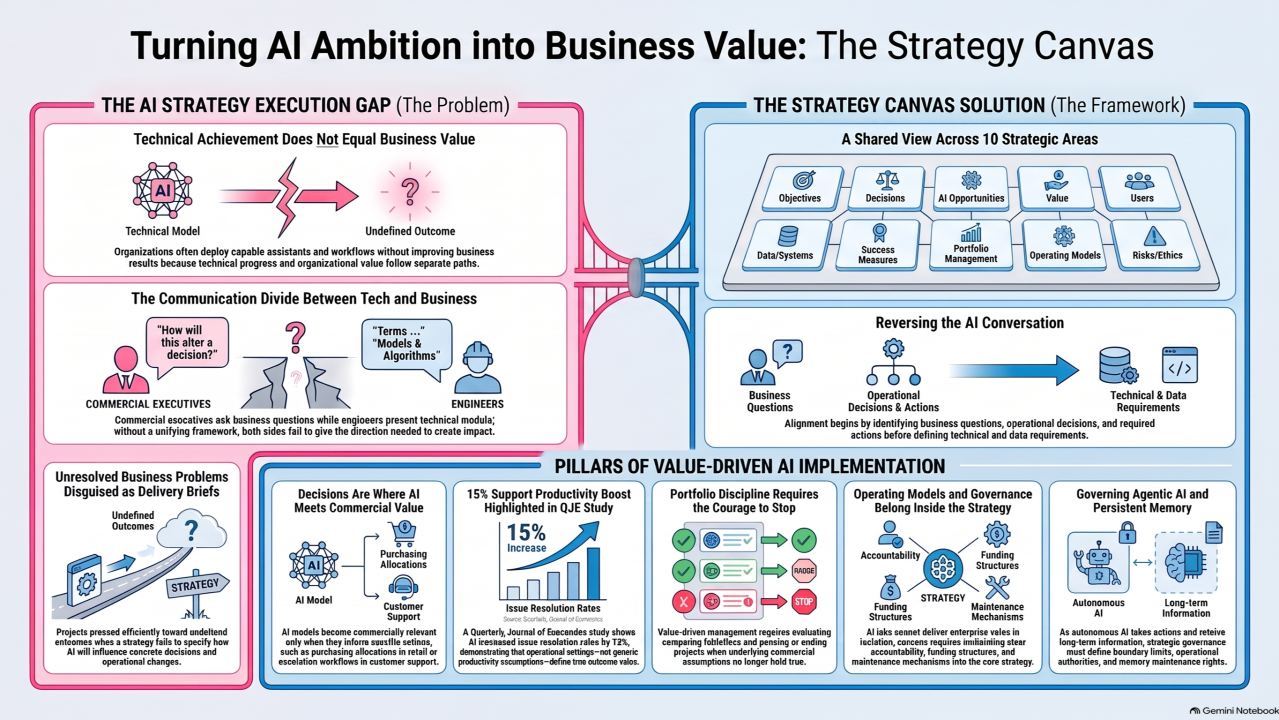
The origins of the canvas reveal something important about the problem it addresses. In the conversation, its development begins with a room divided between commercial executives seeking business answers and technologists explaining a physical data model, with both groups approaching the same initiative through fundamentally different concerns.
The technical presentation could be correct without helping the executives understand what would change for their business, while the executives’ requests could remain commercially reasonable without giving engineers enough direction to build anything useful. Expertise existed on both sides, but the connection between their contributions remained unclear.
The response was to reverse the conversation, beginning with business questions, decisions and actions before identifying the information and systems needed to support them. What emerged was an early decision map that made the relationship between commercial intent and technical work visible. 
This distinction matters because the strategy execution gap can begin long before execution starts. When a strategy fails to explain how a technical capability will influence a decision, change an action and improve an outcome, the implementation team inherits an unresolved business problem disguised as a delivery brief.
A project can then proceed efficiently toward an outcome that nobody has properly defined.
What the Canvas Makes Visible
The Strategy Canvas brings ten areas into a shared view: strategic objectives; decisions and use cases; analytics and AI opportunities; value; consumers and users; data and systems; success measures; portfolio management; governance and operating models; and risks and ethics.
Its contribution comes from the relationships between those areas, because each places conditions on the others. A strategic objective becomes actionable through decisions, an AI opportunity becomes useful through adoption, and an expected benefit becomes credible through measures and ownership.
Consider a hypothetical manufacturer seeking to reduce unplanned downtime. A predictive maintenance model might identify equipment at risk, but the commercial result depends on whether maintenance teams can interpret the warning, obtain spare parts, schedule intervention and avoid introducing disruption elsewhere.
The canvas exposes those dependencies before model performance becomes the dominant definition of success. It also makes room for a less comfortable conclusion, because the most important constraint might sit in maintenance planning, supplier arrangements or decision authority rather than in the prediction itself.
By making the whole chain discussable, the framework gives business and technical teams a shared basis for deciding what must change and whether the proposed investment can reasonably produce that change.
Decisions Are Where AI Meets Business Value
One of the strongest ideas in the discussion is the placement of decisions between strategic ambition and technical capability. Enterprises frequently describe their objectives in broad terms such as growth, efficiency or resilience, while delivery teams work with concrete tasks such as retrieval, classification, forecasting and generation.
Decisions connect these levels by identifying the moment when information can influence what the organization does.
For a retailer, improved demand forecasting becomes commercially relevant through purchasing, allocation and replenishment decisions. For a service organization, an AI recommendation becomes valuable when it helps resolve a customer problem more effectively, changes an escalation decision or improves the consistency of service.
This perspective also changes how teams define their requirements. Instead of asking for more data or a more advanced model in general, they can identify the information, timeliness, accuracy and explanation needed for a particular decision under particular conditions.
The resulting conversation becomes more precise because the value of technical performance depends on its operational use. An improvement in accuracy may matter greatly when it changes an expensive intervention, while a larger improvement may matter little when the receiving team cannot act differently.
Outputs Do Not Capture Their Own Value
The distinction between outputs and outcomes becomes especially important when organizations calculate productivity benefits. A system might produce a report faster, summarize more documents or reduce the time required to draft a response, yet those improvements still leave a business question unresolved.
The organization must determine how the released capacity will improve service, increase throughput, strengthen quality, reduce expenditure or support work that previously went undone.
Research provides a useful illustration of why this must be examined carefully. A study published in The Quarterly Journal of Economics found that AI assistance increased customer support productivity by 15% on average, measured through issues resolved per hour, while the effects varied substantially across workers and experience levels. The result demonstrates a measurable operational benefit within a specific setting, while also showing why a single productivity assumption should not be applied indiscriminately across an enterprise.
For leaders, the implication is to make the value mechanism explicit. If time saved is the starting point, the next question concerns what happens to that time, who makes the necessary changes and what evidence will demonstrate that the organization benefited.
Without that connection, a business case can count potential capacity as though the organization has already captured its value.
Value Driven AI Must Leave Room for Discovery
Starting with business objectives creates discipline, but it also introduces a potential limitation if those objectives become fixed instructions that technical teams are expected only to execute.
An enterprise may understand its existing problems while remaining unaware of opportunities that become visible through experimentation. A new capability can reveal a different customer proposition, make an established process unnecessary or expose an assumption that previously seemed unavoidable.
The discussion addresses this tension by treating the canvas as an iterative framework with feedback moving in both directions. Business priorities guide technical investigation, while technical discoveries can challenge the original priorities, the chosen process and even the definition of the opportunity.
This creates a more demanding interpretation of strategic alignment, because alignment cannot mean preserving every assumption made at the beginning. It must include a legitimate route for changing those assumptions when evidence improves.
A value driven approach therefore needs room for exploration alongside accountability. Early investment can be justified by a clear learning objective and an important uncertainty, provided that subsequent funding depends on what the experiment reveals and how that learning changes the opportunity.
Strategy Needs a Route Back from Execution
Feedback loops are easy to endorse and difficult to establish when they cross organizational boundaries. An engineering team can improve a system within its remit while lacking the authority to question the process, budget or commercial commitment surrounding it.
The discussion identifies a revealing example in procurement arrangements that separate management consulting from engineering support. When strategy and implementation are purchased through different categories, governed by different sponsors and judged against different deliverables, the enterprise can formalize the separation it later asks collaboration to overcome.
A recommendation from implementation may then have no clear route into strategic decision-making, even when it demonstrates that the original approach should change.
The canvas can make this disconnect visible, but leadership must provide the authority and mechanisms required to resolve it. Teams need a way to raise findings, decision-makers need responsibility for responding, and funding arrangements need enough flexibility to accommodate justified changes.
The quality of an AI strategy consequently depends partly on whether operational evidence can alter executive choices. A feedback loop becomes meaningful when somebody can act on what comes back.
The Operating Model Belongs Inside the Strategy
The operating model determines how ambition becomes repeatable work, including who collaborates, who decides, who funds, who maintains and who takes responsibility when results fall short.
Addressing these questions after technical development creates a predictable weakness, because the organization may discover that its solution requires capabilities, incentives or forms of coordination that the project never included.
The canvas brings these considerations into the strategy conversation while there is still time to shape the initiative around them. A proposed application can then be assessed alongside the practical changes required for people to use it effectively.
This also explains the limitations of treating an AI lab as a complete operating model. A lab can provide expertise, experimentation and useful distance from established routines, but enterprise value still depends on how its work enters operational processes, obtains ongoing support and becomes somebody’s responsibility.
Organizational design cannot remain outside the scope when the expected benefit depends on changing how the organization works. The relevant design can evolve through implementation, provided that the people responsible for strategy remain involved in those discoveries.
Data Readiness Becomes a Question of Purpose
The canvas also offers a more focused way to discuss data quality and readiness. Broad ambitions to improve enterprise data can be necessary, but they become difficult to prioritize when they lack a connection to the decisions and services they are intended to support.
Beginning with the intended outcome allows teams to identify which information matters, where it originates and what level of reliability is required for its use.
A decision made within minutes may require different freshness and availability from one reviewed quarterly, while an application influencing a consequential customer interaction may demand stronger controls than an internal exploratory tool.
This does not remove the need for common definitions, shared infrastructure or wider governance. It provides a way to explain why particular foundations deserve investment and how their contribution will be recognized.
Over time, connections across canvases can reveal recurring requirements that individual projects might otherwise solve separately. A shared customer definition, a dependable product hierarchy or a reusable access mechanism can become a portfolio investment because its value is visible across several business outcomes.
The enterprise can then improve its foundations through a combination of immediate needs and an increasingly informed view of common dependencies.
Portfolio Management Requires the Courage to Stop
An individual use case can appear attractive while adding little to the enterprise portfolio, particularly when several initiatives compete for the same people, depend on the same unfinished capability or claim overlapping benefits.
The portfolio dimension of the canvas brings these relationships into view, allowing leaders to compare opportunities through their strategic contribution, dependencies, readiness and evidence.
It also creates a more rational basis for stopping work. A project may remain technically interesting after its commercial assumptions weaken, while an impressive demonstration can make withdrawal politically difficult.
Revisiting the canvas allows the conversation to return to the intended outcome and the conditions needed to achieve it. If those conditions no longer hold, pausing, narrowing or ending the initiative can preserve resources for stronger opportunities.
The important distinction is between an experiment that produces useful learning and a project that continues because nobody wants to acknowledge what the learning implies. Portfolio discipline requires both permission to explore and the willingness to change investment decisions when evidence arrives.
Governance Must Steer the Work
The discussion gives governance a practical role through questions of ownership, measurement and intervention. Establishing policies and frameworks provides structure, while achieving an outcome requires people who actively steer the work within that structure.
An enterprise needs to distinguish responsibility for a governance framework from responsibility for realizing a business benefit. These roles may interact closely, but neither can substitute for the other.
A business owner must understand the intended result and the operational changes required to achieve it, while technical owners must maintain the systems and models that support the process. Governance specialists contribute the controls, definitions and oversight needed for the application’s context.
The canvas brings these responsibilities into the same conversation so that accountability follows the path from data to decision to outcome.
Its risks and ethics dimension also broadens the investment decision beyond feasibility and expected return. A commercially attractive application still requires examination of who may be affected, what forms of failure matter and whether the proposed use is acceptable within the organization’s responsibilities and values.
Agentic AI Makes the Canvas More Important
As AI systems move from producing recommendations toward taking actions, the relationship between objectives, authority and outcomes becomes more consequential. A system that can initiate work or coordinate tasks needs a clear definition of the purpose it serves and the boundaries within which it operates.
Autonomy itself provides no assurance that the business will benefit, particularly when additional complexity introduces costs, exceptions and oversight requirements.
Anthropic’s engineering guidance offers a useful technical parallel by recommending that teams begin with the simplest solution capable of meeting their needs and add agentic complexity when it improves outcomes, while acknowledging tradeoffs in cost and latency.
Applied through the canvas, this becomes a business design question about where delegated action contributes value. A bounded workflow may be sufficient for a stable process, while a more flexible agent may be justified where the work requires adaptation.
The choice should follow the opportunity and its operating conditions, with success measures that account for intervention, reliability and the consequences of errors alongside speed or task completion.
Persistent Memory Creates Persistent Responsibilities
Agent memory extends the challenge because retained information can influence future interactions and actions beyond the task in which it was first captured.
Technical documentation for persistent memory describes systems that can create, retrieve, update and delete information across conversations, allowing knowledge to remain available beyond a single context window.
For enterprises, the strategic implications concern the status of that retained knowledge. A remembered customer preference, an inferred exception or an outdated operating assumption may become influential without having the same authority as an approved business record.
The canvas provides a place to connect this capability with ownership, quality, access and correction. Leaders can examine who is responsible for retained information, how its origin remains understandable and how changes in business policy should affect what an agent continues to use.
The opportunity is significant because organizational knowledge can become more accessible and useful, but realizing that opportunity requires deliberate choices about what should persist and how its continued use is governed.
The Leadership Discipline Behind Value Driven AI
The strongest contribution of the Strategy Canvas is the shared discipline it creates around the assumptions connecting investment to impact. It allows a business leader, an engineer, a process owner and a governance specialist to examine the same initiative without pretending that their responsibilities are identical.
Used well, it also prevents the strategy document from becoming the final authority on a reality that continues to change. Objectives remain explicit, experiments remain purposeful and evidence can reshape the route toward value.
Leaders can begin by applying the canvas to a live initiative whose technical progress exceeds its demonstrated business impact, using the exercise to identify the missing decision, responsibility or operational change.
From there, the broader opportunity is to make those connections part of how investment is approved, reviewed and renewed. Enterprise AI becomes more credible when the organization can explain how capability changes work, how changed work improves outcomes and how learning will influence the next decision.
*This article was enhanced with the help of AI tools, drawing on the podcast transcript and complementary online research. To go deeper into the source material, I encourage you to listen to the full episode and make your own learnings.
Listen to or see the entire episode on this link.