The clearest sign of AI maturity is not the number of solutions an organisation deploys, but whether each successful initiative strengthens the capability behind the next one.

Modern skyscraper under construction by MC G’Zay on Pexels
Organisations are becoming remarkably good at building things with AI. Assistants are appearing inside established applications, teams are experimenting with agents, and employees are creating tools that once would have required months of development. That speed is progress and should be applauded and encouraged, even when the first attempt is rough. But as enterprise adoption accelerates, leaders need a more demanding definition of AI maturity.
Imagine two organisations. One has deployed fifty-some AI solutions. Although many of them are useful, each was built independently. Teams chose their own approaches, created their own integrations, and worked through the same security questions in isolation. The other organisation has deployed half the amount of solutions. But in their case, each one left something useful behind, namely governed access to trusted information, a security pattern, an evaluation method, or a piece of shared architecture.
The first organisation is easier to praise because applications are easy to count, but the second may be further ahead in their transformation journey. It has started to make its AI capability compound.
Success should leave something behind
We should judge an AI initiative by whether it delivers the outcome it promised. Did processing get faster? Did quality improve? Did costs fall, throughput rise, or decisions get better? A project is not successful merely because its technology is impressive. But alongside these questions, an organisation should ask the crucial question: what can we now do more easily because we built this? 
Moving even a simple AI application from prototype to reliable operation exposes the foundations beneath it. Access to company information raises questions about identity, permissions, and data ownership. Teams must choose models, evaluate outputs, monitor costs, assign ownership, and decide what happens when the model or data changes.
Solving those problems is part of the cost of the first application. The waste begins when the organisation solves them again for the second and third applications. It can then accumulate an impressive portfolio without becoming any better at implementing AI. A useful portfolio-level test is actually quite simple: does each successful implementation make the next one easier, safer, or cheaper to build?
The answer will not always be yes. Some solutions should remain local because the problem is local and there is no point sharing it. Turning every component into a shared platform would create its own complexity. Across the portfolio, however, capability should accumulate somewhere.
Reuse extends beyond technology
When people discuss reuse, the conversation usually turns to APIs, libraries, components, and platforms. Those do matter, but technical assets are only part of what an organisation can reuse. A trusted data source with clear ownership is reusable. So are an agreed evaluation method, an approved security pattern, a procurement agreement that provides governed access to several models, and a clear process for deciding when formal review is required. Even a decision can be reused if it prevents ten later teams from resolving the same uncertainty on their own.
One outcome is often neglected as reuse: Failure. But the fact is that it also belongs in this category as well. Evidence that an approach breaks down under particular conditions has value when it is visible enough to stop others from repeating it. Mature organisations get better at scaling what works, identifying weak ideas early, avoiding duplicate initiatives, and retiring capabilities that no longer justify their cost.
Governance should reduce repeated decisions
Governance is usually described as protection against unsafe or irresponsible AI. That remains essential, but good governance should also make future decisions less costly. Hyperight has similarly argued that organisations can accelerate production by reusing established data-governance roles and workflows instead of inventing a separate process for every use case.
If every team must determine independently which data it may use, which models are acceptable, what evaluation is required, and who needs to approve the work, the organisation has governance in name but little reusable capability. When common patterns have already been assessed, low-risk paths are understood and escalation can focus on what is genuinely new or consequential. The standards have not become weaker. Prior decisions have become infrastructure.
Shared capability needs an operating model
Once teams begin to reuse capabilities, the main challenge becomes organisational. The team that created a useful pattern may not be the right team to maintain it for everyone. A solution built for one workflow may benefit five other teams, which raises practical questions about ownership, funding, priorities, and support.
A federated structure is often the most workable answer. Model access, security patterns, common integrations, observability, and parts of governance benefit from consistency and scale, so central ownership can make sense. Workflow priorities, professional judgement, and accountability for business outcomes should remain with the people closest to the work.
The aim is to centralise where reuse creates leverage while keeping responsibility for the value with the function that produces it. A central AI team cannot (and should not) own every workflow merely because AI is involved. At the same time, distributed development should not force every team to rebuild the same technical and governance foundations.
Compounding changes the economics
AI FinOps discussions often focus on licences, model consumption, tokens, and infrastructure. But they reveal little about whether the organisation is improving its ability to implement AI.
Consider an initiative that costs EUR 100,000 and creates EUR 200,000 in measurable annual value. Its business case looks strong on its own, doesn’t it? If it also creates a capability that five later initiatives reuse, reducing their build costs and time to production, its economic contribution is larger than the return from its original workflow.
The reverse is also possible. A portfolio may contain individually defensible projects while generating extensive duplication. Teams may license overlapping products, rebuild equivalent integrations, repeat the same evaluations, and maintain several versions of what is effectively one capability. Each choice can look rational in isolation while the portfolio remains wasteful.
Leaders therefore need measures of reuse and duplication alongside project-level return. Useful indicators include the share of initiatives using approved common components, the time required to move from prototype to production, repeated spend on equivalent tools, and the number of teams benefiting from a shared capability. No single metric captures maturity, but together they show whether part of today’s investment is lowering the cost of tomorrow’s delivery.
Turn every success into a portfolio decision
Experimentation remains essential, especially while the technology changes quickly. The discipline belongs at the point when an experiment succeeds. That is when the organisation should decide what, if anything, should outlive the original project. Five questions can guide that decision:
• Should the workflow itself change, rather than simply receive an AI layer?
• Should the solution remain local, or does it address a pattern shared by other teams?
• Did the initiative create data access, architecture, evaluation, security, or governance that others can reuse?
• What did the work teach us that should change an existing standard or decision?
• Who will own and fund any capability that continues beyond the project?
Asked on a regular basis, these questions produce something more durable than a collection of applications. They build an organisation that is better at absorbing technological change.
It is crucial because today’s preferred models, vendors, costs, and architectures will change. Capabilities that require specialist development now may become standard product features. A strategy tied too closely to current tools will age with them. A more durable strategy develops the organisation’s ability to evaluate new options, adopt what is useful, reject what is not, and repeat the process without rebuilding its foundations.
When your next AI initiative succeeds, I would urge you to measure the value it created and capture the lessons it earned. Then ask what the organisation can do tomorrow that it could not do, or could not do as easily, before the project began. The most valuable result may be that the next initiative starts from stronger ground.
About the author

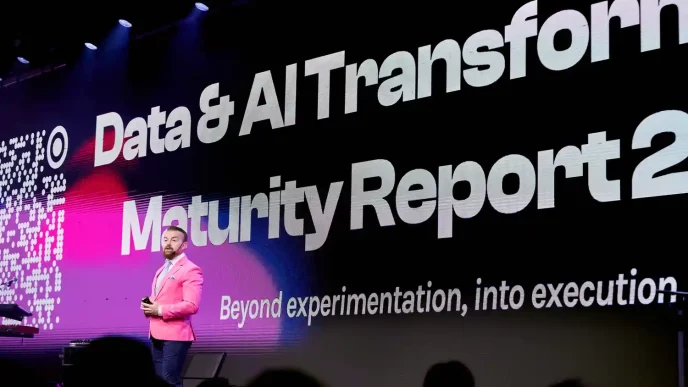
speaker ad the Data 2030 Summit
Serge de Gosson de Varennes is a Data, Analytics & AI leader at Paradox Interactive, where he leads the company’s Data, Analytics & AI function and the execution of its AI transformation on behalf of the Management Team. His work spans data strategy, analytics, AI governance, organisational design, AI economics and the development of capabilities that turn emerging technology into measurable business value.
With a Ph.D. in Mathematics and more than two decades of experience across industries including public administration, healthcare, fraud detection, manufacturing, retail and gaming, Serge has built and led data and analytics organisations and transformed complex data environments.
His current focus is on moving organisations beyond AI adoption towards lasting institutional capability: redesigning workflows, establishing effective operating models, creating reusable capabilities, and ensuring that AI can scale securely, responsibly and economically while delivering measurable business value.
See Serge Live at Data 2030 Summit
Want to dive deeper into building AI capabilities that compound? Join Serge de Gosson de Varennes at the Data 2030 Summit for his session, Beyond AI Adoption: From Use Cases to Institutional Capability, and learn how to turn your organization’s AI initiatives into lasting business value.
*The views and opinions expressed by the author do not necessarily state or reflect the views or positions of Hyperight.com or any entities they represent.