From Reactive DBA to AI-Driven Engineering: How Database Teams Must Shift to the Future
For decades, database administrators have been the guardians of stability. They monitor systems, investigate alerts, fix performance issues, and ensure that critical data platforms remain available. This model worked when infrastructures were small, engines were few, and systems were predictable. That world no longer exists. Today, database teams manage hundreds of servers, thousands of databases, multiple engines, hybrid environments, and 24/7 workloads. At the same time, expectations for uptime, performance, and scalability have never been higher. The problem is not that DBAs are not skilled enough. The problem is that the traditional way of working cannot scale anymore. The future DBA will not spend hours investigating alerts. The future DBA will build systems that investigate themselves.
The Math That Shows the Problem
Let’s look at a realistic scenario. Let’s have a database team with 10 engineers, ~1000 databases, multiple engines, dozens of clusters, and hundreds of servers. In most teams, a large part of daily work is reactive: CPU alerts, replication lag, wait stats spikes, availability issues, storage warnings, query regressions, and blocking incidents. If each engineer spends 2 hours per day investigating alerts and issues the numbers become surprising: 10 engineers × 2 hours/day × 250 days = 5000 hours per year.
Five thousand hours per year spent mostly on reactive work. Five thousand hours that could be used for architecture improvements, automation, AI adoption, reliability engineering, capacity planning, personal growth, and strategic design. This is not a technical limitation. This is a workflow limitation.
The Real Problem: Humans Are Doing What Machines Should Do
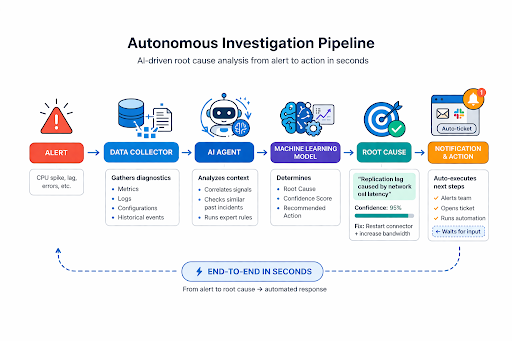
Most investigations follow the same pattern: Alert fires, engineer collects metrics, engineer checks logs, engineer compares with past incidents, engineer guesses root cause, engineer tests hypothesis, and engineer fixes issue. This is a perfect pipeline. And pipelines should not run in human brains. They should run in software.
From DBA Team to Intelligence Platform
Instead of reacting manually, we can design AI-driven operational flows. Imagine this architecture: Every alert triggers a pipeline, the pipeline collects telemetry, a specialized agent analyzes the data, a model compares with historical incidents, and the system returns the root cause. The correct team is notified automatically. This is not science fiction. This is already possible.
One Agent per Engine
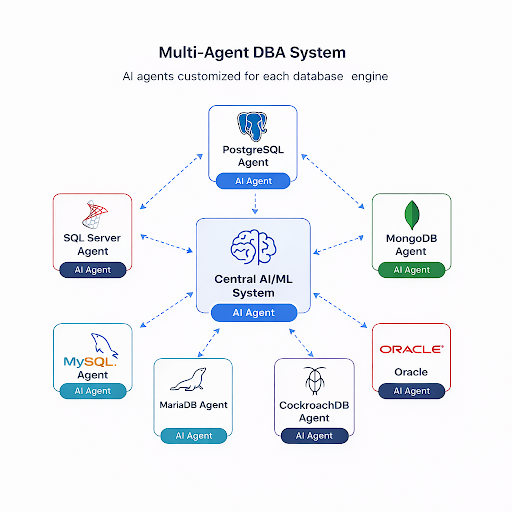
Modern database teams manage multiple engines. Each engine behaves differently, fails differently, and needs different expertise. Instead of expecting every engineer to know everything, we can create engine-specific AI agents. A SQL Server agent understands wait stats and HADR; a PostgreSQL agent understands autovacuum and replication; a MongoDB agent understands replica sets and chunks; and a CockroachDB agent understands ranges and leases. The system does not replace the DBA. It scales the DBA. 
The Next Step: Predict Instead of React
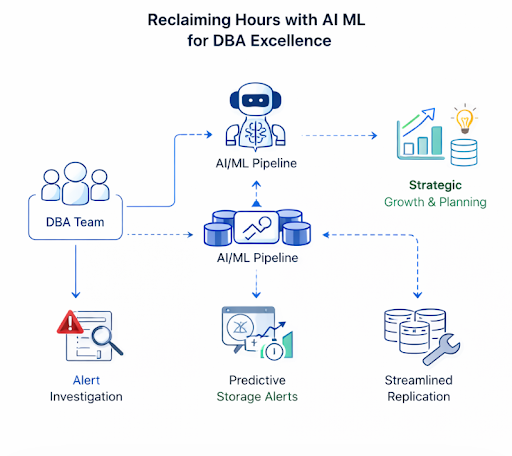
Once pipelines exist, the next step is prediction. Machine learning models can detect patterns before incidents happen. Examples include storage exhaustion prediction, CPU saturation prediction, replication lag prediction, cluster imbalance prediction, and query regression detection. This is where teams move from reactive to proactive. And this is where real productivity begins.
Automation Does Not Remove DBAs, It Changes Them
Many people fear that automation or AI will replace DBAs. In reality, the opposite happens. Less time is spent on checking dashboards, reading logs, running scripts, and repeating investigations. More time is spent on building tools, designing architecture, training models, improving reliability, and teaching agents using experience. The DBA does not disappear. The DBA evolves.
The Future Role: AI Engineer with Domain Expertise
In the past, roles like DBA, Backend engineer, Data engineer, SRE, and ML engineer were separated. In the future, these roles will overlap. The most valuable engineers will be those who combine domain expertise, automation skills, AI knowledge, and infrastructure understanding. A database expert who learns AI can build powerful operational systems. An AI engineer without domain knowledge cannot. This is why domain experts must move first.
AI Is a Bigger Revolution Than the Internet
The internet changed communication. AI changes creation. Today, a single engineer with AI tools can do the work of a team. You can analyze millions of metrics, generate code, build models, simulate incidents, automate operations, and design architectures. AI is not just another tool. It is a multiplier- a very powerful one. Like any powerful tool, the result depends on how you use it. You can use it to replace people, or you can use it to free them.
Organizational Roadmap: Transitioning the Culture to an AI-Driven Model
Shifting from a reactive database administration model to an AI-driven engineering paradigm is not merely a technical upgrade, it is a fundamental cultural transformation. Technology alone cannot scale a team if the underlying mindset remains tethered to manual interventions. To successfully transition your organization, leaders must implement a structured roadmap that prioritizes cultural evolution alongside technological adoption.
- Phase 1: Shift the Mindset from Operations to Engineering The first hurdle is psychological. Many people fear that automation or AI will replace DBAs. In reality, the opposite happens. Leadership must clearly communicate that the system does not replace the DBA, but rather scales the DBA. The objective is to transition engineers away from checking dashboards, reading logs, and repeating investigations. Instead, their focus must shift to building tools, designing architecture, and teaching agents using their deep experience.
- Phase 2: Start Small and Prove the Value Cultural buy-in requires tangible proof. You do not need to transform everything at once. It is vital to start small. Begin by identifying the most repetitive, time-consuming alerts. Build one flow, such as alert > data collection, or alert > root cause suggestion. By successfully automating a single workflow, the team experiences immediate relief. This builds trust in the AI models and encourages engineers to build another flow, and then another.
- Phase 3: Cross-Train Domain Experts in AI In the future, the boundaries between roles like DBA, Backend engineer, Data engineer, SRE, and ML engineer will overlap. The most valuable engineers will be those who combine domain expertise, automation skills, AI knowledge, and infrastructure understanding. Organizations must invest in upskilling their current teams, as a database expert who learns AI can build powerful operational systems, whereas an AI engineer without domain knowledge cannot. This is why domain experts must be the ones to move first.
- Phase 4: Establish Feedback Loops and Continuous Training An AI-driven operational flow is not a “set and forget” solution. Just as senior DBAs mentor junior team members, they must now mentor their AI agents. As machine learning models detect patterns before incidents happen and autonomous pipelines suggest root causes, engineers must validate these outputs. By refining expert rules and correcting anomalies, engineers continuously improve the system. This collaborative loop reinforces the reality that the DBA does not disappear, but instead evolves.
- Phase 5: Reallocate Reclaimed Time to Strategic Initiatives As automated pipelines take over the heavy lifting, the team spends less time reacting and more time designing. It is critical that management actively directs this newly reclaimed time toward high-value work. The thousands of hours previously lost to manual investigations can now be used for architecture improvements, automation, AI adoption, reliability engineering, capacity planning, personal growth, and strategic design. Tracking and celebrating these strategic wins solidifies the new culture and proves the organizational value of the AI shift.
Final Thought
The future DBA will not be the one who investigates alerts faster. The future DBA will be the one who makes alerts to investigate themselves. The teams that understand this early will move forward. The others will spend their time running after a train that has already left the station.
Abouth the author
Data Innovation Summit
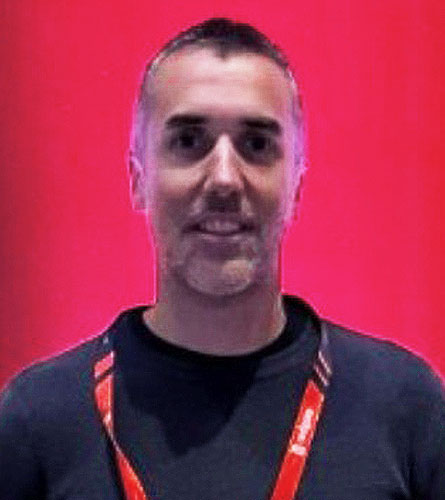
Thodoris Katsimanis is a Technology Manager with over 25 years of experience designing high-concurrency databases and transactional systems. He specializes in building the resilient, scalable architectures required to power demanding production environments at scale.
His recent work focuses on the data infrastructure supporting AI/ML, including vector database operations, schema governance, and real-time ingestion. An international speaker on database internals and concurrency, Thodoris integrates rigorous operational engineering with modern AI initiatives to ensure innovation is built on a robust, production-ready foundation.
*The views and opinions expressed by the author do not necessarily state or reflect the views or positions of Hyperight.com or any entities they represent.