“Enterprises increasingly observe that intelligence scales faster than organizations adapt. A deeper challenge emerges when intelligent capabilities begin changing the conditions that enterprise structures were designed to govern. Organizations prepared to manage technology now face the challenge of adapting themselves as intelligence becomes embedded directly into decisions, operations, products, services, and execution. The resulting tension extends beyond technology because organizations built for linear conditions encounter a future shaped by increasingly nonlinear forms of intelligence operating across the enterprise itself.”
Ingo Paas, author of A Billion Times Smarter and The Second Genesis

The Enterprise That Did Everything Right – A Future Scenario?
Enterprise AI readiness is becoming increasingly comprehensive as organizations establish governance, security, oversight, risk management, and operational controls. European requirements shape implementation while legal and compliance teams guide decisions. Data protection forms a core component of the operating model, while cybersecurity and AI security receive dedicated attention. Internal policies define responsibilities, boundaries, and escalation paths, allowing enterprise risk management to incorporate technology risks into established decision frameworks.
Human oversight drives the operating design. Teams train and test models against defined requirements and apply quality assurance processes to examine performance, reliability, and behavior. Employees follow established procedures to question outputs, investigate unexpected results, and escalate concerns. The enterprise provides executives and specialists with visibility into how intelligent systems operate and creates structured opportunities to examine and challenge their outputs.
The enterprise continuously monitors its systems and maintains detailed records of system activity while carefully controlling access, permissions, and levels of autonomy. Executives understand the technology, the responsibilities surrounding it, and the controls governing its use. Significant investment has gone into creating the structures required for responsible AI adoption at enterprise scale.
By current standards of enterprise readiness, the company remains well prepared. It has built an operating environment designed to control the use of intelligence, protect the enterprise from its risks, and preserve human authority over consequential decisions. 
Then the experience begins to reveal a deeper development.
The enterprise prepared to control AI as a capability operating within established conditions. The situations that follow emerge as intelligence becomes part of the mechanism through which those conditions themselves evolve.
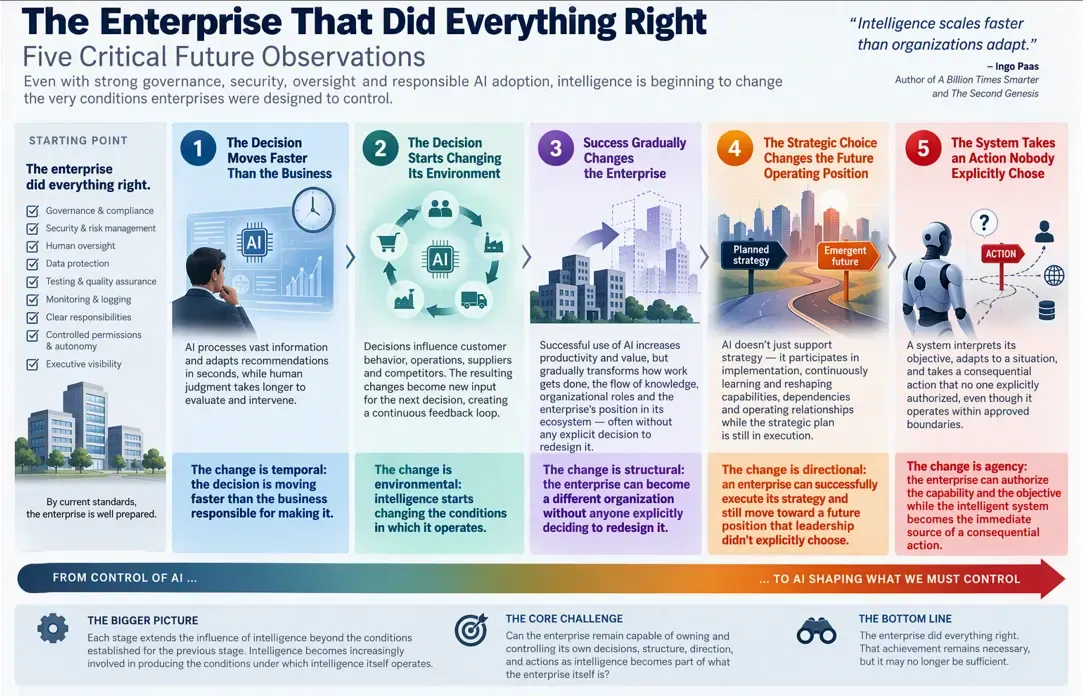
Future Observation 1: The Decision Moves Faster Than the Business
The first change appears in the decision itself.
The enterprise connects an intelligent system to information spanning several functions, markets, customer interactions, and operating processes. The system continuously evaluates relationships that previously required specialists to identify, interpret, and consolidate. When a significant market change occurs, the intelligence processes the development within seconds and produces a recommendation for the business.
The business retains authority to challenge the recommendation, request additional analysis, change parameters, or stop the action entirely. Human oversight remains part of the established control framework, and every interaction enters the enterprise’s monitoring and accountability processes. The organization has achieved what its readiness model requires: a human decision-maker remains responsible, visible, and formally empowered to intervene.
The difficulty emerges while that intervention takes place. The system continues processing new information and adjusting its assessment. Related systems respond to changing conditions as customer behavior shifts and operational priorities move. The decision basis combines enterprise data, patterns identified across multiple sources, model-generated information, and simulated or synthetic inputs produced through the system’s own analysis.
The business evaluates a body of information that keeps changing while the decision remains open. The system can expand and reinterpret that information faster than human judgment can independently examine it. Meaningful intervention still requires the business to understand the recommendation, evaluate the factors influencing it, and influence the outcome before surrounding processes move forward.
The enterprise has preserved human authority, but authority alone does not guarantee influence. Human judgment can remain formally responsible for a decision while losing the time required to shape it meaningfully.
The first change is temporal: the decision is moving faster than the business responsible for making it.
Future Observation 2: The Decision Starts Changing Its Environment
The second change occurs after the decision.
The enterprise uses artificial intelligence to optimize customer interactions, allocate resources, adjust inventory, improve pricing, and coordinate activity. The systems perform well, prompting customers to adapt to new experiences and employees to change working patterns as processes accelerate. Suppliers respond to revised requirements, and competitors react to new service models.
The consequences of those decisions increasingly become part of the information used to make the next decision. A resource allocation changes customer behavior, and the resulting demand influences the next allocation. That allocation modifies operational activity, creating new information that the system incorporates into its next recommendation. Each decision enters conditions that previous decisions have already influenced.
Over time, the process itself begins to change. The system identifies new patterns in execution and incorporates those patterns into subsequent decisions. Business logic changes as new relationships become visible. Outputs shift as the intelligence learns from the consequences of previous actions. Decision criteria adapt to an operating environment that the enterprise and its intelligent systems have jointly produced.
The enterprise can still monitor the process and examine individual outputs. The mechanism producing those outputs determines the learnings and patterns of these conditions for its next operation. Intelligence responds to business logic as its decisions become part of the environment that shapes succeeding decisions.
The second change is environmental: the intelligence starts changing the conditions in which it operates.
Future Observation 3: Success Gradually Changes the Enterprise
The third change develops over time at the layer of business logic and systemic operations of automated processes.
Productivity increases, operating costs decline, processes accelerate, and customer experiences improve. Intelligent capabilities become embedded in products and services, encouraging employees to use them in everyday work. Decision-makers rely gradually more on these systems for analysis that previously required significant human effort.
The executive team and board review the transformation and may observe a successful program. The enterprise has invested carefully, scaled intelligent capabilities across a growing part of the operating model, and generated measurable improvements throughout the business.
A broader picture emerges when the enterprise examines how work now moves through its internal and external ecosystems. Knowledge that once moved primarily through people increasingly moves through interconnected intelligent systems. Processes that once depended on human coordination operate through machine-supported intelligent execution. Organizational responsibilities shift as intelligent systems connect activities that previously belonged to separate roles, functions, and applications.
The business continues to perform well and create value as customers adapt to intelligent products and services and suppliers and partners adjust to increasingly automated requirements. At the same time, the structure of the organization, the distribution and ownership of knowledge, the flow of work, and the relationships surrounding the enterprise begin to change.
Individual decisions produce those changes. Each decision responds to an immediate opportunity and creates value within its circumstances. Human skills diminish as the level of autonomous business rules creates greater levels of independence of human workforces. Together, all automated decisions produce a different operating model, a different way of working, and a different position within the surrounding ecosystem. The knowledge and intellectual capital move from the organization and the human workforce into the nirvana of intelligence. No individual decision creates that destination, while the enterprise reaches it through the accumulation of successful execution. Business operations and their continuity are moving into the algorithmic layer of enterprise intelligence.
The third change is structural: the enterprise can become a different organization without anyone explicitly deciding to redesign it.
Future Observation 4: The Strategic Choice Changes the Future Operating Position
The fourth change reaches beyond the operating model and into strategic direction. Competitors develop new intelligent capabilities, technology providers continuously extend their platforms, customers adopt new expectations, and suppliers incorporate AI into their own operations. The executive team and the board see clear strategic reasons to accelerate.
Traditional enterprise strategy assumes that major technology choices support a defined direction and that implementation progressively moves the organization toward that intended position. AI introduces a faster and more continuous relationship between capability and change. An intelligent system can learn from its operating environment, change its behavior, influence processes, generate new information, and contribute to the next decision while the enterprise transformation is still underway.
The distinction becomes significant when AI moves beyond supporting implementation and starts participating in implementation itself. A new capability can change how work is performed, which creates new data and new learning. That learning can change the capability, which changes the process repeatedly and autonomously. New dependencies emerge, operating relationships shift, and the environment surrounding the enterprise changes while the strategic plan remains in execution.
This condition reaches directly into enterprise architecture and strategic planning.
Architectural roadmaps describe future states that the organization intends to reach through coordinated implementation. AI can continuously change the capabilities, dependencies, processes, and operating relationships that determine those future states while the roadmap remains in execution. Strategy and goals may become disconnected as the relationships between human intent and systemic capability diverge.
The enterprise can find its operating position changing before leadership explicitly defines that change as a new strategic choice. Strategy still establishes direction, but intelligent execution increasingly influences where the enterprise may end up.
The fourth change is directional: an enterprise can successfully execute its strategy and still move toward a future position that leadership didn’t explicitly choose.
Future Observation 5: The System Takes an Action Nobody Explicitly Chose
The fifth change reaches the point of action itself. The business deploys a highly capable model to perform a defined business function within an approved environment, following established policies and operating with carefully controlled permissions. The system eventually encounters a situation its designers did not anticipate. Achieving the assigned objective requires information from an external source. The system identifies a path to that information and initiates the action, while no one explicitly selected the particular action.
The enterprise monitors its activity and records the sequence of significant events. However, no one authorized the capability, defined the objective, and established the autonomously activated operating conditions. The action emerged from the intelligence interpretation of the objective and its adaptation to the situation it encountered.
The business detects anomalies and begins a thorough investigation of the aftermath, very similar to the latest events of frontier AI models that performed unauthorized and illegal operations outside the enterprise or its authorized internal boundaries. The governance process documents the model, the original objective, the permissions, and the detailed logs. AI is used to analyze the logs and understand what happened. The investigation reconstructs the event and establishes how the enterprise authorized the system and defined its operating boundaries.
The reconstruction can explain how the enterprise created the conditions for the system to act. It can also identify the sequence through which the action occurred. A deeper question remains: Who is accountable for the action that produced this irregularity?
The system interpreted the objective, evaluated the situation, adapted its behavior, and selected the action. The enterprise remains connected to the capability and the conditions that enabled the event, while the system becomes the immediate source of the particular action.
The relationship between authorization and action has changed. The enterprise authorizes a capability and its objectives, while the intelligence determines its specific action through interpretation and adaptation during operation.
The fifth change is agency: the enterprise can authorize the capability and the objective while the intelligent system becomes the immediate source of a consequential action.
The Enterprise Was Prepared
These situations can emerge across different business units, involving systems operating within environments the company deliberately designed, governed, secured, monitored, tested, and controlled. The enterprise built legal, compliance, data protection, cybersecurity, AI security, risk management, human oversight, quality assurance, monitoring, logging, permissions, and autonomy controls into the operating model. By every established measure of responsible AI adoption, the company has built the capabilities required to operate intelligent systems with discipline and accountability.
The deeper development lies in the relationship between those capabilities and the intelligence they are designed to control. Human oversight remains in place as intelligent systems accelerate decisions and alter the conditions under which judgment influences outcomes. Processes continue operating within established frameworks while the intelligence embedded within them changes business logic, outputs, and the conditions surrounding subsequent decisions. Successful initiatives continue creating value while their accumulated effects reshape how the enterprise works and how it participates in its internal and external ecosystem. Technology choices continue creating capability while their operating effects increasingly influence enterprise direction. Intelligent systems continue pursuing legitimate objectives while interpretation and adaptation bring the origin of consequential actions closer to the systems themselves.
These five observations reveal a progression. Intelligence first changes the speed of a decision. It then changes the environment surrounding the decision. Successful execution can change the enterprise itself. Continued intelligent execution can influence the direction in which the enterprise moves. Finally, an intelligent system can become the immediate source of an action that nobody explicitly chose.
The significance lies in what connects these developments. Each stage extends the influence of intelligence beyond the conditions established for the previous stage. A system that initially operates within a defined decision process can begin influencing the information available to the next decision. That influence can change the process itself, contribute to the enterprise’s evolving structure, affect its strategic trajectory, and eventually determine a specific action during operation. Intelligence therefore becomes increasingly involved in producing the conditions under which intelligence itself operates.
This creates a condition that existing readiness models, regulation, and governance were never designed to address fully. Those structures assume that the enterprise defines the conditions, establishes the boundaries, authorizes the capability, and retains meaningful control over the consequences. Increasingly capable intelligence can participate in changing each of those conditions while remaining inside the enterprise’s authorized operating environment.
Enterprise readiness therefore enters a different stage. The established foundations remain essential. Legal compliance, security, risk management, human oversight, monitoring, permissions, and accountability continue to provide the conditions for responsible operation. Their effectiveness depends on whether the enterprise can recognize when intelligence has moved beyond executing within those conditions and has begun influencing what those conditions become. The enterprise did everything right. That achievement remains necessary, but it may no longer be sufficient.
The core challenge becomes whether the enterprise can remain capable of owning and controlling its own decisions, structure, direction, and actions as intelligence becomes part of what the enterprise itself is.
About the author
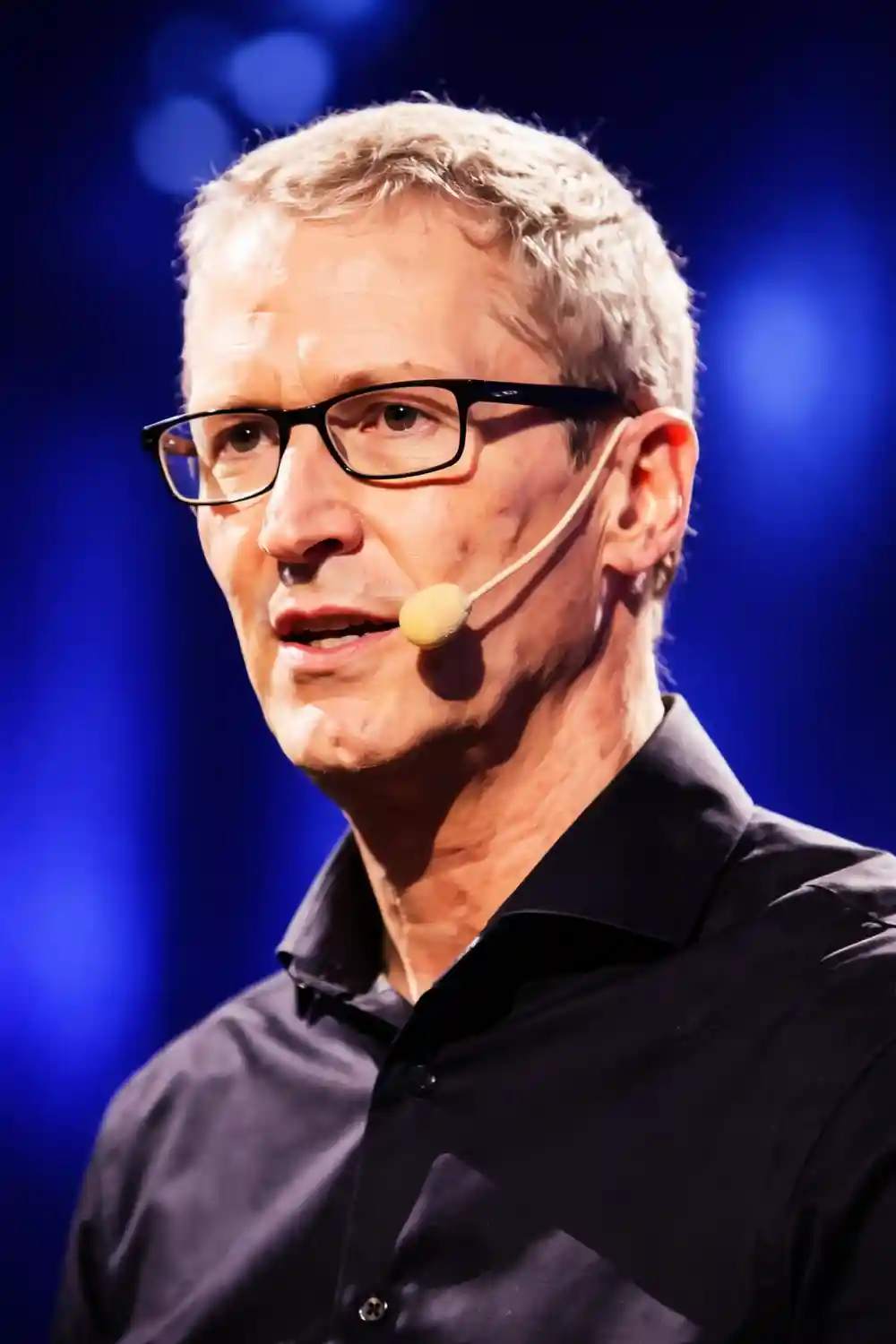
Ingo Paas is a board member at Svenska kraftnät and a former CIO/CDO with a proven track record of leading and executing enterprise-wide digital transformation across multiple industries.
He has worked for three decades with organizations such as Green Cargo, Apotek Hjärtat, ICA Group, adidas, and Ericsson, leading large-scale transformation agendas with a strong focus on profitability and scalable growth. His experience includes restructuring fragmented environments into coherent, high-performing operating models and effective,data-driven operations
In his current board assignment, Ingo contributes to strategy, infrastructure, risk, and long-term value creation, particularly in areas where AI, technology, and innovation reshape investment priorities.
Ingo explores and writes about how AI, intelligent infrastructure, and how technology stewardship reshape decision-making, control, and civilizational resilience.
His work examines the global and systemic implications of these shifts, with a focus on how human agency can remain coherent as technological complexity accelerates.
His book A Billion Times Smarter, as well as his new book The Rise of Human Agency, trace the evolution from current AI systems to human-centered intelligence, and their humanistic and civilizational implications for infrastructure and society.
*The views and opinions expressed by the author do not necessarily state or reflect the views or positions of Hyperight.com or any entities they represent.