
What happens when a global retail giant embraces agents not as experiments, but as catalysts for real operational change? That is the question at the heart of our latest interview with Guillaume Blaquiere, a cloud and data leader at Carrefour who has been instrumental in designing and scaling the company’s agentic framework.
Drawing on a career that spans large-scale IoT systems, cloud-native data platforms, and AI-driven services, Guillaume shares hard-earned lessons on why data foundations matter more than hype, why integration is often harder than intelligence, and how agents can deliver real, measurable value when embedded directly into everyday workflows.
Hyperight: You have a strong foundation across cloud engineering, data architecture and large-scale systems. Which experiences have shaped the way you approach building modern data and AI solutions?

Guillaume Blaquiere: My career path, which I didn’t initially foresee, really gained momentum in 2016, with every experience serving as a foundation. My initial significant challenge was with a Veolia subsidiary focused on connected water meters, during the peak of the IoT trend. The issue was managing data from over 3 million connected meters, each sending 24 metrics every 12 hours, plus various alerts (leakage, fraud, etc.). This generated a massive volume of data that needed decoding, storage, reporting, and analysis.
Our existing On-Prem Oracle database couldn’t handle this scale and scaling it up was too costly. This necessity led us to explore and adopt the Cloud. This project became a cornerstone of my career, involving migration, data pipeline redesign, large-scale usage management, optimization, and cost control (FinOps).
Once the data was in the Cloud, new possibilities emerged. I leveraged AI (non-Generative) to predict water consumption, which was useful for optimizing the pumping system and for estimating consumers’ future bills. 
The transition to Carrefour marked the next chapter, introducing a retail context with even more data, but centered on the same fundamental data challenges.
Hyperight: You’ve been deeply involved in cloud-native and emerging AI technologies. What challenges or focus areas are currently driving your work?
Guillaume Blaquiere: For cloud-native companies, superior data quality offers a competitive edge over legacy organizations. Before the successful implementation of AI, three foundational pillars must be firmly established to ensure system efficiency: data quality, completeness, and freshness.
At Carrefour, which has evolved significantly over 60 years, the IT landscape is complex due to historical mergers and acquisitions. We’ve incorporated multiple companies, sometimes migrating their IT systems (and sometimes not). Recent examples in France include Cora and Match, and in Brazil, Big and Sam.
Furthermore, international subsidiaries introduce challenges related to currency and distinct legal frameworks, tax laws, and varied discount management policies.
Securing and strengthening data quality across all these aspects is an ongoing effort. This is crucial for guaranteeing a robust foundation for subsequent, advanced processes like AI and Business Intelligence (BI). Therefore, establishing these fundamental data prerequisites is paramount for Carrefour’s future success.
Hyperight: At the event, you’ll present on “How the Agents have colonized Carrefour.” What should attendees expect to learn from your session?
Guillaume Blaquiere: This session explores the practical world of agentic systems. While agents are indeed smart, engaging, and valuable, two critical aspects must be remembered:
- A Strong, Valid Use Case is Essential: Many AI projects fail, not due to technology limitations, but because teams attempt to apply AI where it’s unsuitable or where the data quality is inadequate.
- Integration is the Real Challenge: Building an agent with modern models and state-of-the-art frameworks is relatively straightforward. However, integrating it seamlessly into your existing application, context, and environment is significantly more difficult.
For example, in my session, agents built with ADK are deployed on Google Chat. Crucially, 80% of the development time was dedicated solely to connecting ADK to Google Chat.
Hyperight: What shifts in the industry made it clear that adopting an agentic strategy was the right move?
Guillaume Blaquiere: In my opinion, the adoption of GenAI isn’t driven by an industry shift, but by a fundamental change in technology and its potential impact on users. Consider that prior to the initial ChatGPT release, massive investments were poured into the Metaverse, yet its real-world utility and immediate applicability were questionable.
With Generative AI and Agentic systems, there’s a tangible increase in technological usefulness. Companies are embracing this new paradigm for working and task completion.
Hyperight: You helped design and evolve the agent framework now used at Carrefour. Can you briefly walk us through how it was architected and iterated?
Guillaume Blaquiere: Our project began with a small-scale deployment to demonstrate the value and potential of integrating agents with Google Chat. Following the input and proposals from our users, we evolved the service. The internal nature of the agent facilitates an easy and honest feedback loop, as colleagues are open to providing candid reviews.
This step-by-step process allowed us to continually incorporate new features, such as BigQuery data integration, documentation retrieval from Confluence, JIRA connectivity, Thoughts display, and user authentication.
Hyperight: In your experience, what foundational elements – data, processes, tools, or team skills – are essential for launching and scaling an agentic initiative?
Guillaume Blaquiere: The core takeaway from my session emphasizes a crucial shift: prioritize the use case above all else. Avoid inventing flows or processes that lack real-world relevance or user demand.
Secondly, focus on integrating the agent seamlessly into the end-users’ daily tools. The agent must go to the users; users should not have to hunt for the right agent for a specific task. The agent’s usage must be natural, seamless, and ideally, invisible.
Hyperight: What were the breakthrough moments along the way? And which technical or organisational hurdles proved the most challenging?
Guillaume Blaquiere: The successful launch of the Data Governance agent was a major achievement. While the initial fear was low adoption for a tool nobody expected, it was immediately embraced by hundreds of business and data users, and its quality was well received.
Organizationally, there were no significant hurdles, thanks to the company’s agile structure. The only minor delay was securing Google Workspace admin approval to fully integrate the agent as a recognized Google Chat application, which was a standard internal security procedure.
The primary difficulty lay in integrating with Google Chat itself. The platform was not initially designed to host such an agent, requiring creative solutions to overcome various limitations and complexities. Fortunately, leveraging my GDE recognition allowed me to communicate these issues directly with the Google Chat Product Manager at Google. I’ve since noticed positive changes in the product; while not perfect yet, the platform is definitely evolving in the right direction.
Hyperight: What measurable value has the agent framework delivered so far across the use cases you’ve worked on?
Guillaume Blaquiere: We are actively working to establish key performance indicators (KPIs) for our application. A recent Google update now allows us to track crucial metrics such as latency, number of events per user interaction, and token cost, directly within BigQuery.
In addition, we plan to release a feedback tracker early next year. This tool will allow us to evaluate the agent’s answers and use that data in the evaluation process for future releases, employing the “LLM as a judge” pattern.
From a user experience standpoint, the deployment of the agentic process has significantly improved service. Prior to its introduction, members of my data platform team handled user support, with response times varying from minutes to hours.
Now, users receive answers in approximately one minute, 24/7, with the added capability of asking follow-up questions and requesting query examples.
Hyperight: Looking beyond Carrefour, what conditions should other organisations meet to adopt a similar agentic approach effectively?
Guillaume Blaquiere: The most critical advice is to experiment! Becoming familiar with the technology is essential. Sometimes it’s brilliant, and other times completely inadequate. The quality of your agents, and therefore their success, will be influenced by how you use the technology, the data you provide, and the prompts you write. Experience, from small tests to large deployments, is the only way to succeed.
Beyond the specific use case and technical integration, user adoption is the second crucial aspect to manage. The pace of GenAI evolution is so rapid that non-technical users may struggle to keep up, or even reject the tools due to continuous change. Effective change management is therefore vital to bring the entire company up to speed.
Hyperight: Finally, what lessons or advice would you share with data and AI professionals preparing for an increasingly agent-driven future?
Guillaume Blaquiere: Building on the advice already shared, the most important step is to begin immediately! Start experimenting, be prepared to fail, start over, and continuously iterate. You must embrace and become comfortable with this new trend. Don’t wait ⇒GO!
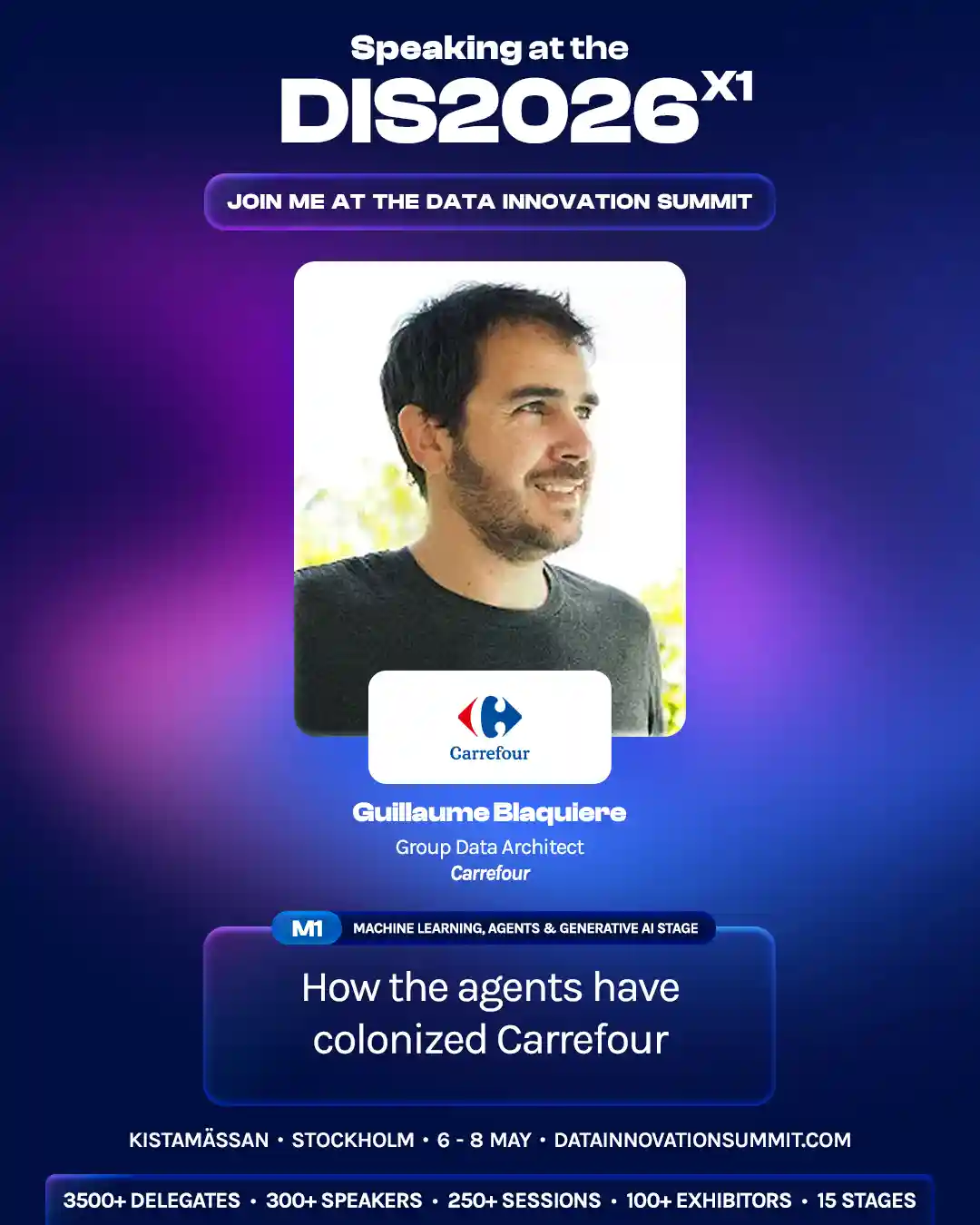
If you’re curious about applying agentic AI to improve workflows and team efficiency, Guillaume Blaquiere’s session at the Data Innovation Summit 2026 is a session you won’t want to miss!
Whether you’re exploring AI adoption, improving operational efficiency, or looking to experiment with agentic systems in your organization, this session provides practical lessons and strategic guidance you can apply immediately.