
For much of the generative AI boom, Europe has been asking itself a question that sounds reasonable but may be leading us in the wrong direction: where is Europe’s OpenAI? The comparison is understandable because the United States has produced OpenAI, Anthropic, Google and Meta, while China has built an increasingly formidable ecosystem around companies such as DeepSeek, Alibaba and Moonshot AI. Europe, by comparison, has fewer frontier laboratories operating at comparable scale, and the resulting debate often begins from the assumption that technological sovereignty requires us to reproduce what the United States and China have already built.
The latest AI After Work (AIAW) Podcast conversation with Christian Landgren , Co-Founder and CPTO of Berget AI , suggested a much more interesting way of looking at the problem, particularly because the host Anders Arpteg repeatedly pushed the discussion beyond the comfortable version of the sovereignty argument. Rather than simply asking how Europe can build a larger model, the conversation moved between inference infrastructure, open-weight models, cultural values, cybersecurity, energy consumption, agentic architectures and the concentration of technological power. What emerged was not an argument for European technological isolation, nor the simplistic conclusion that everything should be built locally, but a broader interpretation of sovereignty as the ability to retain meaningful choices while AI becomes embedded in the machinery of companies, governments and society.
That distinction matters because AI is beginning to look less like another category of enterprise software and more like an enabling layer beneath an enormous range of activities. Developers are reorganizing how they write software around coding agents, commercial teams are using AI to prepare proposals and respond to customers, public-sector organizations are experimenting with AI inside administrative processes, and companies are starting to connect models to proprietary systems, databases and workflows. Once those capabilities become deeply integrated into the operating model of an organization, the question of who controls the models, infrastructure, data and interfaces stops being an abstract geopolitical discussion and becomes a practical question of resilience.
Sovereignty Does Not Begin With the Model
One of Christian’s most useful observations is that Europe does not necessarily have to own the frontier model in order to control how that model is used. Open-weight models create a separation that is often lost in discussions about technological sovereignty because the company that develops the intelligence does not necessarily have to be the company that operates the service through which an enterprise consumes it.
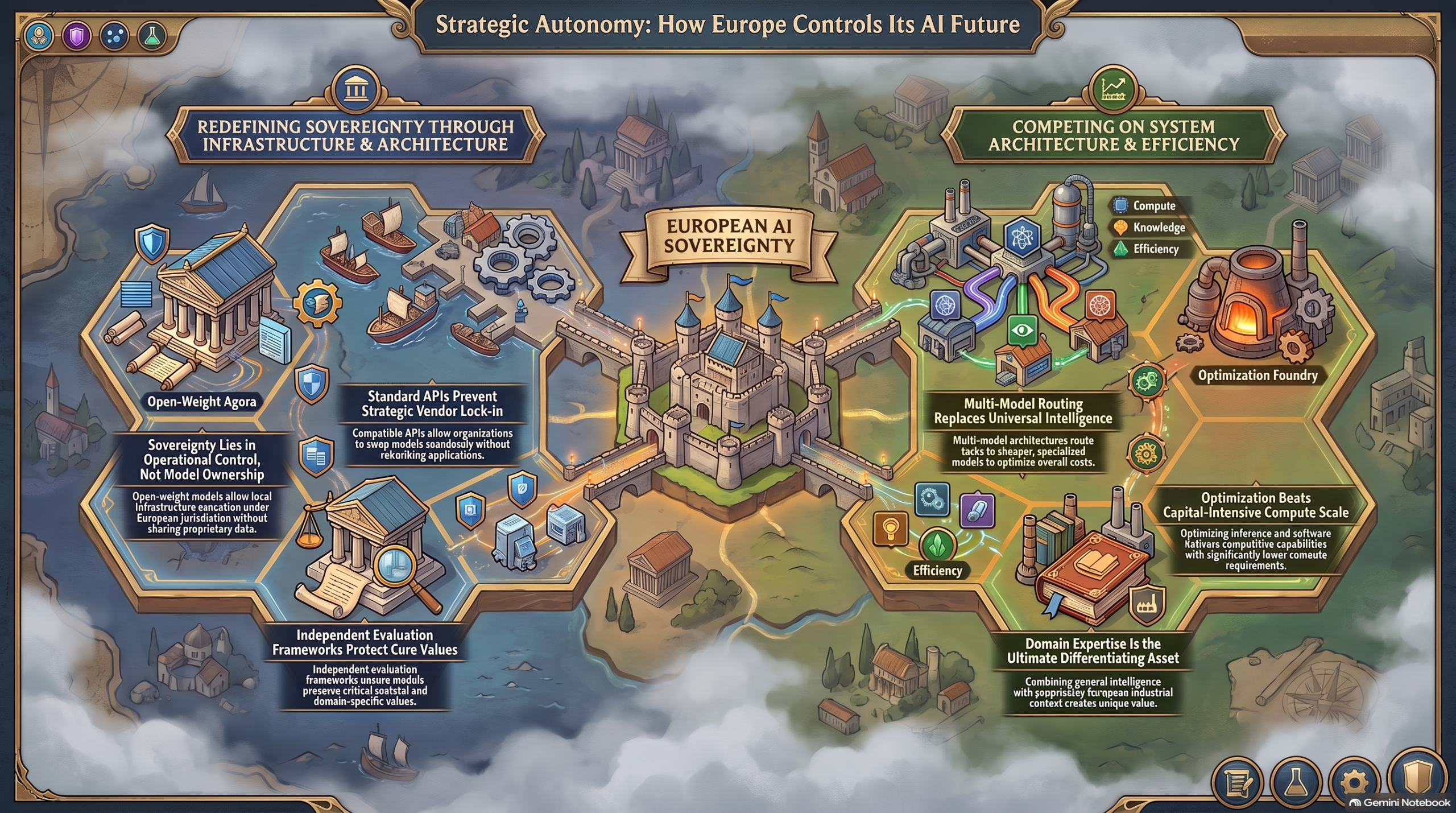
A model can be developed in China or the United States while its weights are operated on infrastructure in Sweden, under European jurisdiction, with organizational data remaining inside that environment. This does not magically remove every dependency from the technology stack, because the GPUs may still come from American companies and the semiconductor manufacturing chain remains global, but it changes where some of the most consequential dependencies sit. An organization can gain access to globally competitive intelligence without necessarily sending every internal document, prompt, software repository or piece of business context into an externally controlled service.
Berget AI was born from precisely this problem. Christian described encountering organizations, particularly in regulated environments and the public sector, that could see the value of machine learning and generative AI but could not simply transmit sensitive information to external AI services. Rather than attempting to solve this by creating another frontier laboratory from scratch, Berget focused on inference: placing powerful hardware in Sweden, running open models on that infrastructure and exposing them through interfaces familiar enough that developers could move workloads without redesigning their applications. 
The distinction sounds technical, but strategically it is significant because model ownership and model operation are different questions. European sovereignty does not need to mean that every layer of the stack has a European passport. It can instead mean identifying the layers where control matters most, understanding which dependencies can be tolerated, and designing the system so that those dependencies do not quietly become permanent.
That is why Christian’s emphasis on OpenAI-compatible APIs is more important than it first appears. Compatibility means that an organization can replace one endpoint with another without rebuilding the entire application, which sounds mundane compared with the excitement surrounding foundation models but is exactly the kind of architectural decision that determines whether an enterprise can change course later. Vendor lock-in rarely arrives with a dramatic announcement. It accumulates through proprietary APIs, custom integrations, data formats, workflows and operational dependencies until switching becomes so expensive that an apparently optional provider has become part of the organization’s infrastructure.
Seen in that light, sovereignty is less a label attached to a cloud provider than a property of the architecture itself. An organization that can change models, redirect workloads, retain its data, preserve its evaluation framework and move between infrastructure providers has more sovereignty than one that cannot, regardless of what flag appears on the supplier’s website.
The Model May Be Becoming Less Important Than the System Around It
The conversation became more interesting when Anders challenged Christian on the proposition that open-weight models are approaching the performance of the leading proprietary systems, because the answer exposed a broader shift in how enterprise AI may develop. Christian did not argue that all models are becoming equivalent, and in fact he described meaningful differences between them, with some models performing particularly well on front-end software development, others showing strength in back-end tasks or cybersecurity, and still others being more useful for particular types of reasoning.
That diversity suggests that the obsession with identifying a single “best model” may eventually become less useful than it appears today. Enterprises do not normally ask which database is universally best, because the answer depends on what is being stored, how it is queried, what latency is required, what reliability guarantees matter and what the surrounding architecture looks like. AI models may be heading toward a similar position, where a general ranking matters less than the fit between a model and a particular task.
Agentic AI accelerates this transition because a single request from a user can produce many model interactions behind the scenes. An agent may need to understand the user’s intent, search internal information, classify documents, generate code, inspect the result, call external tools, evaluate what happened and decide whether another round of reasoning is necessary. If every stage is sent to the most capable and expensive frontier model, the economics quickly become uncomfortable, particularly when organizations begin running thousands or millions of these workflows.
Christian’s argument is that a more mature architecture will route different tasks to different models according to what they actually require. A smaller, inexpensive model may be perfectly capable of classification or extraction, while a model specialized for software development can handle coding, and the largest reasoning system is reserved for the comparatively small number of decisions where its additional capability justifies the cost. The important asset then becomes the orchestration layer that knows how to combine these models rather than privileged access to one supposedly universal intelligence.
This has profound implications for the economics of enterprise AI because it means that model competition may become a component market inside a much larger system. The organization that owns its context, evaluation criteria, routing logic, tools and workflows can replace individual models as the market changes, while the organization that has built everything tightly around one provider is forced to follow that provider’s pricing, product roadmap and technical decisions.
It also makes sovereignty economically useful rather than merely politically desirable. The same architectural flexibility that reduces dependency can lower costs because workloads can move toward models that provide the necessary capability without paying a frontier-model premium for every intermediate step. A multi-model architecture therefore creates both resilience and bargaining power, which is a considerably stronger business case than sovereignty framed only as a response to geopolitical anxiety.
The Most Interesting Sovereignty Question May Be What the Model Leaves Out
The most original part of the discussion, however, was not about data centres or GPUs at all. It appeared when Christian described Berget’s work on model evaluation and began talking about what happens when an AI system compresses information.
We tend to think about summarization as a neutral productivity function. A four-page meeting transcript becomes one page, a long report becomes a few paragraphs, or hundreds of documents become an executive briefing, and the main quality question is usually whether the result accurately captures the source material. Yet every summary requires selection, which means the system must continuously decide what deserves to remain and what can be discarded.
Christian described experiments in which models were given material containing different categories of information and asked to compress it substantially. Across the models they tested, information relating to technology, business and process tended to survive reliably, while other subjects, including labor protection, equality, trust, religion and social values, could disappear more easily during compression. The observation was not presented as proof that one geopolitical family of models is good and another bad; in fact, one of the more surprising themes in the conversation was how poorly those simple geographical assumptions can describe actual model behavior. The more consequential point was that models inevitably prioritize information, even when users experience the output as a neutral summary.
That becomes important when AI starts mediating a large part of what organizations read. Executives will not inspect every original meeting transcript if an agent can produce a daily briefing. Employees will increasingly ask models to summarize research, regulations, customer interviews and internal documents. Agents will summarize information for other agents because passing the entire context through every stage is inefficient. In each of these situations, the model is not merely shortening information but influencing what remains visible.
The problem is subtle because users see what survives but rarely inspect what disappeared. A summary can be factually correct and still reshape the emphasis of the underlying material, particularly if certain classes of information are consistently considered less salient than others. Over millions of interactions, these small choices could influence what organizations remember, discuss and eventually prioritize without anyone consciously deciding to make that change.
This is where the discussion introduced a much richer definition of sovereignty. If European organizations care about particular social norms, labor traditions, approaches to equality or institutional values, then it is not enough to know that the server happens to be located in Europe. They also need to understand how the model interprets and filters information.
The obvious danger is replacing one centralized worldview with another by declaring an official set of “European values” and attempting to hard-code them into models, which would simply move the authority from the model provider to whoever defines the approved evaluation. Anders and Christian instead explored the idea of making the evaluation process itself more open, so that researchers, organizations and communities could propose dimensions worth testing and compare how models behave under those conditions.
That turns evaluation into infrastructure. We currently compare models by intelligence benchmarks, price, speed and context length, but a mature enterprise market may also require organizations to evaluate what models systematically preserve, suppress or reinterpret in the situations that actually matter to them. Model governance would then become less about accepting a provider’s generic safety statement and more about understanding the behavior of the system in the organization’s own cultural and operational context.
A Chinese Model Is Not the Same Thing as a Chinese AI Service
The evaluation work led to another distinction that is particularly relevant to the European sovereignty debate: the model itself should not be confused with the service through which most users encounter it.
Many Western users have interacted with Chinese AI systems through applications or APIs operating under Chinese requirements and have observed restrictions around politically sensitive subjects. It is therefore tempting to conclude that the underlying model weights must contain exactly the same restrictions. Christian argued that Berget’s experience running open weights locally shows why that assumption needs to be tested rather than taken for granted.
A hosted service can apply policy layers before and after inference, filter queries, block responses or modify how a model behaves without those restrictions necessarily being embedded in precisely the same way inside the underlying weights. Christian described earlier Chinese models where contextual effects were visible and later models where Berget’s evaluations did not find the same patterns, which is one reason the company has been building a more systematic framework rather than relying on country-of-origin assumptions.
This does not mean that geopolitical origin becomes irrelevant, nor does it prove that open models contain no hidden security risks. Quite the opposite: the ability to operate weights independently makes rigorous evaluation more important because the organization running the model can no longer outsource the security judgment to the provider. What changes is the analytical unit. Instead of saying that a model is safe or unsafe because it comes from a particular country, enterprises can begin distinguishing the training origin, the model weights, the inference environment, the service-layer controls and the jurisdiction under which the deployment operates.
A Chinese-developed open model running on Swedish infrastructure under Swedish operational control is therefore not identical to the same model family delivered through a consumer service operating inside China. The intelligence may share an origin, but the surrounding system is different, and in enterprise AI the surrounding system increasingly determines what the model can access, where information travels and what controls exist around its behavior.
That is another reason the open-weight ecosystem matters strategically for Europe. It makes models portable enough that their operational environment can be separated from the company or country that originally created them.
Openness Creates a Problem That Cannot Be Wished Away
Anders was particularly important in preventing the open-weight argument from becoming too comfortable because he repeatedly returned to the most difficult counterargument: once sufficiently capable model weights have been released, they cannot be recalled.
A proprietary provider can change a policy, restrict an API, monitor certain forms of usage or remove a capability after discovering a problem. Those controls are imperfect and can certainly concentrate excessive power in the provider, but they exist. Once open weights are widely distributed, by contrast, safeguards can potentially be altered through fine-tuning, copies can proliferate and the original developer loses much of its ability to control how the system is used.
The problem becomes increasingly serious as models gain capabilities relevant to cybersecurity, biological research or other areas where intelligence can be used for both defensive and offensive purposes. Anders therefore kept pressing Christian on whether the open-weight principle should still hold if future models become dramatically more powerful than those available today.
Christian’s response was more nuanced than an unconditional defence of openness. He acknowledged that increasingly capable models create real responsibilities and argued that there may be little societal benefit in racing toward systems many times more powerful before institutions have adapted to what already exists. He had previously supported calls to slow the development of increasingly capable systems for precisely this reason. At the same time, he challenged the idea that concentrating advanced capability inside a handful of American companies represents an obviously safer outcome, particularly if those models can discover vulnerabilities that the organizations responsible for defending infrastructure cannot access.
That disagreement is valuable because neither side of the trade-off disappears simply because we prefer the other. Open models distribute capability and reduce dependency, but they also weaken containment once the weights have escaped into the world. Closed models preserve more control over distribution, but they can concentrate knowledge, economic power and security capabilities inside a very small number of private organizations.
The AI policy debate is sometimes presented as though one of these risks can simply be selected away. The episode instead exposed the more uncomfortable possibility that we are choosing between different forms of systemic risk and will have to develop institutions capable of managing both.
The Concentration Problem Is Already Here
The discussion of openness eventually led into a larger question about concentration of power, and this is where Christian’s sovereignty argument becomes broader than European industrial policy.
Advanced AI has strong feedback effects. Companies with the best models attract users; users generate revenue; revenue finances more compute and research; better models attract more users; and the resulting scale gives the leading providers the capital required to continue pushing forward. As organizations integrate those systems more deeply into their operations, switching becomes harder and more money flows into the same ecosystem.
The concern becomes more pronounced if AI starts contributing materially to AI research itself. Christian’s opening story about the experimental inference engine called Midgard offered a small but concrete example of that phenomenon. He asked an AI coding system to work on the difficult problem of creating an inference engine optimized for a particular model and AMD hardware configuration, went to sleep, and found that the system had produced a working attempt by the following morning. After further nights of iteration, Christian said the experimental engine was reaching substantially higher aggregate throughput than the comparison system he had been using, although he was clear that this remained an internal experiment requiring broader validation before any production deployment.
The most interesting part of the story is therefore not whether one experimental benchmark turns out to be 10 or 20 percent higher after rigorous testing. It is that AI was being used to improve the efficiency of the infrastructure required to run AI.
If that pattern scales, the feedback loop becomes technological as well as financial. Better models can increasingly help optimize kernels, inference engines, software frameworks and eventually parts of the research process that produces the next generation of systems. An organization with large amounts of compute and advanced models could therefore improve not only because it can hire more engineers but because its existing AI capabilities help accelerate the machinery that creates future capabilities.
This is the deeper reason concentration matters. The question is not merely whether European companies pay too much money to American cloud providers. It is whether the structure of the AI economy creates compounding advantages that make it progressively harder for alternative ecosystems to emerge.
What if Europe Competes on Efficiency Rather Than Pure Scale?
The Midgard experiment also points toward another idea that deserves more attention in the European AI debate. Most discussion about AI progress is built around increasing inputs because better models have historically required enormous quantities of compute, and the obvious response to growing demand is therefore to build larger clusters, secure more GPUs and increase access to electricity.
Europe certainly needs additional compute, but competing only on scale puts the region into a capital-intensive contest against companies and countries willing to spend extraordinary amounts on infrastructure. There may be another dimension of competition in which Europe has more room to differentiate: extracting more useful intelligence from the compute it already has.
Inference remains an enormous optimization problem. Better kernels, model quantization, distillation, hardware-specific software, caching, routing and model specialization can all reduce the amount of computation required to accomplish a particular task. Multi-model agent architectures extend the same logic at the system level by ensuring that expensive intelligence is invoked only when it produces meaningful additional value.
This matters environmentally, but it matters just as much economically. An organization that needs half as much compute to deliver the same useful capability can serve more customers from the same infrastructure, reduce operating costs and become less constrained by access to scarce hardware and power.
For Sweden, that intersects with another part of Christian’s argument: the country’s electricity system, climate and infrastructure could make it a particularly attractive location for European AI capacity, but simply hosting data centres owned by somebody else would capture only part of that opportunity. The more strategic ambition would be to combine physical advantages with European inference providers, software expertise and optimization capabilities so that the region develops intellectual and commercial capacity around the compute rather than merely supplying electricity and land to it.
This is also where the usual comparison with American frontier laboratories becomes less useful. Europe may struggle to outspend the largest US technology companies on general-purpose training runs, but there is no reason it cannot become exceptionally good at specialized inference, industrial AI, efficient deployment, model evaluation and the orchestration of heterogeneous systems.
Europe’s Strongest Asset May Already Be Sitting Inside European Companies
Christian repeatedly returned to the idea that the next frontier of AI value may not come from endlessly increasing the intelligence of one universal model but from combining capable general models with the knowledge that already exists inside organizations.
This deserves more attention because Europe has a very different industrial structure from Silicon Valley. The continent contains deep expertise in manufacturing, telecommunications, automotive engineering, pharmaceuticals, energy, financial services, logistics and public administration, much of which is not represented cleanly in a generic internet training corpus. The knowledge sits in engineering documentation, historical maintenance data, operational systems, specialist processes, proprietary databases and, crucially, in the experience of people who have spent decades understanding particular industries.
A foundation model can provide general intelligence, but it does not automatically possess that context.
The commercial opportunity may therefore be less about creating a slightly larger general model and more about building systems that can combine general intelligence with proprietary European knowledge. A manufacturer does not necessarily need to own the world’s most capable chatbot if it can build an AI system that understands its factories, machines, engineering constraints, suppliers and maintenance histories better than any generic assistant possibly could.
The same is true in medicine, energy, banking or government. The differentiating asset is often not the model but the combination of model, context, tools, workflow and domain expertise.
That perspective also changes how Europe should think about open models. Their strategic value is not merely that they are cheaper alternatives to proprietary APIs. It is that they can become components inside systems whose real intellectual property sits elsewhere.
If the model is replaceable while the organizational context remains proprietary, the balance of power between enterprise and model provider begins to change.
Public Procurement Determines Whether Alternatives Ever Reach Scale
There is, however, an uncomfortable economic reality behind all of this. European companies cannot become meaningful alternatives merely because policymakers say sovereignty is important. Infrastructure companies require customers, revenue and enough time to build mature products, and early customers are especially important in markets where scale lowers costs and improves the product.
This is why the discussion about public procurement matters more than it sometimes receives credit for. Governments are among Europe’s largest buyers of technology, and their procurement decisions help determine which ecosystems acquire reference customers, operational experience and the financial capacity to expand.
There is an obvious contradiction if European governments speak enthusiastically about technological sovereignty while structuring procurement in ways that almost automatically direct AI and cloud spending toward the same handful of global hyperscalers. This does not mean European institutions should buy inferior technology simply because it is European, because protection without competitive pressure would create its own problems. It does mean that procurement can value characteristics such as interoperability, portability, European jurisdiction where appropriate, open interfaces, transparent supply chains and credible exit options rather than evaluating technology as though provider dependence were irrelevant.
Christian’s point is ultimately economic as much as geopolitical. Every procurement decision strengthens an ecosystem. If Europe wants meaningful alternatives later, some institutions have to be willing to become customers while those alternatives are still developing.
The Real Meaning of AI Sovereignty Is Optionality
The most useful conclusion from the discussion between Anders and Christian is therefore not that Europe should retreat from American or Chinese technology, nor that every important component of the AI stack needs to be manufactured within the European Union. Such a strategy would be unrealistic and would probably make European companies less competitive rather than more sovereign.
A more credible definition of sovereignty is the preservation of optionality.
An enterprise has more control when it can replace a model without rebuilding its application, move workloads without losing its data, evaluate model behavior according to its own requirements and decide which information can leave its infrastructure. It has more control when simple tasks can be routed toward efficient models while frontier systems are used only where their capabilities genuinely matter, and it has more control when its proprietary knowledge remains an organizational asset rather than becoming permanently entangled with one external provider.
The same principle applies at the European level. Europe does not need complete technological autarky, but it does need enough infrastructure, expertise and viable alternatives that dependence remains a choice rather than an inevitability.
That is what makes this episode more interesting than another discussion about whether Europe is “behind” in AI. Anders and Christian were really discussing a different competitive game, one in which the objective is not necessarily to reproduce Silicon Valley at European scale but to build an ecosystem capable of absorbing global innovation without surrendering control every time the technological leader changes.
The foundation models will continue to improve, and the identity of the leading model will change repeatedly. Some of today’s celebrated systems will be forgotten surprisingly quickly, just as models that appeared dominant only a few years ago have already been overtaken. Betting an entire enterprise architecture on permanent model leadership therefore makes little sense.
What is more durable is the ability to adapt.
Europe needs access to strong models, but it also needs inference infrastructure on which those models can run, open interfaces that allow them to be exchanged, evaluation systems that reveal how they behave, orchestration layers that match models to tasks, and companies capable of combining general intelligence with the specialized knowledge accumulated across European industries. It needs to become better at extracting useful work from every GPU rather than assuming that competitiveness can only come from owning more GPUs, and it needs procurement systems willing to create a market for credible alternatives instead of waiting for those alternatives to achieve hyperscaler scale before considering them viable.
None of this resolves the deepest questions raised in the episode. Open weights still create genuine security risks, while closed systems create genuine concentration risks. Global models may provide extraordinary capabilities while carrying assumptions that organizations do not understand. AI may reduce the cost of innovation while simultaneously accelerating the feedback loops that allow a small number of companies to become even more powerful.
Those tensions are precisely why the sovereignty debate matters.
The useful version of European AI sovereignty is not about erecting technological walls around the continent, and it is not about pretending Europe can or should build every component itself. It is about ensuring that as intelligence becomes embedded in the infrastructure of business and society, Europeans retain the technical and economic ability to make choices about how that intelligence is deployed.
If Europe can preserve that freedom while drawing on the best technology the rest of the world produces, it may not need to win the AI race according to somebody else’s definition of victory.
It may be enough to remain capable of choosing the direction in which it runs.
To listen or watch to the entire podcast episode here.
*This article was enhanced with the help of AI tools, drawing on the podcast transcript and complementary online research. To go deeper into the source material, I encourage you to listen to the full episode and make your own learnings.