
Some enterprise data governance initiatives follow a predictable path: organizations craft elaborate frameworks, draft endless handbooks, and conduct hours of training. Despite all this activity, programs often struggle to survive without constant, manual operational CPR.
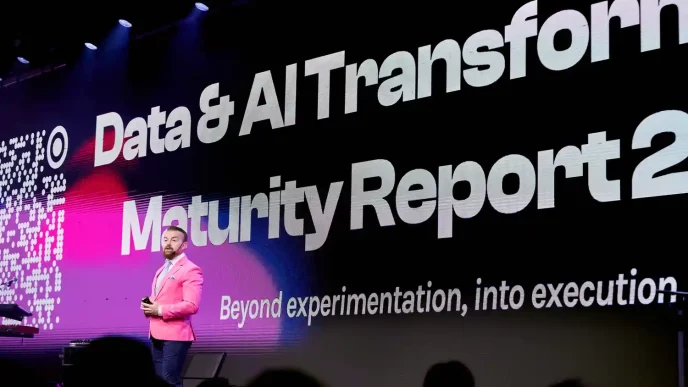
At the 2025 edition of the Data 2030 Summit, in her presentation, Eeva Randén, Data Governance Lead at the Finnish Savings Bank Group, in her talk From Complexity to Clarity – People-First Data and AI Governance shared how stepping away from rigid, process-centric models helped her organization navigate complex data landscapes and build a sustainable data culture.
Takeaways from the presentation for Building People-First Governance
- Governance is a human challenge, not a process problem: Programs flatline when frameworks become the end goal. Always ask “Who is this for?” before deciding “What” to build.
- Ownership requires clear visibility: One cannot expect people to take responsibility for data quality, risk, or compliance if they cannot see what they own.
- AI governance uses the same core foundations: Avoid complex, standalone frameworks or tool setups. Apply clear ownership, visibility, and risk management directly to AI.
- Reuse existing workflows instead of creating new ones: Embed data and AI priorities into current risk, privacy, compliance, vendor management, and cybersecurity processes.
What is the Finnish Savings Bank Group?
To understand Randén’s challenge, it helps to understand the operational environment. The Finnish Savings Bank Group (Säästöpankkiryhmä) is Finland’s oldest banking group, backed by a 200+ year tradition of serving communities and supporting customer financial well-being.
Operating as a cooperative amalgamation of 14 independent local banks with nearly 100 branches across Finland, the organization combines a deeply distributed business with a lean operational model. Despite running a complex financial institution, the group relies on a relatively small team to manage its core operations.
In a high-stakes banking setting where strategic goals include being the “best place to work for top professionals”, any request made to employees regarding data management must deliver clear, immediate value rather than additional administrative overhead.
The Trap of Process-First Governance
Reflecting on past governance implementations, Randén notices a common issue: teams often turn processes and frameworks into the end goal. While checklists were completed and policies were created, the programs felt dependent on artificial life support. The moment workshops ended or leadership attention shifted elsewhere, the initiative threatened to flatline. 
“It felt like we were giving CPR to our data governance program rather than building something that could live and breathe on its own” stated Eeva Randén during her session.
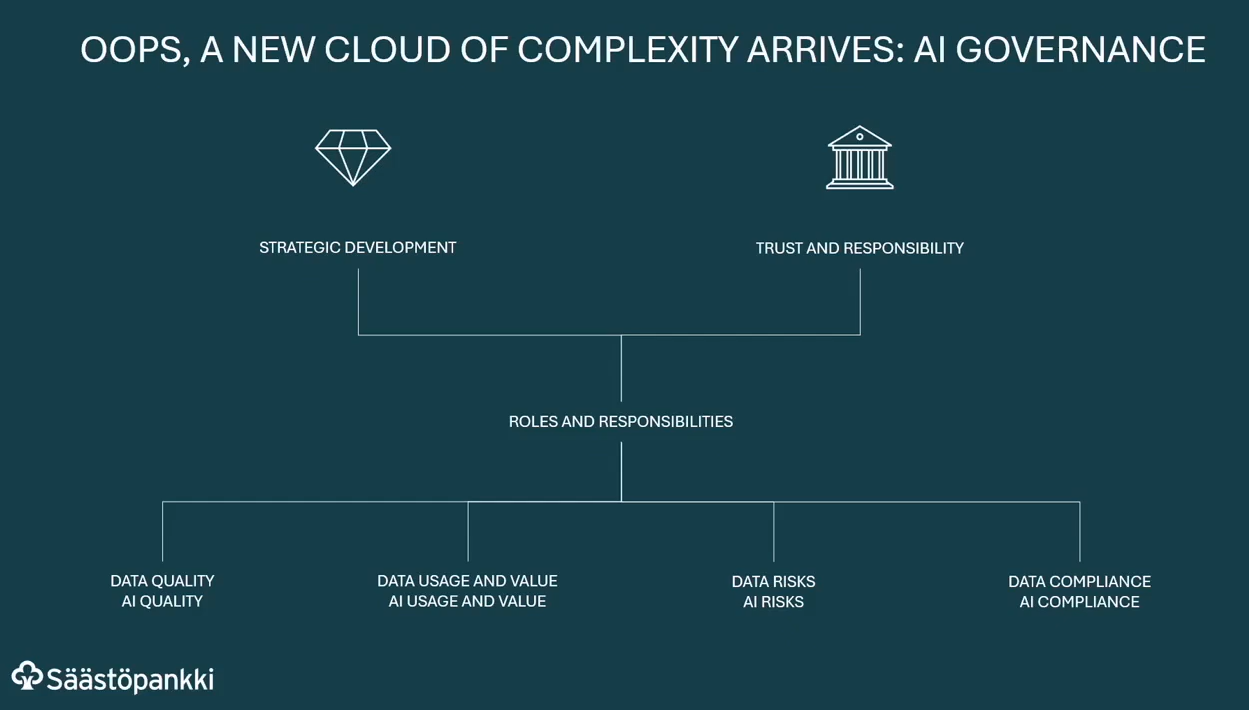
This fundamental disconnect stems from treating data governance as a technical or procedural challenge rather than a human one. Organizations routinely ask “what” needs to be done and “how” to execute it, while completely overlooking the essential starting point: Who is this actually for?
Starting with “Who”: Establishing Ownership Through Visibility
Shift the starting point to the people involved focusing on who works behind the datasets, who experiences the daily friction of poor data quality, and who gains tangible value when data is managed effectively.
When it is shifted to a people-first mindset, as she highlights, accountability follows:
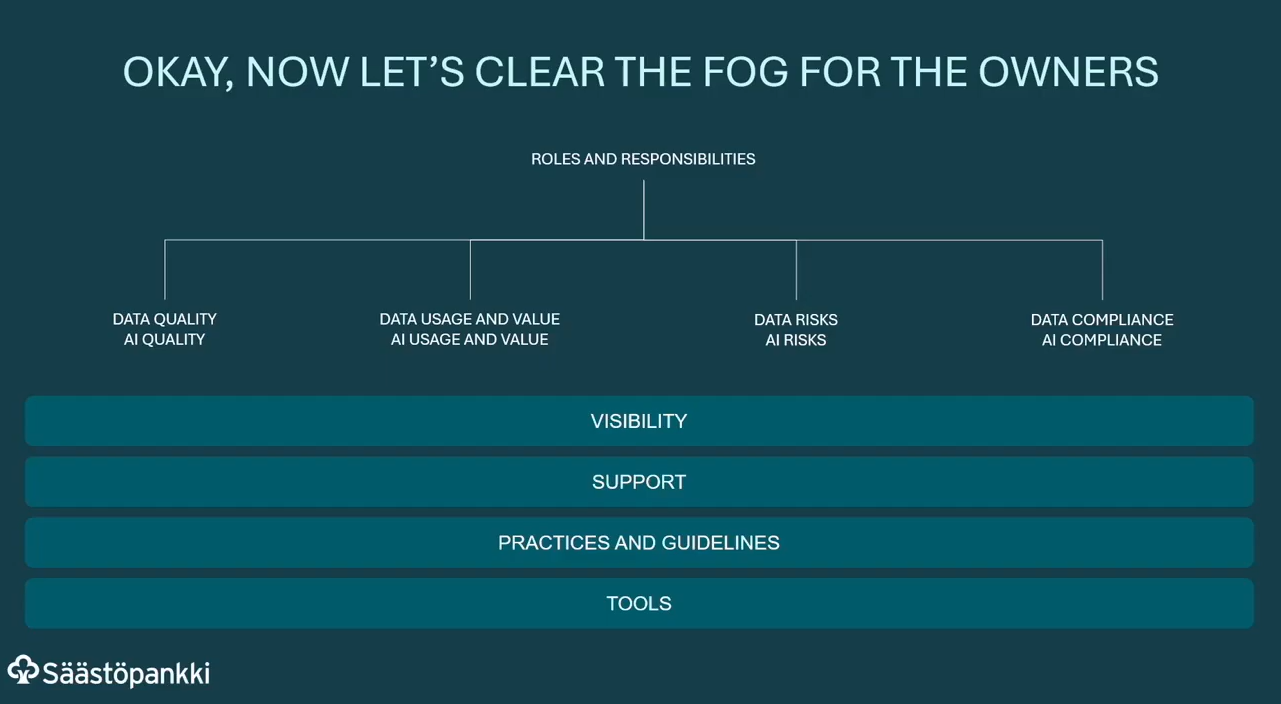
Ownership means nothing without visibility.
Data owners cannot manage quality, evaluate risks, or ensure regulatory compliance if they cannot clearly see what they own. Establishing manageable, transparent boundaries, whether that being through data domains, glossary terms, report inventories, or data products, provides the concrete foundation necessary for true accountability.
Extending the Principles to AI Governance
As AI tools expand across industries, organizations face mixed messaging: adapt immediately or risk obsolescence, but proceed cautiously due to governance demands? Feeds are saturated with frameworks and technology platforms promising instant compliance, but tools alone cannot solve organizational governance.
Rather than introducing overly complex, standalone framework layers, the core principles of effective data governance apply directly to AI governance:
- Clear Ownership: Identify who holds accountability for AI solutions and the data they consume or generate.
- Operational Visibility: Track model performance, output quality, and business value.
- Risk Management: Maintain regulatory compliance, evaluate risks, and safeguard customer trust.
Starting with existing operational structures avoids unnecessary complexity. By integrating data and AI priorities into current workflows across privacy, risk, compliance, cybersecurity, vendor management, and procurement, organizations can establish practical oversight without designing redundant processes from scratch.
Building Together in Incremental Steps
One of the conclusions from this presentation suggests that sustainable governance relies on continuous support rather than upfront perfection. Starting with the simplest possible mechanisms to offer visibility allows governance models to evolve alongside user needs.
By starting with people, adoption becomes the foundation of the governance model rather than an elusive end goal. Data leads and stewards don’t have to carry the burden in isolation and actually can build the model side by side with the teams who use it every day.
The Full Presentation from the Data 2030 Summit
This overview highlights only a portion of the shared insights. The full video presentation from the 2025 edition of the Data 2030 event is available for members, including real-world feedback from data owners, strategy integration methods, and practical operational steps.
Participate in these discussions live.
Join industry leaders, CDOs, and enterprise architects at the Data 2030 Summit in Stockholm, Sweden, taking place October 21 – October 22. Connect with peers, exchange real-world insights, and discover scalable strategies for modern data management, governance, and AI deployment.