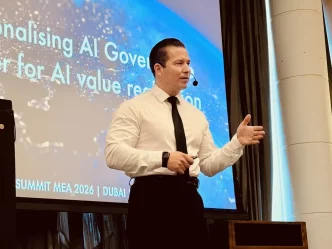
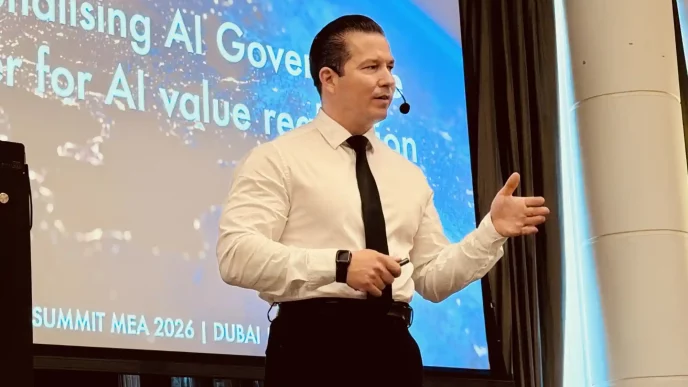
This week, we’re spotlighting Andrew Wu, Engineering Manager and ML Architect at Visa.
A developer at heart, Andrew spent years writing code for backend systems and ML pipelines before stepping into engineering leadership. Today, he leads teams driving Visa’s ML Platform and Data Science operations. In this interview, Andrew explains why he views AI leadership as construction management, why traditional ML still handles the heavy lifting in finance, and how to move models past the demo phase and safely into production.
Hyperight.com: What’s the best way to describe your job to someone outside tech?

Andrew Wu: I would describe it as being a construction manager for AI systems. The interesting idea is only one part of the job. A lot of my work is about making sure the foundations are solid: the data, the infrastructure, the monitoring, the compliance checks, and the people building it. The goal is not just to build something impressive, but to make sure it can run safely and reliably in the real world.
Hyperight.com: What originally sparked your interest in AI/data, and what keeps you inspired today?
Andrew Wu: I have always been interested in numbers and what you can do with them. Earlier in my career that meant moving data efficiently and building systems around it. Later it became about using data to understand user behaviors and make better decisions. I often say that data is the soul of a company. You can dress a company up with mobile apps, websites, or data products, but in the end the data it has, and how well it understands and uses that data is what really defines it. What keeps me interested now is how quickly the field is changing. Things that used to take days of manual work, like preparing or labelling data, can now be accelerated dramatically if you design the workflow well.
Hyperight.com: What is one challenge you’re trying to solve, and why does it matter?
Andrew Wu: One challenge I care a lot about is getting models out of notebooks and into production, then keeping them healthy there. In our case, the core is still traditional ML: classifiers for transaction categorization, tuned, versioned, monitored, and retrained across markets. Generative AI is useful for labelling, tooling, augmentation, and workflow support, but it is not a replacement for the production discipline around the model.
That matters because financial systems do not have much room for guesswork. If a model touches a large volume of transactions, it has to be observable, auditable, and reliable long after the first release. The less glamorous work—monitoring, retraining, governance, and clear ownership—is what makes ML useful outside a demo. 
Hyperight.com: A tool you can’t live without?
Andrew Wu: An AI Agent with memory, context, and access. The model matters, but the real value is in the setup around it: project history, codebase knowledge, sprint context, standards, and open commitments. Without that, it is just a chatbot. With the right context, it becomes part of the workflow and helps with planning, follow-ups, and the constant switching between topics.
Hyperight.com: What trend in data or AI do you think will shape the Nordic region the most?
Andrew Wu: I think AI will become a normal layer in everyday work, not a separate tool people open occasionally. The Nordic region is well suited for that because many teams already work with high trust, high autonomy, and relatively low hierarchy. When people already have agency, useful AI support can spread quickly.
For engineers, it may remove a lot of repetitive coordination work. For managers, it can help keep track of capacity, backlog, risks, and commitments. For product people, it can make early prototyping and validation much easier. But I still think traditional ML will do the heavy lifting where precision and reliability matter, while generative AI improves how people work around those systems.
Hyperight.com: What’s one piece of advice you’d give to others entering the data and AI field?
Andrew Wu: For people entering the data and AI field, my advice is not to focus only on the model. Whether you use AI for coding, writing, planning, operations, or production workflows, the real value usually comes from context and memory. A generic model does not know your codebase, your standards, your constraints, or what good output looks like in your domain. You have to shape that context over time. Once you do, the system becomes useful for real work, not just demos. The people who benefit most will be the ones who learn how to build that context early.