
Artificial intelligence has crossed the threshold from speculative innovation to enterprise core. Across every sector, organizations are rushing to integrate large language models, build retrieval-augmented generation (RAG) pipelines, and deploy autonomous agents. But despite massive investments, a recurring bottleneck remains: most enterprises struggle to move AI out of the sandbox and into scalable, reliable production.
The primary friction it’s the data powering them, not the AI models themselves.
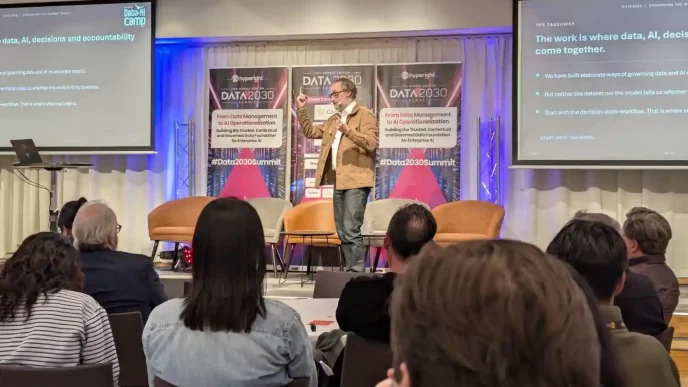
In his insightful Data 2030 Summit keynote, How Data Governance Leaders Become AI Governance Leaders, Wouter Mertens, Field CTO and former Product Manager for AI Governance at Collibra, unpacked why the key to unlocking rapid, safe, and high-impact AI value lies in leveraging an asset many enterprises already possess: a mature data governance foundation.
The Misalignment Gap in AI Deployment
When organizations struggle with AI adoption, it is rarely a technical failure of the algorithm. Instead, it stems from organizational and data-level misalignment.
Deploying AI introduces competing pressures across three critical personas:
- The Head of AI: Driven by time-to-market, seeking fast deployment, continuous innovation, and immediate ROI.
- The Data Governance Team: Focused on data quality, lineage, regulatory compliance, and ethical standards.
- The Risk & Security Officer (GRC): Concerned with data leakage, unauthorized access, dynamic drift, and broader enterprise risk.
When these stakeholders communicate ad hoc, AI initiatives stall. Market pressure demands speed, but without a unified framework, teams default to slowing down innovation or bypassing governance entirely, exposing the enterprise to severe risk. 
Data Governance: The Engine of AI Velocity
A common misconception is that AI governance requires an entirely new discipline, complete with newly invented roles, workflows, and complex gatekeeping protocols. In reality, AI governance is simply a natural extension of robust data governance.
To accelerate AI initiatives without sacrificing control, forward-thinking organizations are operationalizing three strategic shifts:
1. Extending the Data Governance Mindset
AI systems are ultimately advanced consumers of data. The practices established for managing data products including ensuring data quality, tracking provenance, and defining ownership, apply directly to AI pipelines. When teams treat AI as an extension of their existing data fabric, they eliminate the need to start from scratch.
2. Reusing Existing Roles and Workflows
Inventing bespoke approval processes for every new AI use case creates organizational friction. By adapting existing data stewardship models, access control frameworks, and change-management workflows, enterprises can evaluate AI risk faster. Data stewards already understand where high-value, highly sensitive data resides: their expertise is vital for training models safely.
3. Moving from Static Gates to Platform Infrastructure
Legacy governance relied on manual checks, static policy documents, and spreadsheet tracking. Modern AI governance demands an infrastructure-first platform approach. Through automated data lineage, teams can visually trace how internal data connects to specific models or RAG architectures. This real-time visibility provides immediate answers regarding data origin, access rights, and security compliance, giving developers the confidence to push to production faster.
Beyond Model Governance
While model evaluation and drift monitoring are necessary, the vast majority of enterprise AI risks stem from the underlying data. Large language models are increasingly standardized and the real differentiator and the primary vector for risk is the quality, context, and security of the enterprise data fed into them.
Establishing active, platform-driven data governance ensures that as autonomous agents and complex AI workflows proliferate across the business, the underlying data remains trusted, secure, and fully auditable.
Uncover the Full Blueprint at Data 2030 Summit
Understanding the strategic overlap between data and AI governance is just the beginning. To explore the deep operational strategies, real-world architecture examples, and full presentation insights on transforming your data governance into an AI accelerator, watch the full video of this presentation.
The momentum behind data and AI transformation is only accelerating, making continuous learning and cross-industry alignment essential for modern technology leaders. The upcoming Data 2030 Summit provides the ideal stage to transition these strategic insights into enterprise practice. Connect with global field CTOs, CDOs, and leading data strategists for hands-on technical sessions designed to sharpen your governance roadmap against industry benchmarks. Reserve your ticket for the Data 2030 Summit today to gain the actionable frameworks needed to build a trusted, scalable foundation for the next era of AI innovation.