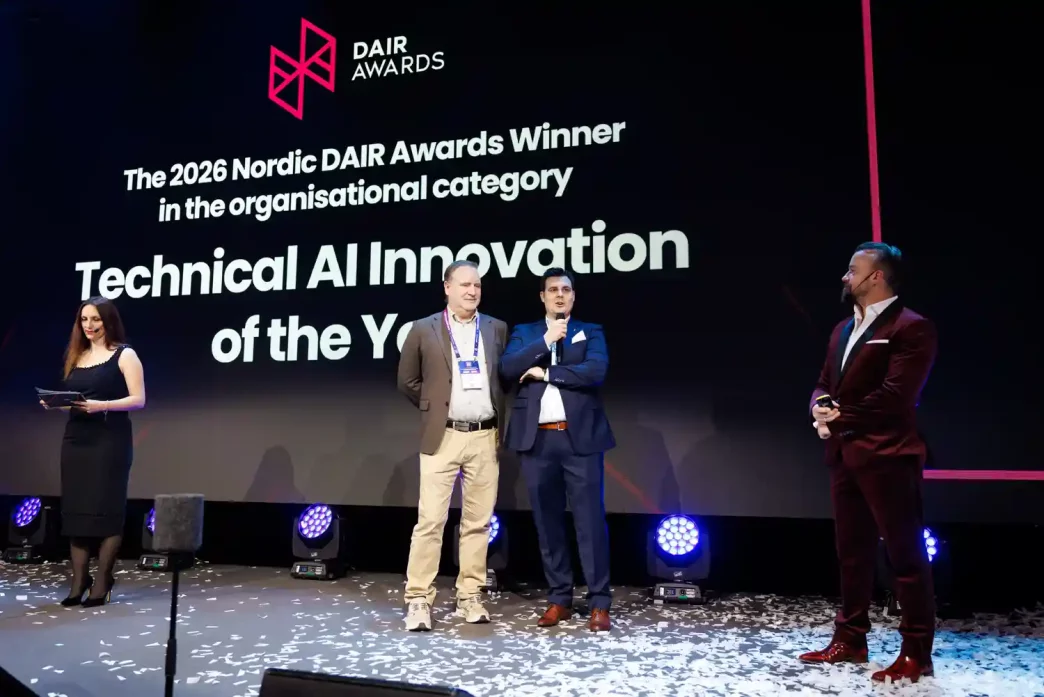
In a field stacked with exceptional talent, competition was fierce at this year’s Nordic DAIR (Data & AI Readiness) Awards at the Data Innovation Summit. Standing alongside an impressive lineup of nominees, including industry leaders like Frende Forsikring, CCP Games, Nextory AB, Ørsted, Boliden and Nordea, every contender brought something remarkable to the table. Ultimately, however, it was Saab AB that distinguished themselves, walking away with the Technical AI Innovation of the Year.
The Innovation
Most organisations talk about AI readiness. Saab has built AI into a fighter aircraft.
Gripen is not a platform with AI bolted on as a future aspiration. It is an operational combat aircraft with AI running at the core of its mission systems today. That distinction matters enormously. Moving AI from controlled research environments into a safety-critical, real-time airborne system, one where the consequences of failure are absolute, requires a fundamentally different standard of rigour, architecture, and design philosophy. Saab has met that standard, and in doing so has created one of the most advanced and credible AI implementations in any safety-critical system anywhere in the world.
At the heart of the Gripen AI framework is a sensor fusion and decision-support pipeline of exceptional sophistication. The system continuously ingests data from radar, electronic warfare suites, electro-optical and infrared sensors, datalinks, and the wider battlespace network, synthesising this into a single, highly curated tactical picture in real time. Machine-learning-based classification, probabilistic reasoning, and rule-based tactical logic operate in combination to identify and prioritise threats, propose manoeuvre options, recommend weapon employment, and dynamically re-plan as situations evolve. All of this happens within the stringent timing and determinism constraints of air combat, on certified airborne computing hardware. This is not a proof of concept. It is a working system delivering measurable results.
What makes Saab’s approach genuinely distinctive is the deliberate choice to combine data-driven AI with explainable, deterministic logic and human-centred design. The Gripen AI does not attempt to replace the pilot. It acts as a cognitive partner: absorbing information overload, surfacing the most relevant insight, proposing courses of action with clear rationale, and keeping the human in authoritative control of every consequential decision. This is responsible AI in the most demanding sense of the term, not as a compliance posture, but as an operational necessity. A pilot who does not understand or trust what the AI is telling them will not act on it. Saab’s human-machine interaction design is built around that reality. 
The Technical Description
The technical architecture reflects the same clarity of thinking. A modular design separates perception, reasoning, and interaction layers, allowing different AI techniques, including machine learning, heuristic methods, and optimisation algorithms, to be composed, tested, and verified. This hybrid model is not a compromise; it is the architecture that makes real-world deployment possible. Upgrades and new AI capabilities can be introduced in service without re-architecting the underlying system, giving Gripen a genuine capacity to evolve throughout its operational lifecycle.
The impact is already visible. In evaluation and exercise scenarios, pilots report significantly reduced cognitive load and improved situational awareness in dense, multi-domain environments. Mission effectiveness improves through faster, higher-quality decisions, more efficient use of weapons and sensors, and better coordination with other assets. Crucially, the same AI building blocks that operate in the live aircraft are reused in ground-based mission support systems and high-fidelity simulation environments. This creates a continuous learning loop across training, development, and live test operations, compressing the cycle between operational insight and capability improvement.
By taking AI all the way from research into a certified, operational fighter aircraft, Saab has done something that very few organisations in the world have achieved. And because the underlying framework is modular, scalable, and platform-agnostic, Gripen represents more than a combat aircraft. It is a reference implementation for how AI can be responsibly, rigorously, and progressively embedded into safety-critical systems across air, land, and sea domains. That is the standard Saab is setting, and it is one that the broader data and AI community should know about.
About the Award
The award recognizes a company, startup, or enterprise that has introduced a technically novel AI innovation, such as a new model, framework, or process, that has influenced the broader industry. This award honors breakthroughs in AI development that have moved from experimentation to recognized standard practice, significantly shaping how organizations build or apply AI today. The winning innovation should demonstrate originality, scalability, and proven adoption or influence, setting a new benchmark for technical excellence in AI.
You can watch the full ceremony here:
To see more videos from the 11th edition of the Data Innovation Summit, head to the Hyperight’s YouTube channel.