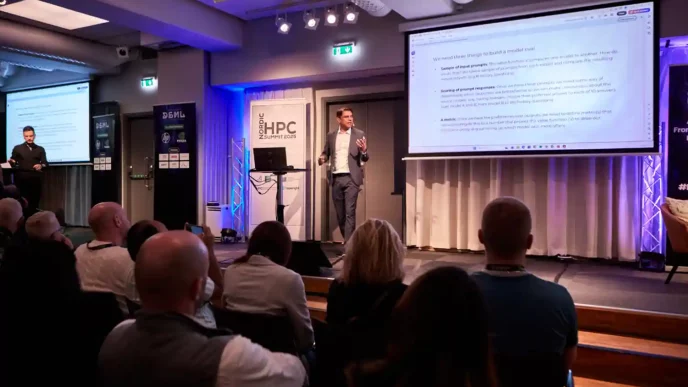

The promise of Artificial Intelligence has often been met with a paradox. In sectors like information services, adoption is rampant; yet, in the “high-stakes” worlds of Oil & Gas and Pharmaceuticals, the climb is steeper. At the previous edition of Data Innovation Summit in Stockholm, a compelling session titled “Vision Unveiled: Driving Adoption with Explainable AI” explored why these industries are lagging and how a shift toward transparency is about to trigger a multi-billion dollar revolution.
The future of industrial AI is more than just about better algorithms but it is about building a foundation of trust.
Why Some Industries Lag
While we often hear about the omnipresence of AI, the reality on the ground is more nuanced. Data presented during the summit revealed a stark contrast in “AI use intensity”. Ishita Ghosh from Walmart USA explains that while manufacturing and healthcare are beginning to hit their stride, the Oil & Gas sector has historically been slower to integrate these technologies.
However, the tide is turning. The previous year, Ishita Ghosh, shared the projection that the global market for AI in Oil & Gas is projected to surge from $2.88 billion in 2023 to over $5.1 billion by 2028. Similarly, the AI pharma market is expected to skyrocket to a staggering $14.5 billion by 2032. The catalyst for this growth is a move away from “black box” models toward specific, vision-based applications that solve real-world safety and efficiency problems.
Computer Vision: From Safety to Discovery
The session highlighted how Computer Vision (CV) is moving beyond simple image recognition into complex, life-saving industrial roles.
- In Oil & Gas: The focus is shifting to autonomous safety measures. From PPE detection and fire/smoke monitoring to “danger zone alerts,” CV acts as an ever-watchful eye. By replacing traditional, manual sensors with real-time visual intelligence, companies are mitigating extreme pressure hazards and structural health risks that were previously difficult to monitor.
- In Pharmaceuticals: The traditional “trial and error” method of drug discovery is notoriously expensive and time-consuming. The session explored the cutting-edge world of 3D Computer Vision, where AI analyzes microscopic structures and molecular point clouds. This technology allows researchers to visualize how molecules bond and rotate in a 3D space, dramatically increasing the efficacy of drug formulations before they ever reach a lab bench.
The “Black Box” Barrier
If the technology is so potent, what is holding these giants back? The speaker pointed to a quote by Stephen Hawking regarding the risks of AI, but pivoted to a more immediate, practical concern: the lack of transparency. 
In highly regulated industries, you cannot simply “trust the machine.” High costs, security concerns, and a heavy reliance on third-party integrations create a dependency that many enterprises find risky. When a model operates as a black box stakeholder buy-in vanishes. To bridge this gap, the industry requires Critical Thinking at the design phase and a move toward Explainable AI (XAI).
The Future is Explainable
The presentation was centered on the “Explainable AI for All” framework. This isn’t just a technical requirement; it is a business imperative. The session outlined several pillars for the next generation of AI deployment:
- Quantifiable Metrics: Linking AI outcomes directly to business growth and revenue.
- Domain-Specific Language: AI that doesn’t just give a “yes/no” answer but explains its reasoning using the terminology of pharmaceutical scientists or petroleum engineers.
- Sensitivity Analysis: Understanding which features carry the most weight in an outcome.
As generative and agentic AI models (like DeepSeek or Claude) continue to evolve, their ability to provide “layman’s reasoning” for complex decisions will be the ultimate driver of adoption.
Unlock the Full Vision
How exactly does 3D CT scan data convert into point clouds for drug efficacy? What are the five specific safety use cases that are currently transforming oil field production? And how can your organization implement the “guardrails for AI ethics” discussed on the Stockholm stage?
The brief overview above only scratches the surface of the deep technical and strategic insights shared during this session. To stay ahead of the curve in industrial AI, you need to see the data, the charts, and the full breakdown of the evolutionary AI roadmap.
Become a Hyperight Member today. By joining our community, you gain exclusive access to the full video recording of “Vision Unveiled: Driving Adoption with Explainable AI”, along with an extensive library of keynote sessions from the world’s leading data practitioners.
Subscribeto Watch the Full Session.
Interested to see more? Join the 11th edition of Data Innovation Summit in Stockholm, Sweden (In-person & Online) from 6–8 May 2026 where the focus will be Applied AI, Data Engineering, Physical AI, and Generative AI for Enterprise.