
Data architecture inherently governs organizational behavior, decision velocity, and AI success far more than policy charters. Centralized bottlenecks and fragmented silos create decision deadlock and unreliable AI. To build an agile, AI-ready enterprise, leaders can transition from accidental governance to intentional design by adopting domain-driven Data Mesh frameworks, enforcing automated data contracts, treating data as products, and embedding compliance directly into the platform layer.
Key Concepts Defined
- Data Architecture: The structural blueprint defining how an enterprise collects, integrates, stores, and routes its data assets.
- AI Governance Engine: The programmatic system of automated data contracts, permission boundaries, and lineage protocols embedded directly within data pipelines to ensure compliance, security, and quality.
When leadership teams evaluate organizational power, they look at corporate org charts, reporting lines, and governance charters. In modern data-driven enterprises, these structures are often secondary. The real governor of an organization or better yet, the engine that dictates decision velocity, innovation speed, and AI readiness is the data architecture. Architecture governs behavior whether you intend it or not.
When data systems are central, restrictive, or fragmented, human behavior adapts to those constraints. As organizations scale up their investments in Artificial Intelligence, this invisible dynamic becomes an urgent strategic bottleneck. To build an agile, AI-first enterprise, leaders can focus on recognizing that data architecture is the underlying framework of enterprise power.
The Invisible Governor: How Technical Design Dictates Behavior
In physical spaces, architecture dictates human movement. A building with a single central atrium encourages interaction, while a facility with isolated corridors keeps teams compartmentalized. Data architecture functions the same way within the digital realm.
In the traditional monolithic data platform, when an enterprise aggregates all data into a single, tightly controlled repository managed by a central team, it inadvertently creates a centralized decision monopoly. Business units seeking customized insights must submit requests, join long queues, and wait weeks for analytical delivery. 
This layout imposes a policy: Wait for permission and minimize independent experimentation.
Conversely, when data platforms don’t have any plans or have uncoordinated fragmentation, departments end up creating isolated shadow IT systems. In this case, the architecture imposes a different set of unwritten rules: Trust only local data, treat other business units with skepticism, and optimize for local metrics rather than enterprise goals.
As noted in The Gap Between AI Strategy and Organizational Reality, when an organization fails to align its technical design with its operational goals, an enterprise “Decision Deadlock” occurs. The organizational reality remains anchored in legacy hierarchies designed to preserve control, while executive strategies demand speed and agility.
AI as the Ultimate Amplifier of Architectural Power
If data architecture acts as the silent governor of human behavior, Artificial Intelligence acts as its ultimate multiplier.
Organizations globally are rushing to deploy Large Language Models (LLMs), predictive analytics engines, and autonomous agentic workflows. However, an AI model cannot go beyond the structural parameters of the data environment it operates within. An AI model is trapped by the boundaries and quality of the given data. It cannot figure out things it was never given the data to understand.
- Fragmented Architectures Breed Unreliable AI: When enterprise data definitions are conflicting and siloed across departments, AI agents synthesize disparate inputs into plausible yet inaccurate outputs. The intelligence layer fails because the architecture beneath it lacks shared semantic clarity.
- Centralized Bottlenecks Stifle AI Deployment: If every AI use case requires manual approval and custom pipeline engineering from a central data team, innovation stalls. The governance process inflates precisely because the underlying architecture lacks structural guardrails.
Many enterprises attempt to solve these issues by establishing AI Governance Committees. But governance charters written on paper rarely override systemic technical barriers. When authority is missing from the system level, organizations tend to overcompensate with bureaucracy. Real AI governance does not live in policy PDFs and it is programmed directly into data lineages and automated validation contracts.
Shifting Power Paradigms via Data Mesh
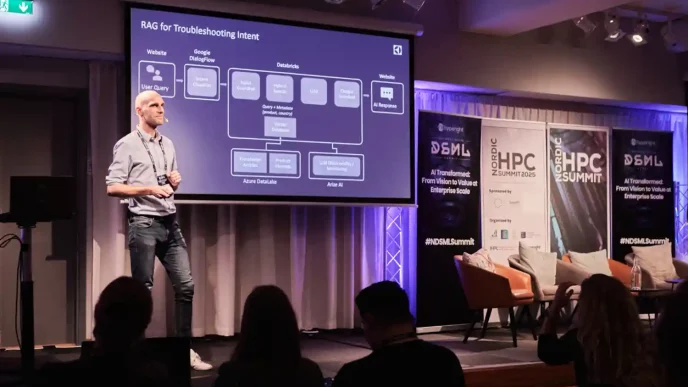
The shift from centralized bottlenecks to intentional governance is demonstrated by organizations adopting domain-driven data platforms. One example is with Data Mesh in Defence: From Data Silos to Mission Advantage form Saab where they illustrate how structural architectural changes alter operational capability.
In high-stakes environments, traditional centralized data warehouses create critical latency. By transitioning to a Data Mesh architecture, data ownership is decentralized and distributed directly to the domain experts who create and understand the data.
When domain teams manage data as a standardized product, equipped with clear automated contracts and interoperable schemas, the distribution of power changes fundamentally:
- Domain Autonomy: Teams obtain the authority and infrastructure to build, publish, and iterate on their data products without requesting central IT intervention.
- Federated Governance: Global compliance, security, and quality rules are automated at the platform layer rather than enforced via manual approval gates.
- Cross-Functional Velocity: Consumers across the organization can discover and use reliable data assets on demand, accelerating analytical and AI initiatives.
By redesigning the architecture, the organization shifts from passive reliance on central teams to active, domain-led innovation.
Building Architecture with Purpose
If data architecture governs behavior, data leaders are responsible for ensuring that governance is intentional rather than accidental. Shifting toward intentional data architecture requires three foundational changes:
1. Implement Data Contracts as Operational Agreements
Rather than relying on vague expectations, data producers and consumers should establish explicit, code-based data contracts. These contracts define schema standards, uptime expectations, and security protocols automatically, preventing broken downstream pipelines and enforcing governance at the point of ingestion.
2. Shift from “Data Assets” to “Data Products”
Treating data as a static asset results in forgotten databases and ambiguous ownership. Packaging data as an enterprise product with clear SLAs (Service-Level Agreements), documentation, and automated lineage, ensures business units take active accountability for the information they generate.
3. Embed Governance directly into the Platform Layer
Governance should not feel like a roadblock and it should function like the guardrails on a highway. By embedding security policies, access controls, and automated validation tools directly into the developer portal, compliance becomes an automated feature of everyday workflow rather than a manual audit process.
The Strategic Imperative
Organizations often believe they are designing tech stacks purely to meet IT functional requirements. In reality, every data pipeline created, every permission wall that is built, and every database schema deployed is actively shaping how employees collaborate, make decisions, and execute strategy.
As generative models and autonomous agents integrate deeper into enterprise operations, the stakes will continue to rise. An organization running on fragmented, centralized, or ill-defined data architecture will inevitably produce fragmented, delayed, and compromised AI outcomes.
To lead effectively in the AI era, executives should think about a fundamental question: Does our current data architecture empower the behaviors we need, or is it quietly enforcing the very constraints we are trying to overcome?