Is synthetic data a perfect privacy solution or a dangerous digital mirage? Sociology Professor Ericka Johnson deconstructs the sociotechnical illusions of generated data and shares her framework for a more traceable, honest, and auditable approach to AI.

Synthetic data is often sold as the “clean” alternative to messy human datasets-a way to bypass privacy hurdles and bias in one go. But for Ericka Johnson, a Sociology Professor at Linköping University and CSO of Fair AI Data, the reality is far more haunting.
As the Director of the Swedish national graduate school for WASP-HS, Ericka doesn’t just look at the code; she looks at the cultural fallout. She says that what first drew her to synthetic tabular data was fear. During a research project where she generated synthetic data, she found some strange results: while some important data disappeared as expected, other deeper glitches were occurring, too. This intrigued her, and the more she studied it, the more she realized that synthetic data is a powerful tool that can go very wrong, very fast.
Ahead of her session at the Data Innovation Summit, we sat down with Ericka to discuss her research on how synthetic data is used, understood, and potentially misunderstood.
For those less familiar, how would you explain synthetic tabular data in simple terms, and how is it typically used today?

Ericka Johnson: Synthetic tabular data is, at its core, fabricated data that mimics real data. Imagine you have a spreadsheet full of customer records – ages, purchase history, income levels. Synthetic tabular data is a brand new spreadsheet where every single row is made up, but the patterns, the relationships, the statistical behavior – it all looks and acts like the real thing. No real person is in there, but the data behaves as if they were.

Today we see it everywhere – banks use it to train fraud detection models without exposing real account holders, hospitals simulate patient populations without touching anyone’s medical records, retailers forecast demand without leaking proprietary sales data. It’s become the go-to solution whenever teams need more data and safer data. It’s essentially a privacy-preserving mirror of reality – which is exactly what makes it powerful, and also what makes it dangerous.
Why has synthetic data become so important in modern AI and data science workflows?
Ericka Johnson: Firstly, there is a big appetite for data today – modern models need enormous volumes of diverse, labelled data that simply don’t exist in the wild. Secondly, regulation – GDPR, ethics regulation – make real personal data harder to use legally. Third, bias awareness – teams are starting to ask whose data they were using and what/who is excluded – and want to balance the training data they are using. Synthetic data addresses all three: it’s infinitely scalable, theoretically more privacy-compliant than real data, and can balance and correct representation gaps. At least in theory.
In your session at the upcoming Data Innovation Summit, you challenge the idea that synthetic data is just “more data” and argue that it actually reshapes reality-can you explain what you mean by that and why it matters?
Ericka Johnson: This is the argument I care most about getting right. When you generate synthetic data, you are not copying reality – you are encoding a model of reality. Every generator makes assumptions: about which variables matter, which correlations are preserved, which distributions are “normal.” Those assumptions become the new ground truth for everything trained downstream. That is a fundamental reshaping of reality, and it matters enormously because the people impacted by those algorithms often have no way to trace the problem back to its synthetic origin.
What are the worst-case scenarios if synthetic data is poorly generated or misunderstood?
Ericka Johnson: I’ll give you a concrete scenario: a hiring algorithm trained on synthetic employee data that perfectly replicated the statistical patterns of a historically male-dominated company. It passed every benchmark. It got deployed. And it systematically disadvantaged women – not because anyone intended to, but because the synthetic generator predictably amplified the majority element in the data (male employees) and minimized the minority elements. This data not only faithfully preserved a structural inequality no one thought to audit, it actually amplified it. In credit scoring, synthetic training data that over-represents certain zip codes can redline entire communities. And perhaps most insidiously – if synthetic data enters training pipelines without clear documentation, future teams will have no way of knowing what version of ‘reality’ their model actually trained on.
How can teams prevent these risks-what should they be doing differently when generating, evaluating, and documenting synthetic data?
Ericka Johnson: I promote analysed, curated and well documented synthetic data. It has four parts. First, provenance transparency: document exactly what real data the generator was trained on, including its known gaps and biases (DIS participants probably recognize the tradition of data sheets for data sets here. It is also important for synthetic data). Second, distribution auditing: don’t just check statistical fidelity – check demographic and subgroup representation explicitly – and yes, this is important for all tabular data, not just population data. Third, downstream labelling: any model or dataset that touched synthetic data must say so, permanently, in its documentation. Fourth, testing for representation, not just utility: before deployment, actively try to find where the synthetic distribution diverges from reality – especially in edge cases and underrepresented groups. The goal isn’t perfection. The goal is traceable, auditable, honest data science. This is why I started Fair AI Data, to make a platform that does exactly this, helps organizations detect and correct datasets – through automated analysis, intersectional auditing, and standardized documentation tools.
Based on your work so far, what have been your biggest learnings, and what do you think the industry still gets wrong about synthetic data?
Ericka Johnson: What the industry still gets wrong is treating synthetic data as a technical problem with a technical solution. It’s not. It’s a sociotechnical problem. The question of what a “realistic” distribution looks like is never neutral – it always reflects choices about whose reality we’re modeling. Until data scientists start asking those questions as rigorously to their synthetic data as they ask about model accuracy, analyzing and documenting the synthetic data as well, we will keep building systems that are statistically impressive and humanly harmful.
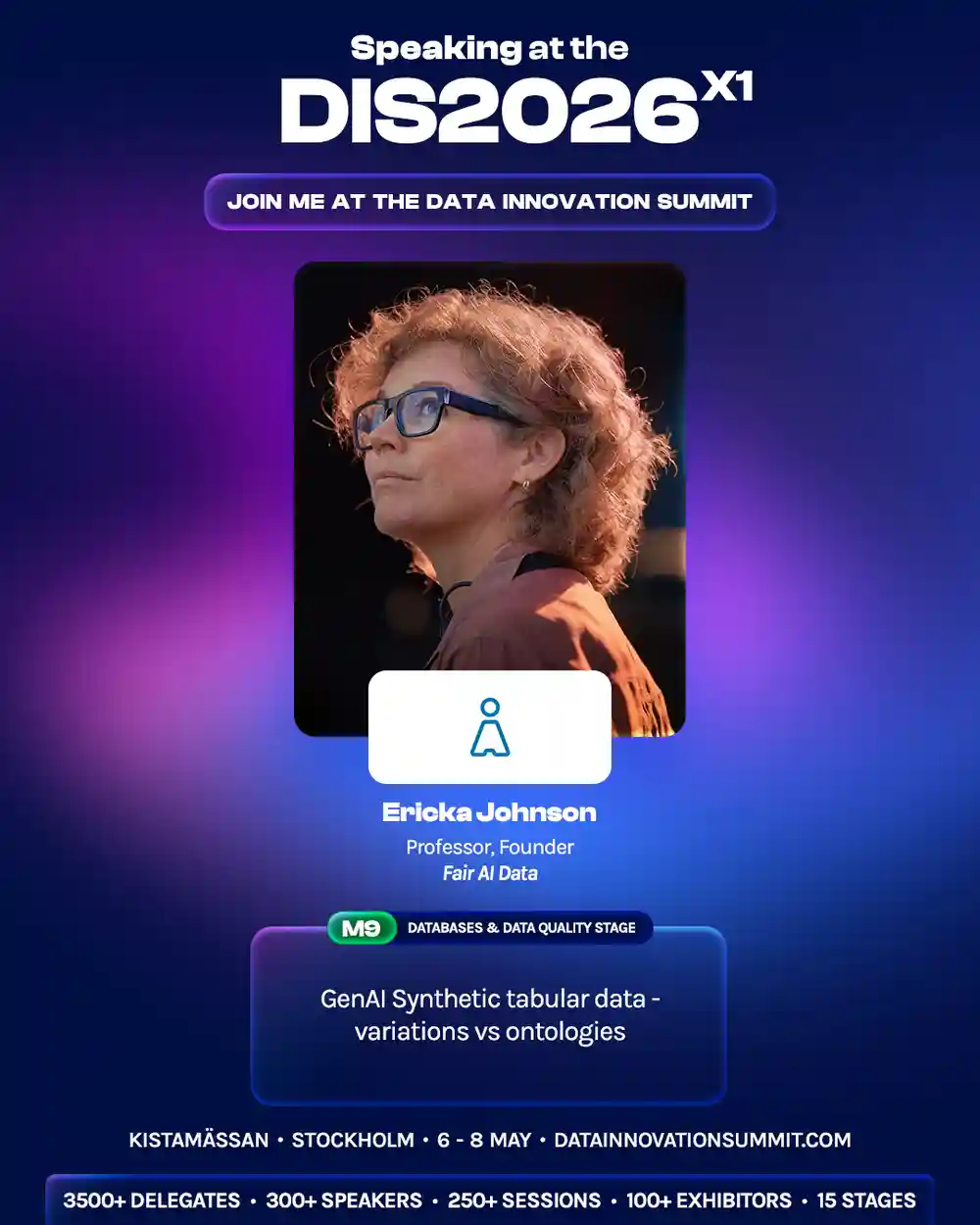
Don’t miss the chance to hear from Ericka Johnson live as she deconstructs the “sociotechnical” illusions of synthetic datasets. Join her session at the Data Innovation Summit to learn how to move beyond mere statistical fidelity toward a more traceable, honest, and auditable approach to data science.