

What the Last Year Really Taught Us, and Why 2026 Will Be About Depth, Not Hype
By the end of 2025, it had become difficult to talk about artificial intelligence without sounding either euphoric or exhausted. The early shockwaves of generative AI had settled into something more complex and, in many ways, more honest. For enterprise leaders, the year did not feel like a sequence of spectacular breakthroughs. It felt like work.
Episode 173 of the AI After Work (AIAW) Podcast captured this moment with unusual clarity. Rather than chasing the next headline, the conversation circled around a quieter but more consequential shift: AI is moving from spectacle to infrastructure. The most important changes in 2025 were not always visible in benchmarks or launch events. They showed up in how teams built systems, where models failed, and what it actually took to turn capability into value.
This article reflects the discussion between Jesper Fredriksson, and Fredrik Olsson and Anders Arpteg on AI in 2025 through and looks ahead to 2026 not as a year of magic, but as a year of maturation. The central insight from the episode is simple but uncomfortable: we are far better at generating intelligence than operationalizing it. The gap between what models can do in isolation and what organizations can reliably deploy remains wide. Closing that gap will define the next phase of AI.
2025 as the Year the Narrative Changed
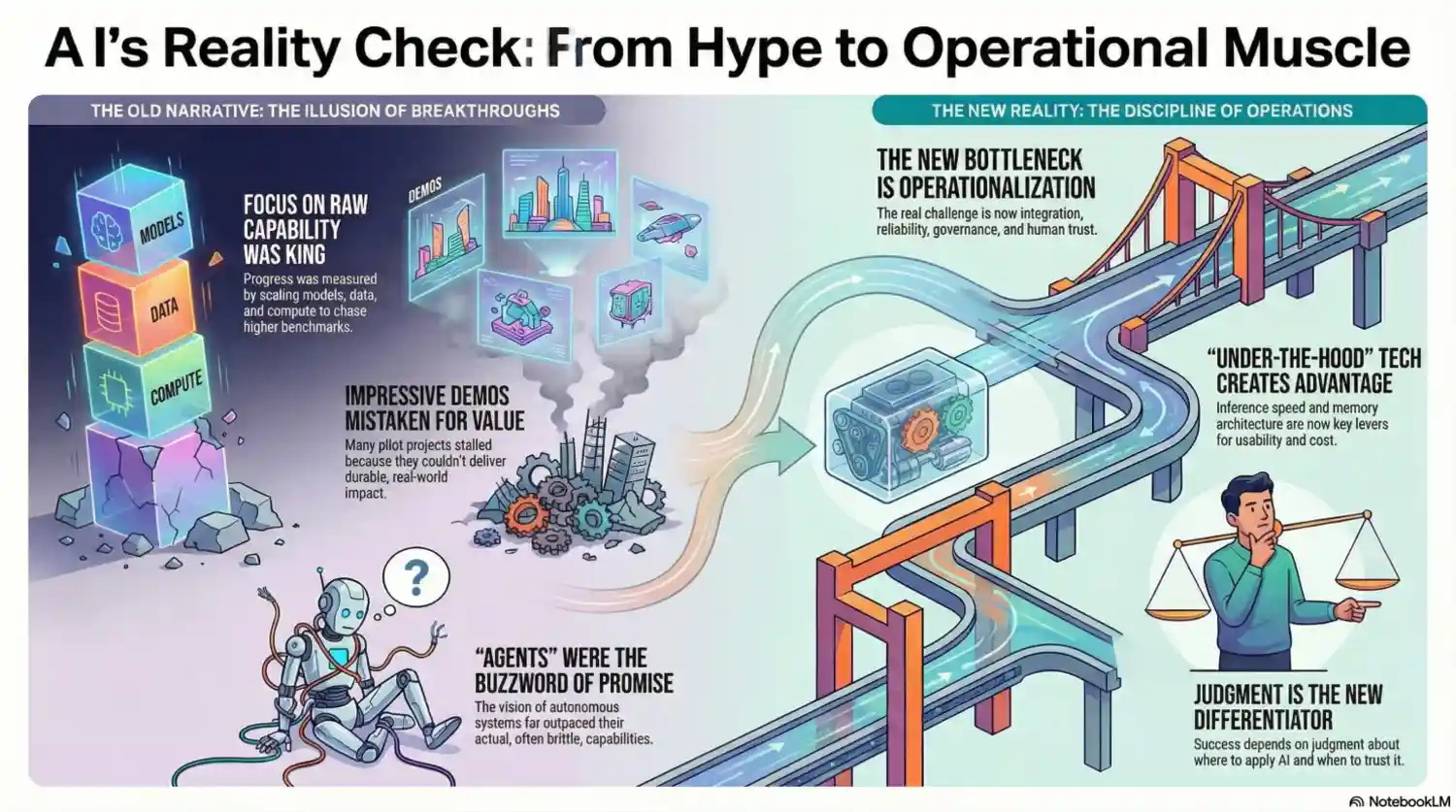
In hindsight, 2025 may be remembered less for dramatic model leaps and more for a collective recalibration. After years of exponential curves and breathless forecasts, reality asserted itself. Models improved, sometimes meaningfully, but not in ways that automatically translated into business outcomes.
Across enterprises, the same pattern repeated. Pilot projects proliferated. Demos impressed. Internal excitement surged. And yet, when asked to deliver durable impact, many initiatives stalled. This was not because the technology stopped working. It was because organizations underestimated the difficulty of turning probabilistic systems into dependable ones. 
One of the most important realizations of 2025 was that raw capability is no longer the bottleneck. Large language models are already good enough to support a wide range of tasks. What remains hard is integration: stitching models into workflows, governing their behavior, handling errors gracefully, and aligning them with human decision-making.
This is why so many conversations in the episode gravitated toward engineering discipline rather than novelty. The frontier is no longer just model training. It is orchestration, reliability, latency, evaluation, and human trust. AI has stopped being a research curiosity and started behaving like any other critical system, with all the attendant messiness.
The Plateau That Wasn’t a Plateau
A recurring theme in 2025 was the idea that AI progress was “slowing down.” Benchmarks improved incrementally. Gains felt harder won. For some, this sparked concern. For others, relief.
What became clear is that we were misreading the curve. The apparent plateau was not a limit of intelligence but a limit of scaling alone. For several years, the industry relied on larger models, more data, and more compute to drive progress. That strategy still works, but its marginal returns are diminishing. The next gains require different kinds of innovation.
The panel in Episode 173 framed this shift as a return to research depth. Instead of brute-forcing performance, labs are once again interrogating architecture, learning dynamics, memory, and reasoning. This is not a step backward. It is a sign of maturity.
Importantly, this shift also changes what enterprises should pay attention to. The most meaningful improvements in 2026 are unlikely to arrive as single headline numbers. They will arrive as compound effects: faster inference enabling new user experiences, better error handling enabling autonomy, and improved reasoning enabling longer, more complex tasks.
Why Inference Speed Quietly Became a Strategic Lever
One of the most understated but impactful developments of 2025 was the renewed focus on inference speed. At first glance, faster responses seem like a usability detail. In practice, they change everything.
When latency drops, AI systems feel less like tools and more like collaborators. Waiting breaks cognitive flow. Speed restores it. For developers, this means tighter feedback loops. For knowledge workers, it means AI becomes something you think with, not something you consult.
Inference speed also reshapes cost structures. Faster, leaner models unlock broader deployment, especially at the edge or in constrained environments. This matters far more to enterprises than another small benchmark improvement. Speed determines whether AI can be embedded everywhere or only in high-value niches.
In 2025, much of the real innovation happened below the surface: kernel optimization, model pruning, hardware-aware compilation. These are not glamorous topics, but they are the difference between prototypes and platforms. As the episode discussion suggested, this is where a significant share of competitive advantage will emerge in 2026.
Agents: Less Capable Than Advertised, More Important Than Ever
If 2025 had a buzzword, it was “agents.” And if it had a disappointment, it was also agents.
The promise was compelling: autonomous systems that plan, act, recover from errors, and operate across tools. The reality was more sobering. Outside of coding and narrowly defined workflows, agents struggled. They failed silently. They hallucinated actions. They required heavy scaffolding.
Yet dismissing agents as overhyped would be a mistake. The episode’s discussion surfaced a more nuanced truth: agents are not failing because the idea is wrong, but because autonomy is genuinely hard.
True agency requires more than tool calling. It requires judgment about when to act, when to stop, and when to ask for help. It requires robustness in the face of partial information. Most importantly, it requires systems that can recover from failure rather than collapse under it.
In 2025, we learned how far we are from that ideal. In 2026, the work will be about narrowing that gap. Progress will not come from declaring everything an agent, but from carefully expanding autonomy in domains where failure is cheap and learning is fast.
The Hidden Constraint: Memory
Few limitations frustrate users more than AI’s lack of persistent memory. Each session starts fresh. Context evaporates. Hard-won understanding disappears.
Technically, this is not an oversight. It is a consequence of how modern models are trained and deployed. Persistent memory challenges scalability, privacy, and cost. Updating weights continuously for individual users is computationally prohibitive at scale.
Yet memory remains one of the most important unsolved problems in AI. Without it, systems cannot truly learn from interaction. They cannot build long-term understanding of users, organizations, or environments.
In 2025, workarounds proliferated: retrieval systems, external stores, structured prompts. These approaches helped, but they also added complexity. What the episode hinted at, and what 2026 may deliver, are hybrid architectures where memory is no longer an afterthought but a first-class component.
The implications are profound. Memory enables continuity. Continuity enables trust. And trust is the prerequisite for autonomy.

Reasoning: Better Than Before, Still Shallow
Another theme that surfaced repeatedly was reasoning. Models in 2025 undeniably reason better than their predecessors. Chain-of-thought techniques, reinforcement learning, and task decomposition have all improved performance on complex problems.
And yet, there is a growing recognition that today’s reasoning is shallow. It often resembles pattern completion more than deliberation. Models can solve puzzles, but they struggle with sustained, multi-hour problem-solving without human intervention.
This matters because many enterprise tasks are not about clever answers. They are about endurance. Planning. Revising assumptions. Navigating ambiguity over time.
The episode drew a useful contrast with systems like AlphaGo and AlphaZero, which demonstrated deep reasoning in narrow domains. The challenge ahead is to combine that kind of structured reasoning with the broad knowledge and flexibility of language models.
If that synthesis arrives, even partially, it will reshape what we expect from AI. 2026 may not deliver human-level reasoning, but it is likely to deliver systems that can stay “on task” far longer than today’s models.
OpenAI, Google, and the End of the Illusion of a Single Winner
One of the quieter conclusions of 2025 is that the AI landscape is no longer converging on a single dominant player. Instead, it is fragmenting by capability.
Different labs are winning in different dimensions. Some excel at multimodality. Others at coding. Others at efficiency. This is not a sign of weakness. It is a sign that AI is becoming a general-purpose technology with multiple axes of excellence.
For enterprises, this means vendor strategy matters more than ever. The right model is not “the best model.” It is the model that fits the task, the cost structure, and the risk profile.
The episode underscored an important lesson: relying on a single provider is increasingly untenable. The future belongs to organizations that can evaluate, integrate, and switch models as conditions change.
What Actually Created Value in 2025
Strip away the noise, and a pattern emerges. The AI initiatives that succeeded in 2025 shared three characteristics.
- First, they were tightly scoped. Rather than aiming to transform entire organizations, they focused on specific workflows where value was measurable.
- Second, they treated AI as a system, not a feature. Model choice mattered less than data quality, monitoring, and human-in-the-loop design.
- Third, they invested in people. Teams that understood both the technology and the business context were far more effective than those chasing tools.
These lessons are unglamorous, but they are durable. They suggest that the AI advantage in 2026 will accrue not to the most adventurous organizations, but to the most disciplined ones.
2026: The Year of Deeper Capability, Not Broader Claims
Looking ahead, the most plausible prediction is not a single breakthrough, but a convergence of incremental advances that collectively change what is possible.
Inference will get faster. Memory will become more usable, if not fully solved. Agents will remain brittle, but more reliable in constrained domains. Reasoning will improve enough to extend task duration and reduce supervision.
Just as importantly, enterprises will get better at saying no. The lessons of 2025 have inoculated many organizations against hype. This creates space for more thoughtful experimentation.
In that sense, 2026 may be less exciting to watch from the outside, but far more productive from within. The work will be quieter. The gains more cumulative. And the impact more real.
The Real Shift: From Intelligence to Judgment
Perhaps the deepest insight from Episode 173 is that intelligence alone is no longer the differentiator. Judgment is.
Judgment about where to apply AI. About when to trust it. About how much autonomy to grant. About when to intervene.
AI systems are becoming powerful enough that misuse is as dangerous as underuse. The organizations that thrive in 2026 will be those that develop institutional judgment alongside technical capability.
That is not a problem technology can solve for us. It is a leadership challenge.
2025 stripped away many comforting illusions. It showed us that progress is harder than it looks, that autonomy is fragile, and that value is earned, not unlocked. At the same time, it revealed how much ground has already been gained.
The conversation in Episode 173 was not about celebrating success or lamenting failure. It was about taking the technology seriously. That, more than any model release, is the sign that AI has entered a new phase.
The next year will reward patience, depth, and craftsmanship. For those willing to do the work, 2026 holds extraordinary promise.