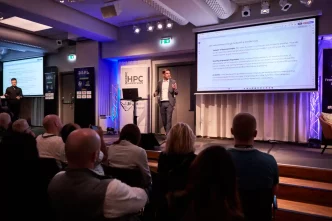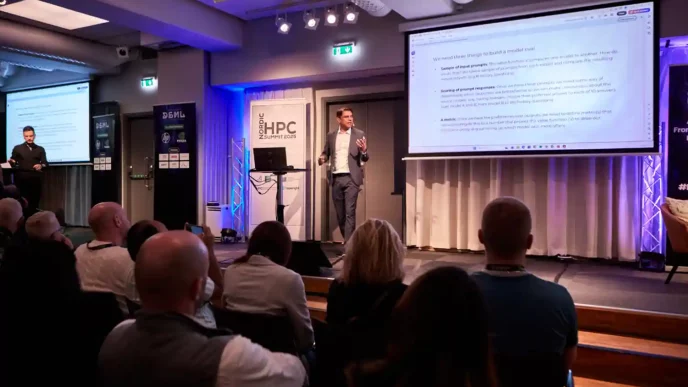

“AI changes everything”. It is one of the most repeated phrases in modern business, but as Daniel Johansson, Principal Account Cloud Engineer at Oracle, emphasized at the Data 2030 Summit, AI is no longer just a technological trend scrolling through news feeds. It is a structural shift in how organizations operate, make decisions, and construct their long-term digital strategy.
In his session, “From Data to AI at Scale: Architectures Powering AI Innovation“, Johansson delivers a pragmatic roadmap for leaders navigating the shift from standard prompt engineering to multi-agent enterprise architectures. His insights reveal that scaling AI isn’t simply a matter of adopting new tools and it requires fundamentally rethinking how data flows through an organization while keeping governance and security absolute.
The Economics of Enterprise AI
The business case for enterprise AI has moved far beyond simple chat interfaces and automated summaries. Across virtually every major sector, Large Language Models (LLMs) are projected to transform 40% of working hours. Far from making human expertise obsolete, this shift promises to strip away administrative drag, redirect employee time toward creative problem-solving and critical decision-making.
At the same time, integrating intelligence directly into data management pipelines is driving an estimated 45% reduction in data errors. When combined with projections pointing toward a 300% revenue growth per employee, it becomes clear why 71% of enterprises have already deployed generative AI technologies. With corporate adoption doubling year-over-year, the gap between early adopters and cautious observers is widening rapidly.
Where Infrastructure Meets Impact
The real test of any technological shift lies in its execution. Across healthcare, manufacturing, and global consumer goods mentioned in this talk is that pioneers are demonstrating how modern AI architecture translates into measurable real-world outcomes:
- Surgical Precision & Diagnostics: At Stanford Medicine, clinicians rely on generative AI to perform rapid text-based interpretations of complex MRIs, CT scans, and X-rays. At the same tim, researchers leverage massive AI superclusters to run intricate surgical simulations that directly inform patient care.
- Supply Chain Vectorization: Japanese gas giant Reni initially turned to Oracle’s vector database capabilities to solve frontline customer service queries. Recognizing the power of semantic data retrieval, leadership quickly expanded the technology across their broader supply chain infrastructure.
- Agentic Efficiency: Premium appliance manufacturer Smeg integrated the Model Context Protocol (MCP) to deploy specialized AI agent fleets across customer operations, yielding an immediate 30% to 40% increase in operational efficiency.
- Engineering Velocity: Internal development teams at Oracle adopted dedicated AI coding assistants for automated unit testing and code orchestration, successfully recovering 10 hours of developer time per engineer every week.
Architecting the Next Era: Models, Agents, and Guardrails
Moving beyond a single-vendor mindset, the future of enterprise data relies on what Johansson calls a balanced “smörgåsbord” of dedicated frontier models hosted inside secure, isolated environments. 
However, raw model capability is only the starting point. The real operational shift occurs when organizations deploy AI Agent Fleets: networks of purpose-built digital agents acting as communication specialists, order orchestrators, and system observers. To safely connect these autonomous agents to internal databases and business software without risking privilege escalation, enterprises are turning to open frameworks like the Model Context Protocol (MCP). Paired with continuous auditing, granular policy controls, and zero-trust encryption, this architecture ensures agents remain fully contained within safe operational parameters.
Unlock the Full Session and Join Us in Stockholm
While these highlights outline the strategic landscape, Johansson’s full presentation goes much deeper into the underlying architecture. The complete talk features a detailed walkthrough of Oracle’s newly launched AI Data Platform, practical methods for unifying vector and relational data formats, and actionable frameworks for managing agent fleets in production.
This depth of practical insight is precisely why the Data 2030 Summit remains the premier gathering for data management leaders, enterprise architects, and technology strategists across the region.
The conversation continues at the upcoming Data 2030 Summit in Stockholm. Join hundreds of industry pioneers for two days of keynotes, interactive technical sessions, and high-level networking designed to help you build a resilient, future-ready enterprise data strategy.