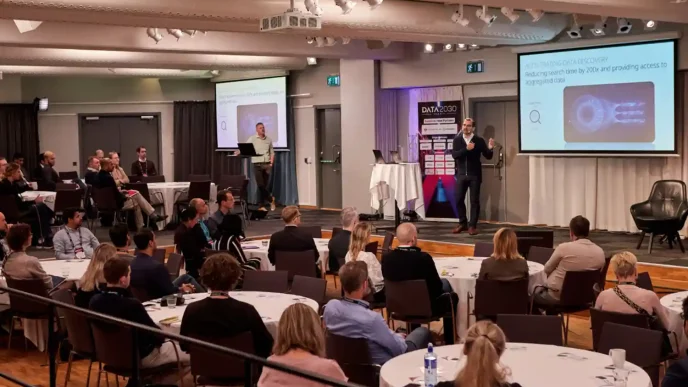
This week, we’re spotlighting Daniel Zakrisson, co-founder of Scaleout in Uppsala. Spun out of Uppsala University, Scaleout builds infrastructure for federated learning and edge AI, delivering technology that powers drones, counter-drone (CUAS) systems, and military vehicles. Serving in the Swedish Home Guard alongside his work with armed forces and defense procurement agencies, Daniel brings a rare end-user perspective to solving the divide between what AI accomplishes in a demo and how it performs in harsh, real-world conditions.
Hyperight.com: What’s the best way to describe your job to someone outside tech?

Daniel Zakrisson: Typically, AI models are trained in a data centre, and then shipped. The moment they meet the real world they start to age. New targets, new terrain, new weather, new countermeasures. In a war, a lot can change in a week and a model trained six months ago is already behind. We build the plumbing that lets a model keep learning in the field, across a distributed network, without sending the data back home. Every drone or sensor learns from what it sees, and the fleet shares what it has learned.
Hyperight.com: What originally sparked your interest in AI/data, and what keeps you inspired today?
Daniel Zakrisson: A long time ago I studied molecular biotechnology at the University. That led into bioinformatics and then into building machine learning based software in medtech. We started Scaleout because we could see how important access to data is to building machine learning systems, and of course now we see the number of applications exploding. What keeps me going now is the gap between what AI can do in a demo and what it does in the field. Most of the industry works on the demo. We work on the gap. Right now the sharpest version of that gap is in Ukraine, where the pace of change is faster than anywhere else and the cost of a stale model is measured in lives.
Hyperight.com: What is one challenge you’re trying to solve, and why does it matter?
Daniel Zakrisson: Continuous learning under bad conditions. Disconnected, intermittent, low bandwidth, jammed. A model on a drone or a CUAS turret has to adapt to a new drone type or a new decoy in days, not months, and it has to do that when the link to the cloud is gone. Our main product is called Scaleout Edge. The principle is that every deployed system learns from every other deployed system, and the learning happens at the edge. It matters because an AI system in a defense application that cannot update in the field is a liability. And the same problem shows up in civilian settings: factories, vehicles, hospitals, anywhere data cannot or should not leave the premises or edge devices.
Hyperight.com: A tool you can’t live without (tech or not)?
Daniel Zakrisson: A notebook and a pen. Many meetings with officers and other officials still happen where a laptop is not welcome.
Hyperight.com: What trend in data or AI do you think will shape the Nordic region the most? 
Daniel Zakrisson: Defence. The Nordic countries are rearming, Sweden and Finland are in NATO, and the investments are going into autonomy, sensors and AI. That will pull talent and companies that never thought about defence into it. Two things will decide whether the Nordics get anything lasting out of this. First, whether we build sovereign AI capability or just buy American models. Small, adapted models running locally will matter more than large general ones for most military tasks. Second, whether we learn from Ukraine fast enough. The Ukrainians are years ahead on what works in the field, and most Nordic procurement still runs on peacetime timelines.
Hyperight.com: What’s one piece of advice you’d give to others entering the data and AI field?
Daniel Zakrisson: Go where the model meets reality. Training is a solved problem for many use cases. Deployment, monitoring, retraining and keeping a model useful over time is not, and few people want to do it. That is where the value is. And spend time with the people who use what you build. I have learned more about what matters in product from soldiers, drone operators and end users than from any other source.