
creating poor-quality data to change? Can they approve the business definition? Can they determine what level of quality is acceptable for a particular use? Can they prioritise remediation over another competing initiative? Can they commit resources needed to fix the problem? Can they stop data being used when they believe the risk is unacceptable? Can they resolve a disagreement between two business areas? And if they cannot do those things themselves, is there at least a clear route to someone who can?
If most answers are no or unclear, the organisation has assigned a role without making it functional.
I have seen Data Owners raise recurring quality issues through the governance structures available to them, only to find that the ability to resolve those issues sits elsewhere. The problem is logged, discussed and assigned a priority. Weeks pass. It reappears on the next report. The owner follows up and learns that the responsible team cannot address it this quarter because of competing delivery commitments. The owner has no authority to change that prioritisation, no budget to fund an alternative approach and no mandate to require a change to the process creating the problem. What they can do is raise it again at the next meeting.
None of this says much about the individual’s willingness to take responsibility. The problem lies in the ownership model.
A role description may assign accountability for quality, definitions, access or compliance. Yet the decisions and actions required often sit with Process Owners, technology teams and other business functions. Accountability becomes fragile when it depends entirely on others choosing to act.
I am not arguing for a Data Owner with unlimited authority. An effective model makes clear where decisions belong and how they can be carried through. 
Stop defining the role. Define the decisions.
Governance programmes spend considerable time defining Data Owner responsibilities: ensure quality, approve definitions, resolve issues, oversee access, support compliance. All reasonable. I would start elsewhere.
Start with the decisions that need to be made about the data.
Who approves its business definition? Who determines the required quality level for a particular use? Who can accept the risk when that level cannot be met? Who prioritises remediation? Who approves a new use of the data? Who decides whether a local variation from an enterprise definition is legitimate? Who arbitrates when two parts of the organisation disagree? Who determines when an issue needs to be escalated, and to whom?
These questions make governance more specific. They also reveal that the answer is often not the Data Owner.
Some decisions may sit with a Process Owner. Others may require Legal, Privacy, Security or Risk. Technology may control what can be implemented and when. Cross-functional disagreements may require a forum, and some decisions require executive authority.
The aim is not to give the Data Owner more authority over everything. It is to make clear how decisions involving the data are actually made. Role descriptions alone can give the impression of clarity while leaving those decision paths undefined.

The hardest questions appear at the boundaries
Much has been written about the distinction between Data Owners and Data Stewards, and I have no intention of adding another definition to that particular pile. What interests me more is what happens when data ownership meets the responsibilities of other roles across the organisation.
A Data Owner may be accountable for a definition while a Process Owner controls how the data is created, an Application Owner controls the system and Technology determines when changes can be made. Privacy or Legal may decide whether a proposed use is permissible. A business unit relying on the data may have different requirements from the one creating it.
All these accountabilities can be legitimate. The difficulty starts when they conflict.
I once encountered this problem over a single field in a system.
Purchasing was the designated owner of a field intended for a purchasing purpose. Sales began using it for something entirely different, and that use became established. When Purchasing needed the field for its intended purpose, the two functions had conflicting requirements.
You might expect the ownership designation to settle the matter. Purchasing owned the field, after all.
It did not.
The disagreement went to the Data Governance Committee, which had authority to decide how the field should be used. After long discussions, it agreed a compromise: Sales would keep the original field, while a custom field would be developed for Purchasing.
Yes, really. The function that owned the original field ended up with a custom field so that another function could continue using the original one.
The formal governance process was followed, and a compromise agreed. Yet the outcome did not reflect the original ownership designation.
I understood why the committee reached that compromise. By then, Sales had an established dependency on the field, and changing it would have had practical consequences. But I was uncomfortable with the precedent it set. Purchasing was the designated owner, yet it was Purchasing that had to adapt. If an ownership designation can be overridden by an established way of working, what authority does that designation actually provide?
Who gets to decide?
The answer was the Data Governance Committee. But knowing who could decide did not make the decision straightforward or guarantee that the designated owner’s requirements would prevail.
A governance model can define every individual role clearly and still leave the organisation facing difficult choices when responsibilities overlap or requirements conflict. The most carefully designed ownership framework will eventually meet a situation that sits between roles. How that situation is handled tells you far more about whether governance is working than how neatly the catalogue is maintained.
Not everything has one right definition
The boundary problem becomes even more visible with enterprise-wide data.
Take the concept of a customer. It sounds as though it should have one agreed definition. In practice, a regulatory report may define a customer through a contractual relationship, active or not. Marketing may mean someone who transacted recently. Credit Risk may need to include related entities, guarantors or group exposure. Customer Service may include anyone who has raised a request, regardless of commercial relationship.
None of those definitions is necessarily wrong; each can serve a legitimate purpose. The problem arises when the organisation has not decided which definition applies in which context, who has the authority to make that determination, and how those decisions are communicated to the people using the data.
The same applies to revenue, product and supplier data. Legal requirements may demand local variations, while legacy systems and years of mergers and acquisitions may have embedded different definitions of the same concept.
The task is to decide where consistency is required, where variation is legitimate and who has the authority to distinguish between them. Forcing one definition on everyone does not work when the requirements are genuinely different. But allowing every business area to define things independently creates problems of its own.
Good ownership gives disagreements about data somewhere to go, and keeps a record of how they were settled. That matters particularly as data travels further from the context in which it was originally created. The person consuming a dataset for analytics or AI may know very little about the decisions, assumptions and compromises that shaped it. Clear ownership should help preserve that context, rather than simply assign a name to a domain and consider the matter closed.
Test ownership when something goes wrong
To test whether data ownership works, I would pick a real problem and follow it through the organisation, rather than start with the framework or catalogue.
Choose a recurring quality issue, an unresolved definition or a proposed use of data crossing organisational boundaries. Follow what happens until someone can make and implement a decision.
Notice who identifies the problem, who is expected to resolve it and who can decide. Who controls the process, system, budget or resources needed for a fix? Where does disagreement go, and how many escalations are required?
The real test comes when somebody has to make a difficult decision under pressure. If the formal owner appears somewhere in that chain but has little practical ability to influence the outcome, the organisation may have ownership on paper without ownership in practice.
And if every significant decision eventually travels upwards to a senior forum because the people closer to the data do not have sufficient authority to act, that tells you something too. Escalation is a necessary part of governance. It should not become the default mechanism through which governance functions day to day.
Ownership that means something
When ownership fails, the temptation is to rewrite role descriptions. Clarify another RACI. Nominate someone more senior. Create another forum. Sometimes that helps. First, though, I would ask: what decision are we currently unable to make, and why?
Perhaps authority was never assigned, or the owner has no mandate to act. Perhaps the decision sits between roles, or the decision has been made but nobody can implement it.
Each problem needs a different response. Adding another layer of governance is unlikely to help if the underlying difficulty remains unresolved.
When an organisation can encounter uncertainty or disagreement and still know where the decision belongs, who can make it and how it will be carried through, the word owner starts to mean something.
When nobody can address the process creating a quality problem or prioritise its remediation, the issue will return. The dashboard will record it. The forum will discuss it. The owner will raise it again.
Which brings us to the next uncomfortable question: if organisations have spent years measuring and remediating data quality problems, why does so much data quality remain persistently poor?
About the author
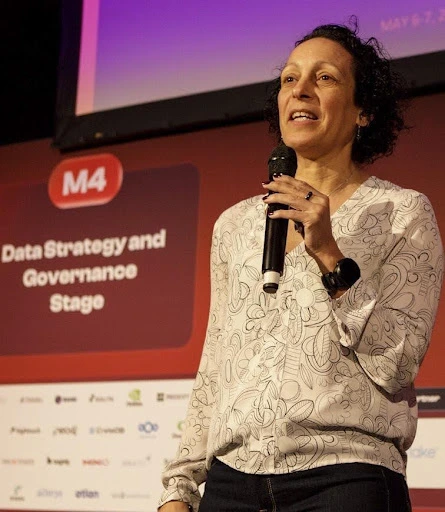
Karima Makrof is the Founder and Chief Adviser at AKLYON Consulting and Senior Manager, Data Governance at PwC Sweden, within the Chief Data Office. With over 25 years of international experience across industries and countries, she works at the intersection of data governance, organisational accountability and decision-making, helping organisations move from having data to being able to act on it with confidence.
Her experience spans financial services, technology, manufacturing, automotive and professional services, including leadership roles with global organisations such as Volvo Group, Oracle, SKF, ESAB, Volvo Cars and Swedbank. This breadth gives her a perspective on how data challenges evolve as organisations, technologies and expectations change.
Today, her work focuses on the gap between governance as it is designed and how it functions in practice, taking a pragmatic approach to accountability, ownership, decision authority and how governance becomes part of the way an organisation operates.
Karima is a regular stage moderator at the Data Innovation Summit and Data 2030 Summit and speaks internationally on data governance, data leadership and responsible AI, bringing a practitioner’s perspective to questions often treated as primarily technical or procedural.
She is the author of The Confidence to Act: 30 Reflections on Data Governance – What Breaks and What Holds?, drawing on over two decades of experience to explore why governance falls short in practice and what enables organisations to act with confidence.
*The views and opinions expressed by the author do not necessarily state or reflect the views or positions of Hyperight.com or any entities they represent.