There is a moment that recurs in the executive teams I work with. Someone has just shown the room what the tools can now do: the board paper drafted in minutes, the anomalies in a hundred contracts flagged overnight, the forecast rebuilt before lunch. People are impressed. And then, usually without anyone saying it aloud, the conversation drifts towards a different question. If the thinking is this cheap, what exactly are we for?
It is the right question, and most transformation programmes never get to it. They answer the question before it, how to get the tool into people’s hands, and stop there. My argument is that the answer sits in the layer of the operating model that programmes treat as an afterthought, if they treat it at all: the human layer. And within that layer, the capability that is becoming scarce is not technical. It is the ability to understand what another person is feeling and to act on it well. Empathy, in other words. Not as a soft nicety, but as a hard operating skill, and one that most organisations are investing in least at the moment they need it most. Since the word carries baggage, a definition: by empathy I mean recognising what another person feels and thinks, understanding why, and responding to it. Psychologists separate this from feeling the same thing yourself, and it is not the same as being nice.
The shift the tools are making
Start with the theory and treat it as theory. Roland Rust and Ming-Hui Huang argue in The Feeling Economy that as artificial intelligence takes over first mechanical and then thinking tasks, the relative value of human work moves towards what they call feeling tasks: empathy, relationships, judgement about people. Coding the US Department of Labor’s occupational data, they found a shift towards feeling-related tasks between 2006 and 2016. The task analysis behind the book was published in California Management Review in 2019; the book builds a broader argument on top of it. I treat that argument as a hypothesis about direction rather than a prediction to plan against.
The firmer ground is older. David Deming’s 2017 study in the Quarterly Journal of Economics found that jobs requiring high levels of social interaction grew by nearly 12 percentage points as a share of all US jobs between 1980 and 2012, and that cognitive and social skills are complements: employment and wages grew most in work that demanded both, while jobs that demanded analytical skill but little social skill shrank as a share of employment. The mechanism is the useful part. Social skills lower the cost of coordination inside a team, and coordination is a kind of work that automation had, so far, not reached.
Two honest caveats. Deming’s data ends before generative AI, so it is evidence about direction, not about what is happening this year. And the premium he describes is for the combination, not for social skill alone: the strongest growth in both jobs and pay came where social skill was paired with analytical skill. The reading that survives both caveats is this: what gets rewarded is the pairing of hard analysis with the ability to work through people, and of those two, the second is the one you cannot download.
Why this is an operating-model question
If empathy were only a personal virtue, it would belong in a leadership course. The reason it belongs in the operating model is what it does to speed. 
Daniel McAllister’s field study of 194 managers and professionals distinguished two foundations of trust at work. Cognition-based trust is the rational assessment that a colleague is competent and reliable. Affect-based trust is the emotional bond: the sense that the other person cares about you and would not act against your interests. In McAllister’s data the first usually has to exist before the second develops, but the second does something of its own. Where affect-based trust is high, people help each other beyond what their roles require, without being asked.
McAllister did not measure decision speed, and I will not pretend he did. The next step is my own inference, from running a company with two partners. I know how each of them will react to a decision before I take it, not because we have discussed every case but because I know them. So I decide, and we talk afterwards. Where that kind of knowledge is absent, people do the rational thing: they hedge, meaning they protect themselves. They check reactions, wait for the meeting, build consensus as insurance against being alone with a mistake. Each hedge is sensible. Together they are the coordination cost Deming describes, and in fast-moving work that cost decides everything.
Now put the tools into that picture. When the analysis arrives in minutes, the bottleneck moves to the decision, and the decision moves at the speed of trust. You can buy the thinking. You cannot buy the trust that lets people act on it.
What the tools expose in the room
Two things I see repeatedly make this concrete, and a third that I hold more loosely.
The first is that trust does not follow the technical facts. People hesitate to give an AI assistant information they would type without a thought into an email in the same environment, under the same contract. The hesitation is not a fact problem, so repeating the facts does not move it. A leader who answers that feeling with a slide about data security will keep wondering why adoption stalls. A leader who can read what is actually happening in the person, and respond to that, will not. That is empathy doing operational work.
The second is that AI puts executive teams in a beginner’s position. In a budget review everyone has a role and a routine. With AI nobody does: the subject is new to all of them and the right answers are not yet known. In that position you find out whether the way your team talks to each other holds up, whether people say the same thing when the most senior person is in the room as when they have stepped out. The tool exposes this without being asked. My observation is that the teams which can hear it, and do something with it, are the ones that later move fast.
The third I offer as an observation from the field, not as a finding: in the teams I work with, AI seems to weaken trust, not only to expose where it was already thin. If that holds even partly, it cuts against the common assumption that the tools reduce the need for human work inside the team. Weaker trust raises the need for empathy, and for shared reflection: time when the team looks at how it is working together, not only at what it produced.
This is what I mean by empathy as a hard skill. Not warmth, not being liked. The accurate reading of what is happening in people, and the willingness to act on it. Without it, in my experience, teams do not take on the hardest problems and the people in them wear out. With it, they move.
“Surely this is the soft stuff”
The word soft has done real damage here. The human layer is the hardest part of an operating model to build, the only part that cannot be bought, and the slowest to grow. Calling it soft has mostly meant that it does not get a line in the plan.
A second objection is fairer: empathy is a trait, and you cannot train traits into people. Partly true. But as an operating-model capability it is built less through training than through structure: how decisions are made, whether disagreement is safe, how much time people spend together on real problems rather than status updates. Those are design choices, and leadership makes them whether or not anyone makes them deliberately.
The third objection is one I would make myself. It is easy to romanticise empathy, and a sentimental argument deserves to lose. Empathy is not the goal. Performance is. Empathy matters because it is the mechanism through which teams act fast on what the machines now hand them, and recover when they get it wrong.
Design for it, this quarter
1. Give the human layer a line in the transformation plan. Most AI roadmaps have rows for data, tooling, governance and training, and none for how people work together. Add the row, with an owner and a budget. If it is nobody’s job, it will be nobody’s result.
2. Measure hedging. For a handful of routine decisions, count how many people are consulted before the decision is taken and how long it waits. Where the numbers are high, you are looking at a trust gap, not a skills gap, and no tool will close it.
3. Use the beginner’s position on purpose. Put the leadership team in a room with the tool and a real problem, and watch the conversation rather than the output. Whether people say the same thing regardless of who is present tells you more about your readiness than any maturity assessment.
4. Decide where the saved time goes. If a first draft now takes ten minutes instead of a day, the saved day has to go somewhere. The default, more drafts, buys nothing. Time spent together on hard problems is how affect-based trust is built, and it is the one input the tools cannot produce.
Where the return is decided
The human layer is not the part of the transformation you reach once the technology is done. It is where the return on the technology is decided. The tools have made analysis abundant; what they cannot make is the trust that turns analysis into action without a week of hedging first. Empathy is not the soft part of the operating model. It is the part that sets its speed.
About the author
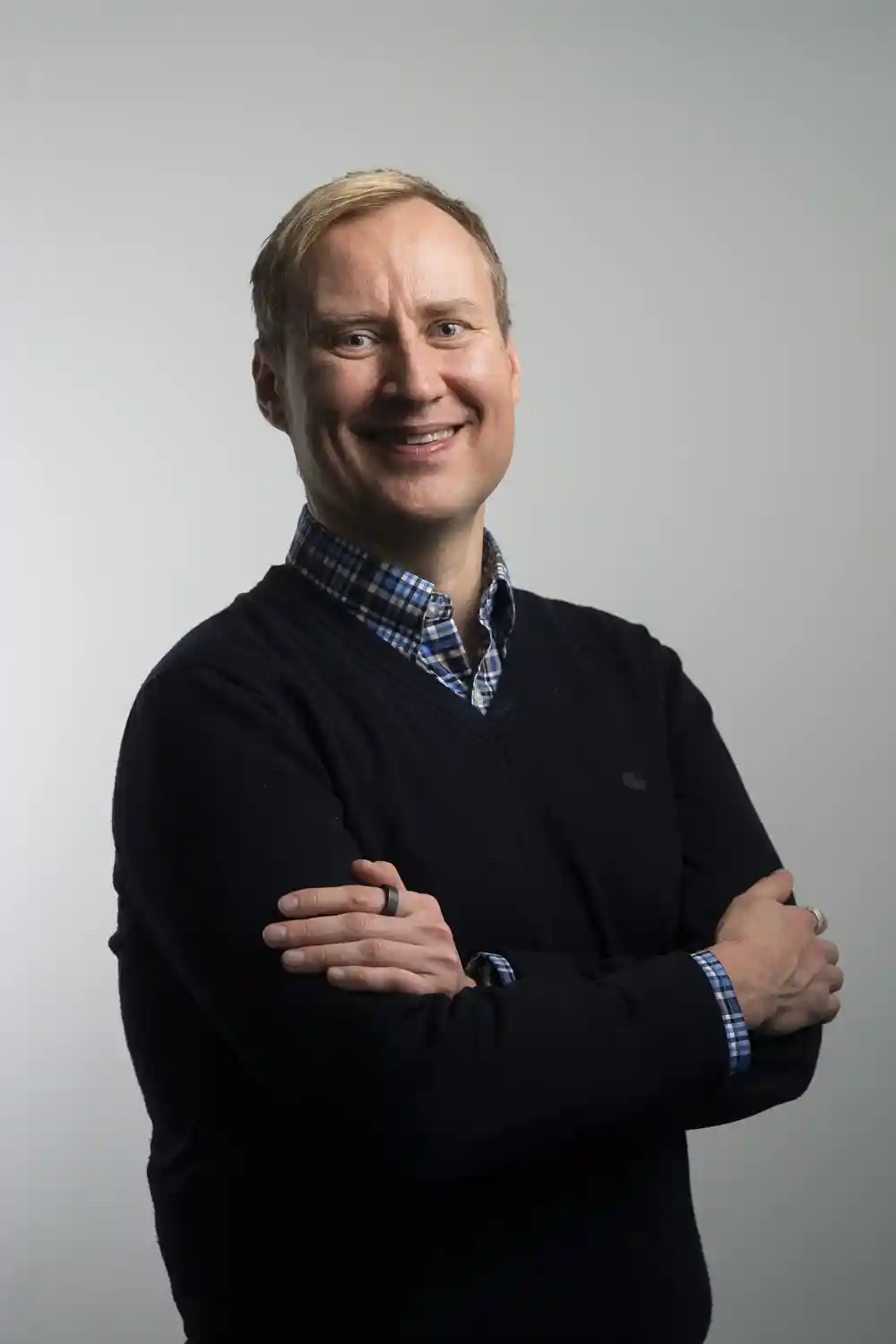
For nearly three decades, Lenni Laukkanen has helped organisations develop and grow through technology. He argues that AI is not a technology question but a leadership one: it rarely fails as a tool — it exposes ways of operating built for a world that no longer exists.
As founder of Astu Labs, trusted advisor to executive teams and keynote speaker, he helps leaders navigate the organisational changes required to capture value from AI. A runner, cyclist and adventurer, he holds that organisations, like athletes, change one deliberate step at a time. More at lennilaukkanen.fi.
*The views and opinions expressed by the author do not necessarily state or reflect the views or positions of Hyperight.com or any entities they represent.