Moving from abstract ethics to pharmaceutical R&D is a leap from theory to high-stakes reality. In this interview, Jakob Thrane Godtfredsen Mainz, Director of AI Governance at Novo Nordisk, discusses transforming philosophy into functional systems-tackling global regulatory hurdles, the necessity of explainability, and why true innovation requires the courage to “fail fast.”

In pharmaceutical R&D, moving from ethical theory to operational reality is a complex evolution. While academic frameworks provide a foundation, applying them across global markets requires a shift from abstract philosophy to pragmatic execution.
Jakob Thrane Godtfredsen Mainz, Director of AI Governance at Novo Nordisk, leads this practical application. With a PhD and Postdoc in AI ethics, Jakob transforms high-level principles into functional R&D systems-focusing on literacy, regulatory validation, and proving that governance is an innovation engine, not a roadblock.
In this conversation, Jakob shares his personal points of view -which do not necessarily reflect the official views of Novo Nordisk- on avoiding the “sunk-cost fallacy,” building multi-stakeholder trust, and why the industry must prioritize business outcomes over AI hype.
With your background in AI and data ethics from academia, what has surprised you most when applying these principles inside an enterprise R&D environment?

Jakob Thrane Godtfredsen Mainz: What has surprised me the most is probably how dispersed and how differently common data- and AI ethics principles are being implemented by regulators and authorities in the pharmaceutical company. As a company with a global footprint, this makes it very difficult to adhere to all requirements and expectations at once. In an academic setting, the discussions on these topics easily become very detailed and theoretical. 
So, if you try to take the same approach as a global company, there’s a risk that you never make it past the initial theoretical state. Even the simplest principles become very complex in practice when you try to apply them at scale to different countries, different patient groups and different cultures.
How does Novo Nordisk R&D approach building trust in AI systems used in research and development?
Jakob Thrane Godtfredsen Mainz: As a pharmaceutical company, building trust in our AI systems from the R&D department means that we will need to build trust in multiple stakeholders, including patients and doctors. We generally have good insights into what drives trust in different stakeholder groups, but it is also clear that there are certain baselines that need to be met to drive trust across stakeholder groups.
One example is explainability. It is often difficult to build trust in a technology, if you don’t understand how it works. Especially if you cannot get an explanation when things go wrong. We therefore need to be able to provide different types of explanations to different audiences. Especially in patient-facing systems involving AI, we will strive to have a high level of explainability, to ensure we are able to explain how the AI system generates its outputs.
What are the biggest challenges enterprises face when aligning AI governance with real business outcomes, not just compliance?
Jakob Thrane Godtfredsen Mainz: One of the biggest challenges is to ensure that your AI solutions actually support your business priorities, and not the other way around. With the current level of hype around AI, many enterprises decide that they want to implement AI in all their business processes, without critically considering whether AI is the best tool in the toolbox to solve the problem at hand. If done right, AI can help reinvent existing business processes, but it should never be an end in itself to use AI for the sake of using AI.
How do you balance responsible AI, regulatory requirements, and the need for innovation speed?
Jakob Thrane Godtfredsen Mainz: It’s crucial to first take a holistic view on one’s overarching risk-appetite. Most regulatory frameworks allow for, or even encourage, taking a risk-based approach. It is rarely necessary to go fully onboard on all requirements at all times. If done right, responsible AI and governance frameworks can function as innovation enablers, helping businesses to gain more insights into their AI solutions, derive business insights from them, and unlocking surprising potentials in existing business processes. In essence, it’s a false dichotomy to think that responsible AI is necessarily in contrast to innovation speed.
From your experience, what is the most common mistake organisations make when setting up AI operating models?
Jakob Thrane Godtfredsen Mainz: In my experience, at least one of the most common mistakes is to start out too big. It’s often a better approach to start small and build from early indicators of success. This, however, also requires a mindset of being willing to fail fast, and kill your darlings when they don’t show sufficient probability of success. Here, it is easy to fall into the “sunk-cost fallacy”. Just because you have already poured a lot of resources into a project, it does not mean that it is rational to keep doing so in order to not waste the initial resources that have been spent.
Looking ahead, what will be the most critical capability enterprises need to build to ensure trusted and scalable AI adoption?
Jakob Thrane Godtfredsen Mainz: Here are three of the most critical capabilities to build and ensure trusted yet scalable AI adoption, as I see them:
- Have a clear view of what drives trust in the relevant end-users of your AI solutions. Then design accordingly.
- Have a clear view of your business priorities. Then look for the right tools in the toolbox to deliver on those priorities.
- Successful AI adoption is all about change management. If you don’t empower your workforce to prioritize and implement AI when and how it makes sense, you will not succeed.
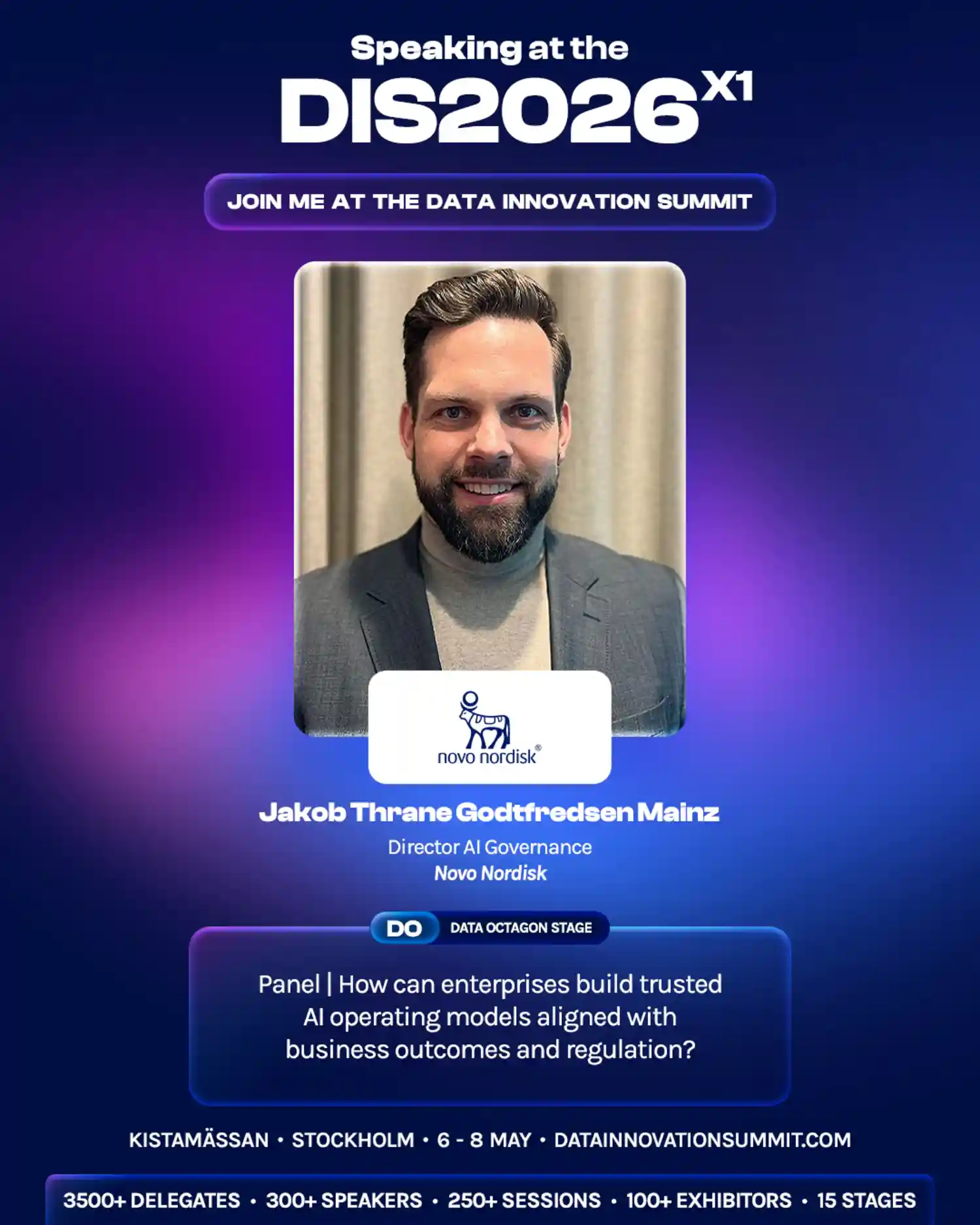
Jakob Thrane Godtfredsen Mainz will be a featured panelist at the Data Innovation Summit 2026 in Stockholm. He will be joining the Data Octagon stage to discuss a critical challenge for modern enterprises: “How can enterprises build trusted AI operating models aligned with business outcomes and regulation?”
Register now to gain exclusive insights into the future of scalable, trusted AI!