
Grandiose headlines frequently promise a world of frictionless, AI-driven business intelligence. Organizations pour millions into cutting-edge architectures and they are building sleek setups, investing in data fabric layers, and mapping out expansive corporate strategies. But even with that, many of these initiatives still collapse under their own weight.
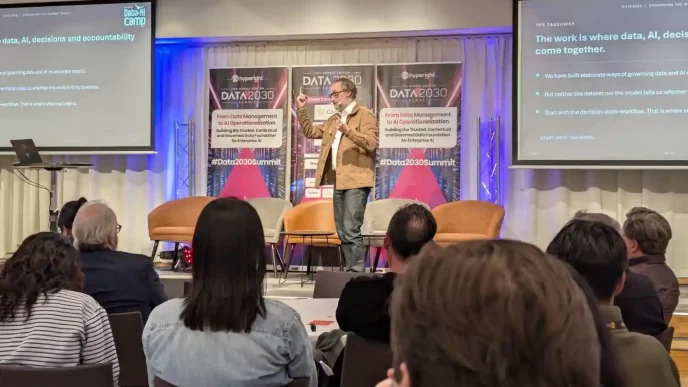
At the past Data 2030 Summit in Stockholm, Zoran and Martin, Line of Business Directors from the data consultancy Solvership, explained why this happens. The culprit is rarely the technology itself, but rather a fundamental disconnect between business ambition, operational reality, and the overlooked superpower of data profiling.
For organizations that have watched data warehousing projects drag on for years, or watched stakeholders disown a report due to “bad data”, this framework offers a change in perspective.
The Illusion of the Flawless Strategy
A real data strategy is more than just a document that strings together buzzwords like “data-driven” and “enterprise AI”. Its true purpose is to translate a business objective like boosting direct sales or cutting operational costs into a functioning data product.
However, a standard trap exists in the typical project lifecycle:
- The Wish List Phase: In early workshops, business teams discuss the abstract value they want to extract. Focus remains entirely on the final output, while the underlying data mechanics are ignored.
- The Blame Game: Data quality problems are inevitably discovered late and usually during User Acceptance Testing (UAT). Because implementation is already underway, business stakeholders view it as an “IT problem”, while the technical team struggles to fix upstream errors they did not create.
To solve this, Solvership introduced a structured 7.5-step framework designed to foster alignment and reveal data friction before a single line of production code is written. 
The Village That Bought a Hotel Chain
To illustrate the framework, the Solvership team shared a real-world use case from Croatia’s hospitality sector.
A major hotel chain aimed to increase direct bookings through its own portal, bypassing the hefty 20% commission fees charged by third-party booking sites. The strategy specifically required targeting high-spending guests who would utilize profit-heavy amenities like restaurants, spas, and excursions.
To execute this, data analysts pulled customer CRM profiles and noticed an anomaly: 60% of the entire international guest database supposedly resided in one certain place which is a tiny, rural village in Croatia.
How can a strategic marketing initiative succeed when the underlying data claims most global luxury clientele stays in a small village? The look at the causation answered that question: this was not an IT error. It was a human process error. Front-desk clerks, rushed by long lines of arriving guests, simply clicked the very first option on a mandatory city drop-down menu to speed up check-in.
Changing the Playbook: Profiling as an Engagement Tool
This is where the framework flips the script. Instead of treating data profiling as a retrospective chore for data engineers, the methodology positions it as the ultimate weapon for analysts before a project officially begins.
By running mandatory profiling tests prior to the first joint workshop, analysts can enter the room with clear, visual evidence of the data’s true state.
The Iterative Profiling Loop
- Analyze: Profile source systems to establish a clear baseline of data quality.
- Model: Create an initial conceptual model based on integration assumptions.
- Align: Hold a workshop where business stakeholders are confronted with real data anomalies (like the village from this example phenomenon).
- Decide: Make a hard strategic choice: Does the organization alter its operational processes to capture cleaner data, or does it accept lower-quality insights?
Unlocking the Full Framework
Data profiling is not just about finding missing values but also about establishing data ownership early, aligning technical architecture with regulatory compliance (like GDPR), and tying data team outputs directly to corporate KPIs.
What are the exact tests every business analyst needs to run before a workshop? How can this alignment scale horizontally across an enterprise? And how did the hotel chain resolve its data bottleneck to successfully drive direct bookings?
This overview only scratches the surface of the actionable insights shared by Solvership. To view the complete presentation, explore the detailed framework, and see live examples of how to build data quality rules alongside business stewards, subscribe to unlock the full video, and check the Data 2030 website to secure your spot at the next event.