
Imagine launching a state-of-the-art AI solution across a primary market, only to watch the customer containment rate hover at a staggering 2%.
That was the reality for the AI team at Electrolux, a global appliance giant handling over 6 million customer conversations annually across Europe. Driven by a desire to modernize a rigid, deterministic chatbot, the team built what looked like a textbook Generative AI solution. But still, the initial results fell massively short of expectations.
What went wrong and more importantly, how did the operation pivot from a 2% success rate to an incredible 60% self-served containment rate just a few months later?
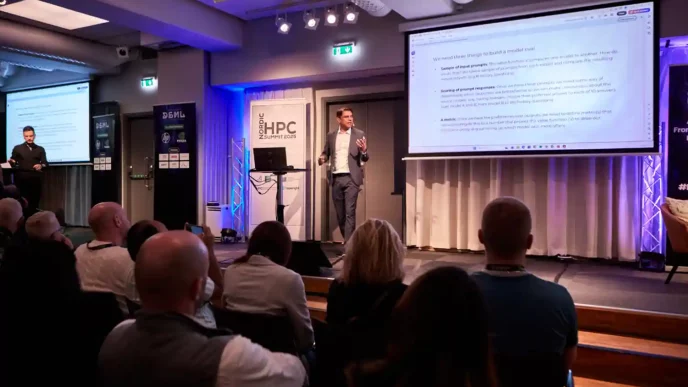
In this candid case study presentation, Daniel Edsgärd, part of the Electrolux’s AI team shows enterprise-grade transition from basic Retrieval-Augmented Generation (RAG) to a highly sophisticated, multi-agent AI system. It serves as a masterclass in the messy reality of deploying Large Language Models (LLMs) at scale and offering invaluable blueprints for anyone trying to bridge the gap between technical proof-of-concept and genuine business value.
The Trap of the “Perfect” Technical Solution
In early 2024, Electrolux faced a classic enterprise dilemma. The customer service ecosystem was bogged down: 90% of customer interactions happened over voice, and of the 10% who used the existing chatbot, a mere 1% felt helped. The rest were escalated to human agents, who themselves struggled to navigate dense internal knowledge bases during live troubleshooting.
The AI team’s initial hypothesis was reasonable: build a straightforward RAG pipeline. By utilizing advanced hybrid search, metadata filtering (by country and product), and cutting-edge guardrails via Nvidia’s NeMo, a drastic improvement was expected. 
Instead, the launch in Spain merely doubled the containment rate from 1% to 2%.
The presentation deep-dives into the exact funnel analysis that exposed the blind spots. It reveals a critical truth that many teams face today: the nature of enterprise problems is often too complex and emotionally charged for a linear keyword or vector search to resolve. Customers did not just want a link to a document; they needed dynamic, empathetic, and step-by-step guidance.
Changing the Playbook: Moving to Multi-Agent Orchestration
To break through the 2% ceiling, Electrolux completely reinvented the architecture. The single-prompt RAG model was abandoned in favor of an advanced Agentic AI system powered by Microsoft’s Agentic Framework (formerly AutoGen and Semantic Kernel).
Instead of handling a single intent, the new system dynamically classifies and routes queries across 12 distinct topic areas from warranty extensions to complex appliance installation. The presentation maps out this remarkably sophisticated orchestration layer, showing how a “Reception Agent” and an “Evaluator Agent” collaborate in a group chat ecosystem to validate if enough information has been provided before a single tool is ever called.
The video also details the implementation of Agentic Retrieval which is a technique where the AI generates multiple variants of a user’s query, executes parallel calls, and merges the responses to drastically optimize retrieval accuracy.
Beyond the AI: Building for the Enterprise
Perhaps the most practical takeaway from the Electrolux journey is the architectural breakdown. Daniel notes a profound lesson: the majority of the effort in building an enterprise-grade system isn’t the AI logic itself; it’s the unglamorous plumbing around it.
The presentation details the tech stack integration, demonstrating how the team leveraged an existing global data platform to handle data modeling and vector storage, all running on Kubernetes with robust CI/CD pipelines. The video also shares the exact framework used for LLM observability and root-cause analysis via Arize AI, which allowed developers to trace the inputs and outputs of every single call stack to eliminate latency issues.
Real Outcomes and Hard Lessons
The shift to an agentic framework yielded massive wins:
- A 60% self-service containment rate.
- A 40% to 50% reduction in live human chat volumes.
- A highly reusable framework that allowed the team to spin up an entirely separate HR AI assistant in just four weeks.
Yet, the presentation does not shy away from the unresolved friction points. Despite the chat success, voice traffic did not drop as expected. Customers who had already searched the website felt frustrated when the chatbot repeated the same information, exposing a need for smarter triaging and seamless human escalation.
The session concludes with five critical, battle-tested takeaways regarding financial agility, deep process discovery, and why the business side should always sit in the driving seat.
For those currently building, scaling, or struggling to find ROI on enterprise LLM applications, this presentation offers a rare, honest look at the architecture and philosophy required to succeed.
This preview is part of our Premium Videos.
Sign up to see the whole presentation about: Building the Future of Customer Service with an Agentic AI System
Presented by: Daniel Edsgärd, Electrolux