
The global AI conversation is still dominated by frontier models, billion-dollar infrastructure investments, and the increasingly theatrical competition between the United States and China. Every week introduces another benchmark, another reasoning model, another claim about agents replacing entire categories of work. Yet beneath the noise of the broader AI race, a far more consequential transformation is quietly unfolding inside governments, municipalities, healthcare systems, utilities, and critical public institutions. This is where AI stops being a demo and starts becoming operational reality. It is also where many of the assumptions driving enterprise AI adoption begin to break down.
In Episode 184 of the AIAW Podcast, David Wallén , CEO and Co-Founder of Intric, shared lessons from more than 50 public-sector AI implementation journeys. Rather than focusing on speculative AGI narratives or the latest consumer-facing AI capabilities, the discussion centered on something much more important: what actually happens when organizations attempt to integrate AI into real operational environments shaped by regulation, procurement structures, legal accountability, and institutional inertia.
That perspective matters because many organizations are no longer struggling with whether AI is technically capable. The models are already powerful enough to automate, augment, summarize, analyze, orchestrate, and support an enormous amount of knowledge work. The harder challenge is organizational. Institutions built for stability, predictability, and risk minimization are now attempting to integrate adaptive systems that evolve faster than their governance models can comfortably absorb. In highly regulated environments, the friction does not emerge primarily from the technology itself. It emerges from procurement frameworks, security requirements, compliance obligations, fragmented data systems, organizational politics, and leadership uncertainty around how to navigate a rapidly shifting landscape.
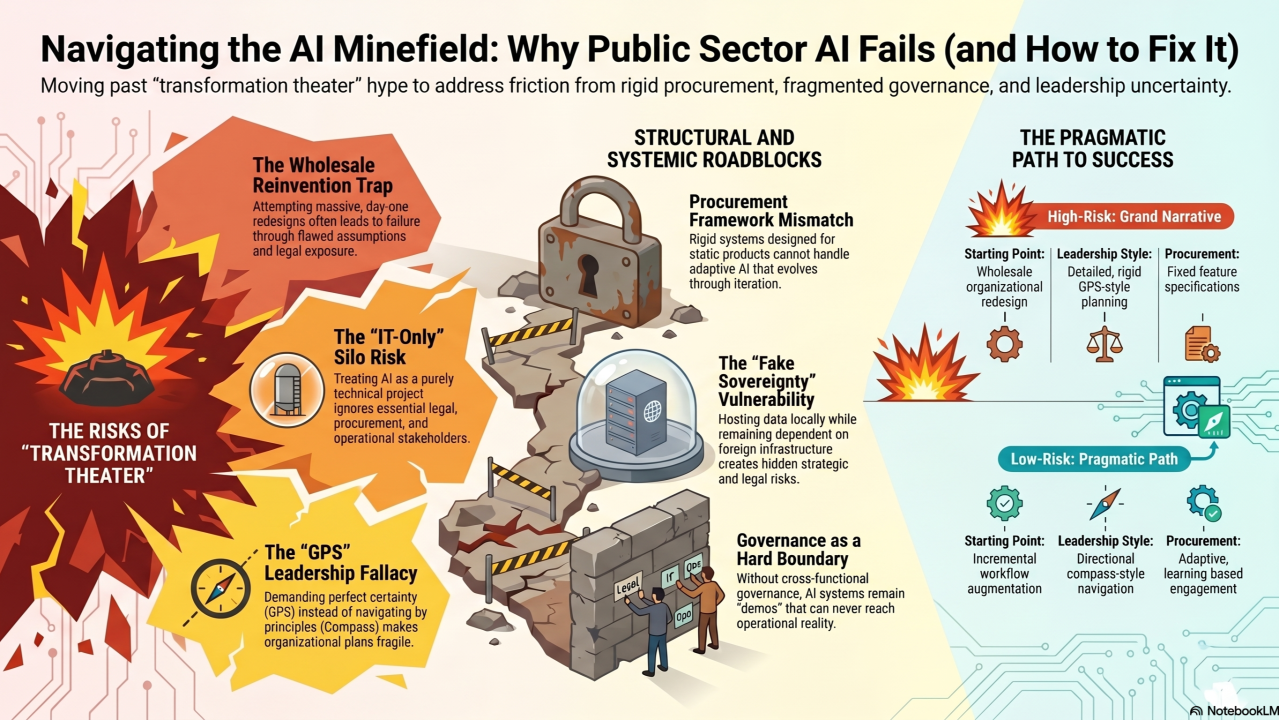
What became clear throughout the conversation is that successful AI transformation rarely resembles the grand narratives often presented in boardrooms or conference keynotes. It does not begin with a revolutionary redesign of the organization. It does not start with replacing entire departments through autonomous systems. In practice, the organizations creating meaningful progress are usually the ones taking a much more pragmatic path. They begin by solving operational problems incrementally, building internal trust, establishing governance structures, and allowing institutional learning to compound over time. Ironically, that slower and more grounded approach may ultimately produce far more transformational outcomes than the organizations attempting to force dramatic reinvention too early.
The Misunderstanding at the Center of Enterprise AI
One of the most important insights from the episode is that many organizations fundamentally misunderstand what AI transformation actually looks like. Executives often frame AI as a singular strategic initiative, something equivalent to a large digital transformation program where the organization moves decisively from one operating model into another. That framing creates unrealistic expectations because AI adoption is not a one-time migration. It is an evolving organizational learning process.
Wallén repeatedly emphasized that the organizations achieving the fastest and most sustainable progress are not the ones attempting wholesale reinvention from day one. Instead, they begin by improving existing workflows. They use AI to augment current processes, support employees in repetitive knowledge tasks, and reduce friction inside administrative operations. Only after learning how the technology behaves operationally do they begin redesigning broader systems and processes. 
That distinction is critical because many organizations still approach AI with a “transformation first” mindset. Leadership teams often ask how AI will completely reinvent customer service, public administration, healthcare delivery, or internal operations before they have even established operational familiarity with the tools themselves. In reality, organizations need to learn incrementally. They need to understand where models fail, how workflows interact with AI systems, what governance constraints emerge, and where human oversight remains essential.
This gradual evolution is not a sign of limited ambition. It is the natural consequence of working with systems whose capabilities, costs, and operational characteristics are still changing rapidly. An organization that immediately attempts large-scale redesign without learning through smaller iterations often discovers too late that assumptions about integration, governance, latency, legal exposure, or user adoption were flawed from the beginning.
The public sector amplifies these challenges because many workflows are tightly coupled to legislation, procurement processes, and formal accountability structures. Unlike startups or digital-native companies, governments cannot simply move fast and adjust later. Every process change may carry legal implications, public accountability concerns, or downstream effects across interconnected systems. This makes institutional learning even more important.
Ironically, many of the organizations now making serious progress with AI are succeeding precisely because they avoided the temptation to pursue transformation theater. They focused instead on operational value, learning speed, and incremental trust-building.
Why Public-Sector AI Is More Important Than Most People Realize
Public-sector AI often receives less attention than enterprise AI, yet its societal impact may ultimately be larger. Governments and municipalities sit on enormous volumes of administrative workflows involving case management, documentation, compliance review, citizen services, policy interpretation, and operational coordination. Much of this work is repetitive, information-heavy, and fragmented across systems that were never designed to interact intelligently.
These environments are therefore extraordinarily well suited for AI augmentation.
At the same time, they are also among the hardest environments in which to deploy AI successfully. Public institutions are intentionally designed to prioritize stability, transparency, fairness, and legal defensibility over speed. Procurement systems are rigid. Data environments are fragmented. Decision-making structures are layered. Risk tolerance is low. Leadership turnover can disrupt long-term initiatives. Regulatory scrutiny is constant.
Yet this is precisely why the lessons emerging from public-sector implementations are becoming so valuable for the broader enterprise market. If AI systems can operate effectively inside municipalities, agencies, healthcare systems, and regulated institutions, they can likely operate almost anywhere.
Wallén described how many organizations initially underestimate the organizational dimension of AI adoption. They assume the challenge is primarily technical and therefore assign responsibility entirely to IT departments or innovation teams. In practice, the opposite tends to be true. The organizations that move fastest create cross-functional structures involving legal teams, operational leaders, data protection officers, procurement stakeholders, and technical teams from the beginning. These horizontal working groups accelerate adoption because potential blockers become active participants rather than external gatekeepers.
This is especially important in Europe, where organizations face a far more complex regulatory environment than many American companies. Questions around GDPR, auditability, explainability, data residency, and operational accountability are not secondary considerations. They are foundational requirements that shape deployment architecture from the outset.
As a result, AI implementation in the public sector becomes less about experimentation in isolation and more about building institutional capability. The organizations succeeding are not necessarily those with the largest AI budgets. They are the ones capable of aligning governance, leadership, operational workflows, and technical infrastructure into a coherent adoption strategy.
The Governance Layer Is Becoming the Real Differentiator
One of the clearest themes throughout the conversation was that governance is no longer a secondary concern attached to AI deployment. Increasingly, governance architecture determines whether deployment is possible at all.
This is a profound shift in how organizations need to think about enterprise AI.
During the first wave of generative AI adoption, many organizations focused heavily on access. Employees gained access to chat interfaces, copilots, and generalized AI assistants that could summarize documents, answer questions, and generate drafts. Those capabilities created excitement because they introduced AI into daily workflows quickly and visibly.
But operational deployment introduces a completely different category of challenge.
Organizations quickly encounter questions about where models are hosted, what data can be processed externally, how decisions are logged, what retention policies apply, who has access to outputs, how auditability is maintained, and how workflows comply with both internal policies and external regulation. These are not edge-case concerns. In regulated industries and government environments, they define the operational boundary of what AI can and cannot do.
Wallén explained how organizations increasingly require multiple operational environments depending on workflow sensitivity. Some use cases may allow interaction with U.S.-hosted frontier models. Others may require European-hosted infrastructure. Certain workflows may require fully on-premise or even air-gapped environments. Governance therefore becomes a dynamic operational framework rather than a static compliance checklist.
This complexity is one reason many organizations are discovering that generalized AI tooling alone is insufficient. Consumer-style assistants may solve broad productivity tasks, but they are rarely designed for deeply regulated operational workflows involving layered governance requirements and institutional accountability.
The future enterprise AI stack is therefore evolving toward orchestration and governance platforms that can manage multiple models, multiple infrastructure environments, varying policy requirements, and workflow-specific controls simultaneously. In that world, competitive differentiation may emerge less from access to a single superior model and more from the ability to operationalize AI safely across complex institutional environments.
Europe’s Sovereign AI Debate Is About More Than Infrastructure
The discussion around sovereignty revealed another major shift occurring across Europe. For years, cloud centralization was treated as an inevitable direction of technological progress. Organizations accepted dependence on hyperscale providers in exchange for scalability, performance, and access to advanced tooling.
Generative AI is now challenging that assumption.
As AI systems become embedded into critical operational workflows, questions around infrastructure control, legal jurisdiction, and strategic dependency become much harder to ignore. European organizations increasingly recognize that relying entirely on foreign-controlled AI infrastructure creates vulnerabilities extending beyond technology itself. These vulnerabilities touch governance, economic competitiveness, public trust, and national resilience.
Wallén referred to the current intermediate phase as a form of “fake sovereignty,” where organizations may host workloads inside Europe while remaining fundamentally dependent on American providers underneath the stack. That observation captures an uncomfortable reality facing many European institutions today. Access to frontier capabilities still largely flows through American ecosystems, even when deployment occurs locally.
This tension is driving significant investment across Europe into sovereign AI infrastructure, open-source ecosystems, and regional compute capacity. The broader objective is not necessarily to replicate Silicon Valley model development at identical scale. Instead, the goal is to ensure that Europe retains meaningful control over how AI systems are deployed inside critical societal infrastructure.
That distinction matters because the next phase of AI competition may not be won purely through model scale. It may increasingly depend on deployment sophistication inside regulated operational environments. In that context, Europe’s strengths around governance, institutional trust, compliance, and operational accountability may become far more strategically important than many observers currently appreciate.
The organizations best positioned for the next decade are unlikely to be those chasing hype cycles alone. They will be the ones capable of integrating AI responsibly into healthcare systems, public administration, utilities, transportation, finance, and industrial operations without sacrificing reliability or societal trust.
Procurement May Be the Biggest Structural Obstacle to AI Adoption
One of the most revealing parts of the conversation focused on procurement systems. Public procurement frameworks were designed for transparency, fairness, predictability, and standardization. They function reasonably well when institutions are purchasing static products with clearly defined specifications. They function far less effectively when organizations are attempting to procure adaptive software systems that evolve continuously.
Wallén described how traditional procurement structures are fundamentally mismatched with the realities of AI innovation. AI systems improve iteratively. Their value often emerges through experimentation, operational learning, and workflow adaptation rather than through rigid feature specifications established upfront.
This creates enormous tension inside public-sector purchasing models.
If procurement requirements become too rigid, organizations lock themselves into outdated assumptions before meaningful learning has occurred. If requirements remain too vague, accountability and evaluation become difficult. The result is often a process optimized for minimizing procurement risk rather than maximizing innovation outcomes.
This challenge extends beyond government. Large enterprises face similar issues through procurement committees, governance boards, legal review cycles, and vendor-management frameworks. However, public-sector constraints amplify the problem considerably because institutional accountability structures are more formalized and politically exposed.
The irony is that AI adoption often requires exactly the opposite dynamic. Successful implementation depends on iterative experimentation, evolving workflows, and collaborative learning between vendors and operational teams. Many procurement systems were simply not designed for that kind of adaptive engagement.
As AI becomes increasingly central to institutional competitiveness, procurement modernization may emerge as one of the most important enablers of meaningful adoption. Organizations capable of creating more adaptive procurement mechanisms will likely move significantly faster than those constrained by rigid legacy frameworks.
The Leadership Trait That Matters Most
Throughout the episode, one leadership capability surfaced repeatedly: courage. Not reckless optimism or blind acceleration, but the willingness to navigate ambiguity without demanding perfect certainty before acting.
That capability is becoming increasingly important because AI transformation does not behave like traditional software implementation. Organizations cannot fully specify the outcome in advance because both the technology and the workflows continue evolving throughout the adoption process. New capabilities emerge constantly. User behavior changes. Regulatory interpretations evolve. Cost structures shift. Integration possibilities expand.
In this environment, rigid planning quickly becomes fragile.
Wallén used a powerful metaphor to describe effective AI leadership. Organizations need to navigate with a compass rather than fixed GPS coordinates. That framing captures the reality of institutional AI adoption remarkably well. Leaders must establish direction, principles, and operational intent while accepting that the exact implementation path will evolve through learning and iteration.
This requires a fundamentally different mindset from many traditional transformation programs, which typically depend on highly detailed planning and predefined implementation stages. AI adoption instead behaves more like an adaptive capability-building process where organizations gradually discover what becomes possible as operational understanding increases.
The institutions succeeding in this environment are usually the ones capable of balancing governance with experimentation. They provide enough structure to maintain accountability while preserving enough flexibility for learning to occur. They encourage operational teams to experiment responsibly instead of waiting for centralized certainty.
Most importantly, they recognize that transformation is not simply about technology deployment. It is about institutional adaptation.
Moving Beyond AI Hype Toward Institutional Intelligence
The broader AI conversation is gradually maturing. The early phase focused heavily on spectacle: astonishing demos, viral applications, and dramatic predictions about automation. The next phase is becoming far more operational. Governance, orchestration, infrastructure control, procurement modernization, workflow redesign, and institutional adaptation are increasingly becoming the defining challenges.
That shift is healthy because the long-term impact of AI will not primarily be determined by which model wins the next benchmark. It will be determined by whether institutions can integrate intelligence into operational systems responsibly, effectively, and at scale.
That is why the lessons emerging from public-sector implementations are so important. These environments force organizations to confront the realities that many enterprise AI discussions still avoid. They expose the complexity of governance, the importance of trust, the difficulty of operational integration, and the necessity of organizational learning.
Wallén’s perspective ultimately remains optimistic. He believes AI should elevate human capability rather than diminish it. But achieving that outcome requires deliberate institutional design. It requires leadership willing to navigate uncertainty, organizations willing to learn incrementally, and governance structures capable of enabling innovation rather than suffocating it.
Most importantly, it requires abandoning the illusion that AI transformation is a simple technology rollout. It is a long-term process of institutional evolution. The organizations that understand this earliest will likely shape the next era of competitiveness, resilience, and public trust.
Read, listen, or watch the entire episode on: www.aiawpodcast.com
*This article was enhanced with the help of AI tools, drawing on the podcast transcript and complementary online research. To go deeper into the source material, I encourage you to listen to the full episode and make your own learnings.