A Week That Reset Perspective
There are certain weeks in the year that reset your perspective. Weeks where you step out of your daily rhythm and into an environment where the pace, the people, and the ideas force you to rethink where the world is heading. NVIDIA GTC 2026 in San Jose was one of those weeks.
This was my first time in the US and my first time attending GTC, which made the experience both professionally important and personally significant. Coming from a background where we have spent more than a decade building global communities and large-scale events around data, analytics, and AI, I approached this week with a very deliberate intent. I wanted to understand how one of the world’s most influential AI conferences operates at scale, to observe how the ecosystem is evolving from the inside, and to identify what we can bring into our own platforms in the Nordics and MEA. At the same time, I was there to support the Nordic delegation, contribute to the surrounding activities, and host a side event focused on accelerating AI value across enterprises and moving from technology-first to business-first innovation.
What quickly became clear, however, is that GTC is not just a conference. The so-called “Woodstock of AI” is a reflection of an industry that has reached a new level of maturity. The combination of keynote messaging, in-depth sessions, exhibition dynamics, and the surrounding ecosystem activities all pointed in the same direction. AI is no longer something organizations are exploring at the edges. It is becoming a core operational capability that must be managed, optimized, and embedded into the business.
Throughout the week, this realization unfolded across multiple layers. In the keynote, it was articulated with clarity and conviction. On the exhibition floor, it was visible in how companies position themselves and the problems they are solving. Around the event, in conversations, side activities, and community interactions, it became tangible through the people building, deploying, and scaling these systems in practice.
What makes this moment particularly important is that it represents a transition. We are moving from a phase defined by experimentation and rapid capability growth into a phase defined by execution, efficiency, and accountability. The question is no longer what AI can do. The question is how to make it work reliably, at scale, and in a way that delivers real business value.
This article is a reflection of that week, structured across the key layers that defined the experience. From the major announcements and what they signal for enterprise AI, to the exhibition and the direction of the ecosystem, to the community and activities that shaped the human side of the week, and finally to the learnings and what this all means as we move forward toward the Data Innovation Summit 2026 in Stockholm. 
Because if there is one thing GTC made clear, it is that we are entering a new phase. It all starts here – as the tagline of this year’s event. And how organizations respond to it will define the next decade.
The Renaissance Moment for Enterprise AI is here
If there was one moment that captured the direction of the entire week, it was Jensen Huang’s keynote at SAP Arena in San Jose. Not just because of the scale or the production, but because of the clarity of the message.
This is a year of efficiency. A year of invention. A renaissance moment for enterprise AI.
That framing alone says a lot about where we are. For the past years, much of the conversation around AI has been driven by experimentation, hype, and rapid capability expansion. What is happening now is a transition into something far more grounded. AI is becoming operational, measurable, and accountable.
One of the most important signals from the keynote was the shift toward economics. Jensen made it clear that token cost will soon become a metric that every business leader understands. Not just engineers or data scientists, but CFOs, CEOs, and board members. This is a fundamental shift. It means AI is no longer a technical curiosity. It is becoming a line item, something that needs to be optimized, benchmarked, and justified in terms of business value.
This connects directly to the broader theme of efficiency. The conversation is no longer about building the most advanced model, but about running AI systems in a way that is scalable, cost-efficient, and aligned with real business outcomes. In other words, moving from capability to value.
Another major takeaway was NVIDIA’s continued expansion into a full-stack provider for enterprise AI. What used to be perceived primarily as a hardware company has now clearly evolved into something much broader. NVIDIA is positioning itself across the entire value chain, from data capture and storage to compute, from AI frameworks to agentic systems, and further into simulation environments that enable what is now being referred to as physical AI.
This is not a small shift. It is a strategic move to become the operating system of the AI economy.
By integrating hardware, software platforms, AI frameworks, and simulation environments, NVIDIA is not only enabling organizations to build AI systems, but to operate them end to end. The implication for enterprises is significant. It reduces fragmentation, accelerates deployment, and creates a more cohesive path from experimentation to production.
At the same time, it raises important questions about ecosystem dynamics, dependencies, and how organizations should think about building versus buying their AI capabilities.
What became clear throughout the week is that we are entering a new phase. The focus is no longer on whether AI works. It does. The focus is on how to make it work reliably, efficiently, and at scale within real business environments.
This is where the real challenge begins.
The GTC Exhibition and What It Signals – The AI Value Chain in Motion
If the keynote sets the direction, the exhibition floor shows you how real that direction actually is.
Walking through the GTC exhibition was an experience in itself. The scale makes it difficult to fully grasp everything that is happening at once, but if you step back and look for patterns instead of individual booths, a very clear picture starts to emerge.
This is no longer an ecosystem fragmented across tools and isolated capabilities. It is an ecosystem organizing itself around production-grade AI. And when you zoom out, it becomes clear that the exhibitors are not random. They map almost perfectly to a full AI value chain that is now taking shape in front of us.
At the foundation sits the infrastructure layer, represented by companies building the physical backbone of AI such as Dell Technologies, Hewlett Packard Enterprise, and Supermicro, enabling compute, storage, and the environments required to run AI systems at scale. But what becomes increasingly clear on the ground is that this layer goes far beyond traditional compute vendors. An entire ecosystem is forming around the industrialization of AI infrastructure itself, including companies specializing in cooling, power management, networking, and data center engineering. Players such as Vertiv and CoolIT Systems are becoming critical enablers of high-density AI environments, while hardware manufacturers like Gigabyte, ASUS, Wistron, and QCT are industrializing how these systems are deployed at scale. Storage and data movement are equally central, with companies like DDN and WEKA addressing one of the biggest bottlenecks in AI systems: how to efficiently move and serve data to compute.
On top of that sits the cloud layer, with players like Microsoft and Google acting as distribution and access points for AI capabilities, allowing organizations to consume and scale these systems without owning all underlying infrastructure.
Moving further up, the platform layer includes companies like Salesforce and SUSE, providing the tools, frameworks, and environments that allow enterprises to develop, manage, and operationalize AI.
What is particularly visible at this year’s GTC is the emergence of a strong agentic AI and application layer, where a new generation of startups and scale-ups are building systems that move beyond static models into autonomous, task-oriented agents. Companies such as Baseten, Together AI, Mistral AI, and Lightning AI are not just providing tools, but enabling how AI is actually deployed, orchestrated, and consumed in real-world environments. Alongside them, a wide range of emerging startups are focusing on orchestration, evaluation, inference optimization, and domain-specific agents, signaling a clear shift from experimentation to execution.
This layer represents a fundamental transition in the market: from building models to building systems that can act. From copilots to autonomous workflows. From AI as assistance to AI as execution.
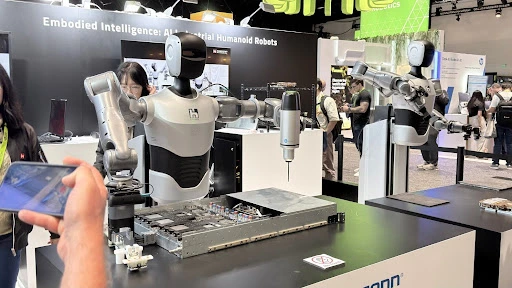
Finally, there is the physical layer, where companies like ABB and KUKA are bridging AI into the real world through robotics, automation, and simulation environments.
What becomes evident is that this is not just an exhibition of companies, but a representation of a vertically integrated AI economy. This is exactly the direction Jensen outlined, where AI is no longer a collection of disconnected innovations, but a fully structured and industrialized system spanning from infrastructure to real-world application.
During the week, I made a conscious effort to spend time with companies that we have not yet engaged with through our own events. The goal was not just to understand what they do, but to see how they position themselves in this new landscape and where they fit in this emerging value chain.
Among the companies I visited were Nscale, Akamai Technologies, Nebius, Cloudflare, Cadence, Baseten, Equinix, WEKA, Lightning AI, Nokia, Together AI, Samsung, Lambda, Crusoe, Mistral AI, and Deloitte, while also reconnecting with partners who have already been part of the Data Innovation Summit ecosystem and observing how their offerings continue to evolve.
Looking across these conversations, a few new strong themes became clear.
The first is the dominance of data center infrastructure at the conference, both hardware and software. From compute to storage to networking and cooling, the focus is on enabling AI at scale, forming the foundation of what Jensen referred to as AI factories. It is not just about having access to GPUs, but about building environments where AI workloads can run continuously, reliably, and efficiently.
The second is the rapid shift toward inference as a primary concern. Many companies are no longer talking about training as the core challenge, but about how to serve models in production, reduce latency, optimize cost per token, and handle real-world workloads at scale. This ties directly back to the keynote message around efficiency and the growing importance of AI economics.
The third is the emergence of end-to-end AI factory solutions. Instead of selling isolated components, many exhibitors are now positioning themselves as part of a complete stack, enabling organizations to move from data to deployed AI systems faster and with fewer integration challenges.
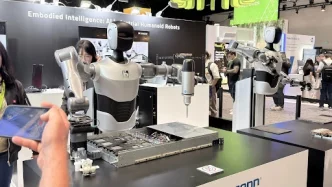
Finally, there is a growing presence of what can be described as physical AI. Simulation environments, robotics, and systems that bridge digital intelligence with the physical world are becoming more prominent. While still early in many respects, this space is clearly gaining momentum and will likely become one of the most important areas in the coming years.
Of course, it is impossible to capture the full diversity of the exhibition in a single perspective. The sheer number of companies and use cases makes that unrealistic. But even within that complexity, the direction is consistent.
We are moving toward an AI ecosystem that is industrialized.
From a Hyperight and Data Innovation Summit perspective, this is particularly interesting. Many of the companies present at GTC are highly relevant to the conversations we are driving in the Nordics and MEA. The opportunity to bring more of these players into our ecosystem, and to connect them with enterprise practitioners who are actively working on these challenges, is both clear and exciting.
The Week Around GTC: Nordic Community, Activities, and Shared Experience
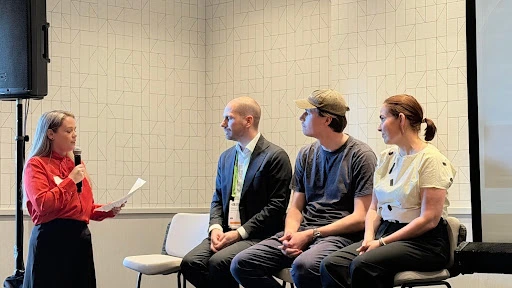
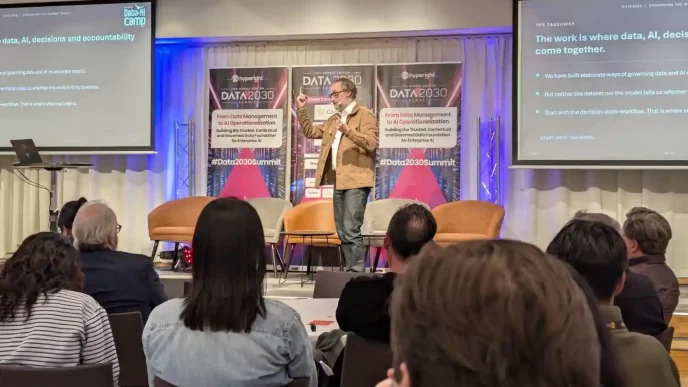
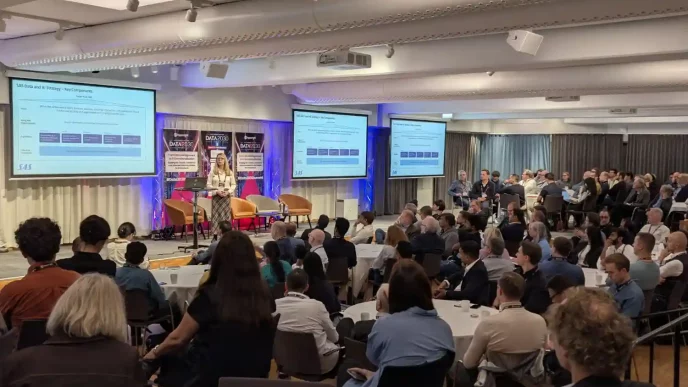
While the official GTC program set the stage, a significant part of the experience was shaped by everything happening around it, particularly within the Nordic delegation and the broader partner ecosystem. Led by NVIDIA, Dell Technologies , SWENODE.AI, and a strong 250+ people community of partners, including ourselves, a number of side events and activities were organized throughout the week, creating a shared space for exchange, reflection, and connection.
The strongest moments of the week, at least for me, were not only found in keynotes or exhibition halls, but in experiencing this journey together with the Nordic delegation, forging new relationships, strengthening existing ones, and creating memories that extend far beyond the conference itself. There is something powerful in bringing together people from different backgrounds, roles, and perspectives, and allowing those interactions to unfold organically over several days in such a concentrated environment.
Even before GTC officially began, the Love at Scale Hackathon in Palo Alto set the tone for what was to come. Organized by Lovable and Swenode.ai in collaboration with NVIDIA and Crusoe , and hosted by Wilson Sonsini Goodrich & Rosati, it brought together an impressive group of builders and innovators. I had the privilege of helping out as a sub-jury member, reviewing several of the products developed during the hackathon, and what stood out most was the speed and creativity of the teams. When talented individuals are given the right tools, the freedom to experiment, and a clear challenge, the results can be remarkable, and the level of ambition in the room was truly inspiring.
Throughout the week, we had the opportunity to meet a wide range of people, from startup founders and students to venture capitalists, enterprise practitioners, and researchers, each contributing their own perspective to the evolving AI landscape. These conversations often provided as much insight as the formal sessions, highlighting how diverse and fast-moving the ecosystem has become.
Visiting NVIDIA’s headquarters, both the Endeavor and Voyager buildings, as well as Stanford University, added another dimension to the experience, providing a closer look at the environments where much of this innovation is being shaped.
We also took part in the Nordic reception in Silicon Valley, where we had the opportunity to hear from the Swedish Minister for Public Administration, Erik Slottner, who presented the latest AI strategy and drew parallels between Silicon Valley and the Nordic Silicon Vallhala. The program included discussions on the new wave of intelligence and on scaling products and businesses in the US, complemented by an address from David Hogan, VP EMEA at NVIDIA, which provided further perspective on the global direction of the ecosystem.
Another highlight was the focus on the current momentum of AI startups in Sweden and across the Nordics. Built on strong engineering traditions, bold founders, and close collaboration between startups, industry, and academia, the region is producing a new generation of globally competitive AI companies. From fast-scaling startups like Strawberry Browser to infrastructure players like Qualia in Denmark and innovators across Finland, Nordic founders are building AI-native products at an impressive pace.
During GTC, we also participated in the unveiling of BuildNordics.AI, a sovereign AI initiative founded by Opper AI, Aixia AB , and evroc. The initiative aims to connect capabilities across the region that have historically existed in silos, bringing together sovereign cloud infrastructure, AI orchestration and optimization, and AI solutions into one cohesive ecosystem. Designed with sovereignty and production in mind, it reflects a growing demand for locally controlled AI in regulated and mission-critical environments, and signals that the Nordics are ready to play a stronger role in shaping this space.
Big thanks to Martin Westblom, Tobias Helmer, Minna Sandberg and Amalia Berglöf for organizing all the Nordic delegation activities. Impressive work.
In addition to these activities, the DEAL Pavilion at GTC offered a packed program with in-depth sessions and discussions, further enriching the overall experience. And of course, being present in the SAP Arena for the pre-keynote sessions and Jensen Huang’s keynote, surrounded by a full arena, reinforced the scale and energy of what this event represents today.
Key Learnings on What This Means for Enterprises
When you step back from the intensity of the week and reflect on everything you have seen and experienced, a few key learnings become very clear.
The first is that AI has officially entered its operational phase. For years, organizations have been experimenting, running pilots, and exploring use cases. That phase is now closing. The conversations at GTC were no longer about what AI could potentially do, but about how to run it reliably, efficiently, and at scale within real business environments.
This shift changes everything. It requires different capabilities, different organizational structures, and a much stronger connection between technology and business outcomes.
The second learning is the importance of economics. The discussion around token cost is not just a technical detail. It is a signal that AI is becoming a measurable and manageable resource. Just like cloud computing introduced cost awareness around storage and compute, AI will introduce cost awareness around intelligence itself. Organizations that understand and optimize this early will have a significant advantage.
The third learning is the emergence of AI factories as a new operating model. This is not just a metaphor. It represents a structured way of thinking about how AI is produced, deployed, and maintained. It connects data, infrastructure, models, and applications into a continuous system rather than isolated initiatives. For enterprises, this means moving away from fragmented projects toward integrated capabilities.
Another important observation is the increasing convergence of roles and disciplines. The boundaries between data engineering, machine learning, software development, and business operations are becoming less distinct. Building and operating AI systems requires collaboration across functions in a way that many organizations are still not fully prepared for.
At the same time, the ecosystem itself is maturing rapidly. The level of specialization among vendors, combined with the emergence of full-stack offerings, creates both opportunities and challenges. On one hand, organizations have access to more powerful tools than ever before. On the other hand, navigating this landscape requires clarity, strategy, and strong decision-making.
Finally, and perhaps most importantly, the human element in this AI renaissance moment remains central. Despite all the technological advancements, the most valuable part of the week was still the people. The conversations, the exchanges of ideas, and the relationships built are what ultimately turn technology into impact.
Technology alone does not create value. People do!
From GTC to Data Innovation Summit 2026 – Turning AI Into Business Reality
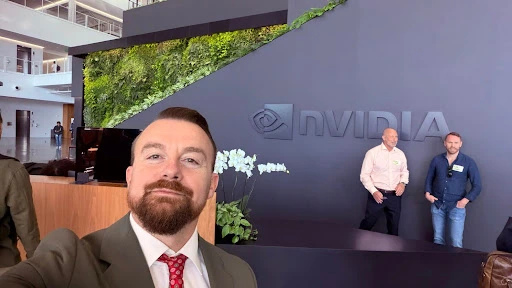
Founder & CEO of Hyperight AB and creator of the Data Innovation Summit (DIS)
As I reflect on the week at GTC, one thing becomes very clear. We are at a critical point in the evolution of AI.
Innovation is no longer measured by ambition alone. It is measured by speed, consistency, and the ability to deliver real business value. This is where many organizations are still struggling. Moving from technology-first experimentation to business-first innovation is not a simple transition. It requires leadership, clarity, and the ability to align the entire organization around a common direction.
Jensen described this as a year of efficiency, a year of invention, and a renaissance moment for enterprise AI. I believe that renaissance goes beyond infrastructure, models, and AI factories. It is also an organizational renaissance.
Enterprises are being challenged to rethink how they operate, how they make decisions, and how they embed AI into the core of their business. This is not something that can be solved by technology teams alone. The responsibility is shifting toward the business. Leadership teams need to define the vision, set the mandate, and create the urgency required to move forward.
AI literacy, strong data foundations, and clear governance are no longer optional. They are prerequisites.
The value that everyone is searching for in AI does not come from isolated use cases or disconnected initiatives. It comes from alignment. Alignment between leadership and execution. Alignment between business and technology. Alignment across the entire organization.
This is exactly where we are focusing our efforts next.
Up next is the Data Innovation Summit 2026 in Stockholm.
We are positioning this year’s summit as an enterprise applied event that focuses on turning vision into reality. Because that is where the real challenge is today. Not in understanding what AI can do, but in implementing it in a way that creates measurable and sustainable impact.
Over three days, we are bringing together one of the largest groups of industry practitioners to share how they are actually implementing data and AI in their organizations. Not from a theoretical perspective, but from real-world experience. What works, what does not, and what it truly takes to move from ambition to execution.
No single company has the full picture of enterprise AI. But when you bring together hundreds of practitioners, each working on different parts of the problem, you start to see the full image emerge. Piece by piece.
The conversations we are hosting this year are too important to ignore.
If you are serious about turning AI into enterprise business value, this is the moment to act. Bring your leadership teams, your business stakeholders, and your technology teams. Because this transformation requires all of them.
We look forward to continuing the conversation in Stockholm.
Learn more and register here: www.datainnovationsummit.com