The path to an AI-driven future is often blocked by a paradox: the more data we have, the less an AI understands without the right framework. As Åge Ingierd, Head of Digital Transformation and AI for Telenor Norway Consumer, reveals, the true “invisible hurdle” is a lack of architected relevance.

How do you move beyond the “AI hype” to build a system that actually understands your business?
In this interview, we are joined by Åge Ingierd, Head of Digital Transformation and AI for Telenor Norway Consumer, to explore how one of the Nordics’ largest organizations is answering that challenge. Operating from within Telenor’s strategy department, Åge leads a powerhouse of AI experts, data scientists, and architects focused on a singular goal: making AI operational at scale.
Throughout our conversation, we explore Telenor’s transition toward a decentralized “value stream” model – an approach that treats data as a high-value, reusable product rather than a technical byproduct. From the hurdle of transforming unstructured data to the cultural shifts required to win the AI race, Åge provides a blueprint for turning data quality into a competitive advantage.
Everyone is chasing an “AI-First” future, but what is the biggest invisible hurdle that usually prevents companies from actually reaching that goal?

Åge Ingierd:I believe the biggest hurdle for many companies is their data. The need for high-quality data intensifies when you want to utilize AI to analyze your data or to improve business process efficiency. As you gain more control over your structured data, you increasingly see the need for well-managed unstructured data, such as high-quality product descriptions and value propositions. 
Much of our existing data was written for humans to read and act upon. This content, often including illustrations and articles, needs to be transformed and cleaned to be usable by AI.
What was the core challenge that convinced Telenor to move away from centralized data teams and toward a decentralized “Value Stream” model?
Åge Ingierd: I think improving time-to-market and streamlining prioritization were key reasons for transforming into a value stream organization. This model fosters autonomous teams where more decisions can be made locally. By having IT and business work together, we can deliver faster and with less friction than when relying on the prioritization of central development teams.
How do you shift the internal culture so that business teams treat data as a high-value “product” rather than just a technical byproduct?
Åge Ingierd: We moved data responsibility out to the teams, having data engineers and software engineers work side-by-side. This allows us to treat data as a valuable and reusable product. Now, when a team develops a product or software, they are also responsible for developing and maintaining the corresponding data product. This should reduce the time between a product launch and the availability of data for insight and action.
In a massive Nordic organization, how do you build common data platforms that accelerate progress without creating a new layer of bureaucracy?
Åge Ingierd: While we are a large Nordic organization, having a common technical infrastructure doesn’t require us to have identical data models or data products from the start. I see this as a gradual transition toward commonality, driven by needs rather than strict enforcement. We had functioning analytics and actionable data before we standardized on a single data platform. Migrating known data sources to a common format requires organizational change and time spent re-learning data and re-engineering models. I believe sharing knowledge about what works and utilizing AI to translate between different data models or country-specific data can help overcome these differences without creating bureaucracy.
Why are the “foundational” essentials-like business glossaries and data quality-actually the most critical factors in winning the AI race?
Åge Ingierd: Good documentation and high data quality are key to getting the right results from AI. Without them, AI can provide wrong answers or no answers at all. As I mentioned, it’s also the unstructured or “unwritten” business knowledge that needs to be captured with good quality and structure.
From the past, data quality, and checking the data have been a focus area, data managers and others working around the data warehouse have really had the focus on quality of the structured data, but now we see that the business glossary is even more important-it’s the company dictionary.
This is where AI can get the information needed to analyze and help us with easy access to data and analysis. Without a glossary to define the term, the AI has no way of knowing how to answer business questions. It will just try to solve the tasks based on the input data, not the definition by the company.
Reflecting on 13 years in the industry, what is the one piece of conventional wisdom about data leadership that you’ve had to completely rethink?
The importance of non-transactional or BSS-adjacent data, and how critical it is to have that information documented in a really clear and granular way so that AI doesn’t get confused. Versioning of this documentation is also crucial so that AI can easily understand what information is the most current.
For example, if you ask an AI, “How many customers do we have with the best camera phone?” it needs the latest technical specs for all phones to answer correctly. An article from 2016 should not be accessible in that context.
“The piece of conventional wisdom” I’ve had to rethink is the old focus on just the ‘big’ transactional data from our core systems. The real challenge today, especially with AI, is managing the huge amount of non-transactional, business-context data, like product specifications, marketing campaign details, or policy documents.
My original thinking was that we just needed to document this information well. Now I realize that’s not enough. We have to architect our data so an AI can understand time and relevance on its own.
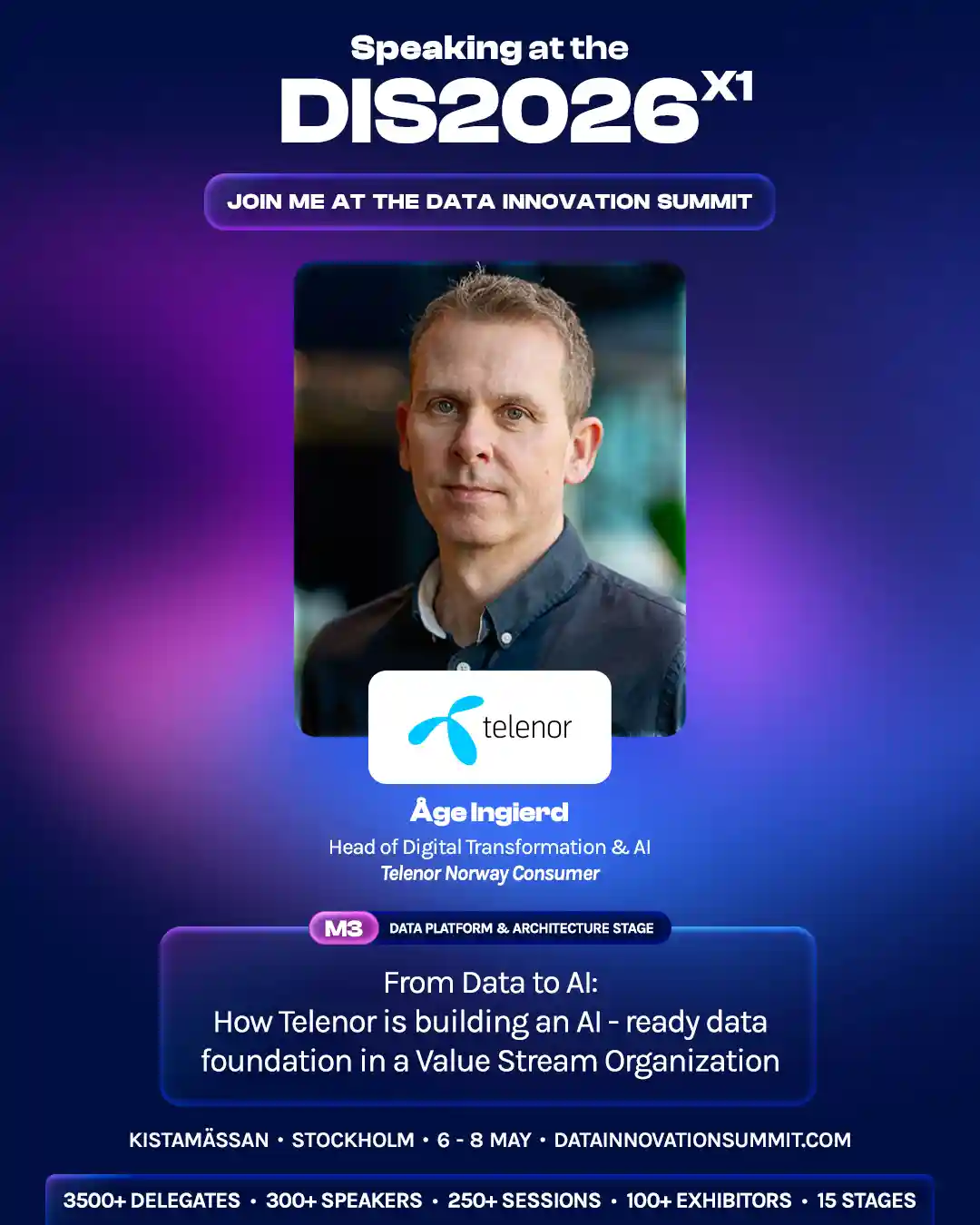
If you want to dive even deeper, join Åge at the Data Innovation Summit as he details Telenor’s roadmap for becoming an AI-first telco through common data platforms and a decentralized ‘Data as a Product’ model. This session is a unique opportunity to learn how to align technical infrastructure with true business-led AI transformation.