

The current conversation about artificial general intelligence is dominated by scale. Larger models. Longer context windows. More parameters. More data. The implicit assumption is that if we keep pushing language models hard enough, general intelligence will eventually emerge as a by-product.
The podcast conversation with Karim Nouira on E174 challenges that assumption at its foundation. Not by dismissing large language models as engineering feats but by arguing that they are solving the wrong problem. Intelligence, in his view, does not emerge from better parroting of human text. It emerges from the ability to navigate the world.
This distinction matters. It reframes AGI not as a language problem but as a control problem, not as a question of scale but of structure, not as a top-down exercise in prediction but as a bottom-up process rooted in embodiment. And it explains why some of the most ambitious claims about imminent AGI feel simultaneously impressive and hollow.
What follows is an attempt to extract and contextualize that argument, situating it within today’s AI landscape and exploring what it means for enterprises, researchers, and leaders trying to separate real progress from noise.
The Hidden Assumption Behind LLM-First AGI
Large language models have reshaped expectations. They reason fluently, write code, synthesize documents, and interact in ways that feel intelligent. It is tempting to assume that general intelligence is simply a matter of adding memory, tools, and agency on top of this foundation.
But that assumption hides a deeper bet: that intelligence is fundamentally linguistic. 
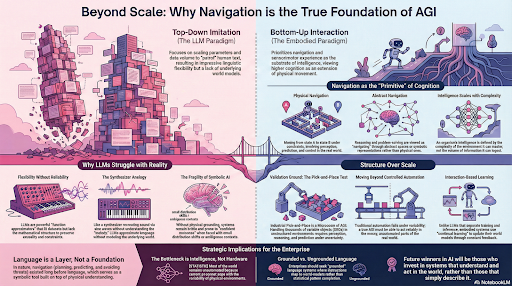
Nouira’s critique cuts across that premise. Language, he argues, is not the origin of intelligence. It is a late-stage compression layer built on top of far more primitive capabilities. Long before humans spoke, they navigated. They planned paths, predicted outcomes, avoided threats, and manipulated objects. These capabilities are not optional extras; they are the substrate on which higher cognition rests.
From this perspective, today’s AI systems excel at symbolic surface behavior while lacking the underlying world models that make intelligence robust. They can produce plausible explanations of reality without being grounded in it. The result is flexibility without reliability and impressive demos that fail under real-world variation.
This is not a philosophical quibble. It is an engineering diagnosis.
Intelligence as a Feature of Nature
A recurring theme in the conversation is the refusal to treat intelligence as an abstract, isolated property. Nouira frames it as a feature of nature, shaped by evolutionary pressure rather than academic definition.
In nature, intelligence exists for one reason: survival. To survive, an organism must move through the world effectively. It must find food, avoid danger, and adapt to changing environments. Every one of these tasks reduces to navigation and not just physical movement, but planning, prediction, and control across space and time.
Seen this way, intelligence is inseparable from embodiment. A system that cannot act in the world, sense the consequences of its actions, and adjust its behavior accordingly is missing the core loop that makes intelligence meaningful.
This reframing has consequences. It implies that intelligence scales with the complexity of the environment a system can master, not with the volume of information it can memorize. It also implies that intelligence is gradient rather than binary. A rat, a cat, and a human differ not because one “has” intelligence and another does not, but because they navigate increasingly complex worlds.
Most importantly, it implies that intelligence is learned through interaction, not ingestion.
Navigation as the Primitive of Cognition
If intelligence is about navigation, what does that mean in practice?
At the simplest level, navigation is about moving from one state to another under constraints. For a robot, that might mean picking up an object and placing it elsewhere. For a human, it might mean solving a mathematical proof. In both cases, the system explores possible paths, predicts outcomes, and selects actions that move it closer to a goal.
Nouira’s argument is that higher cognition is not categorically different from these basic behaviors. Abstract reasoning is navigation in an abstract space. Planning is navigation over imagined futures. Problem-solving is navigation among symbolic representations.
This continuity matters because it suggests a developmental path. A system that cannot robustly perform general pick-and-place in unstructured environments cannot suddenly acquire abstract reasoning through more data. The foundations are missing.
This is where many AGI roadmaps quietly break. They assume that abstract intelligence can be bootstrapped independently of physical grounding. Nouira argues the opposite: without solving embodied navigation, symbolic intelligence remains brittle.
Why Structure Matters More Than Scale
One of the most striking critiques in the conversation concerns the mathematical structure of today’s models.
Large neural networks are powerful function approximators. With enough parameters, they can fit almost any dataset. But this power comes at a cost. The internal representations are implicit, distributed, and largely uninterpretable. Structure is not preserved; it is smeared across a vast parameter space.
Nouira uses a musical analogy to make the point. A synthesizer can recreate any sound by combining thousands of sine waves. The result may be acoustically accurate, but the structure of the original performance is lost. There is no notion of melody, intention, or meaning only signal reproduction.
Language models operate similarly. They approximate linguistic behavior without explicitly modeling the underlying world. This makes them flexible but fragile. Small distribution shifts, ambiguous prompts, or adversarial contexts can produce confident nonsense.
The alternative, Nouira argues, is not less learning but richer structure. Intelligence requires mathematical frameworks that preserve relationships, constraints, and causality. History offers precedents. Dirac’s use of matrices to unify quantum mechanics and relativity revealed antimatter not through data, but through structure. Einstein’s use of non-Euclidean geometry made gravity intelligible as curvature rather than force.
In each case, the leap was not more computation but better representation.
Bottom-Up AGI Versus Top-Down Imitation
This emphasis on structure leads to a fundamental methodological divide.
Most contemporary AI systems are top-down. They begin with vast datasets of human artifacts and attempt to infer general intelligence by imitation. The hope is that by learning from enough examples, the system will internalize the patterns of intelligence.
Nouira describes his approach as explicitly bottom-up. Instead of starting with language, it starts with interaction. Instead of modeling human output, it models the environment. Instead of fitting data, it builds a world model that can be incrementally refined through feedback.
This distinction mirrors child development. A newborn does not begin with language or concepts. It begins with sensorimotor experience. It learns gravity by dropping objects. It learns object permanence by watching caregivers leave and return. Only much later does language emerge as a tool layered on top of embodied understanding.
Crucially, this learning is continual. There is no separation between training and inference. The system is always adapting, always updating its internal model in response to experience.
Why Pick-and-Place Is an AGI Problem
At first glance, industrial pick-and-place seems like a solved problem. Rule-based systems have been doing it for decades. But this impression dissolves under scrutiny.
Traditional automation works only in highly constrained environments. Objects must be known in advance. Lighting, orientation, and placement must be controlled. Variability is the enemy.
The real world is the opposite. Warehouses handle tens of thousands of SKUs, with new items introduced constantly. Objects arrive in piles, not neat arrangements. Materials vary. Shapes deform. Conditions change.
General pick-and-place in such environments is not a narrow task. It is a microcosm of intelligence. It requires perception, reasoning, prediction, and control all under uncertainty. Solving it robustly means solving navigation in the physical world.
Nouira argues that once this capability is achieved, many higher-level problems become tractable. Assembly, logistics, and eventually abstract planning all build on the same foundations.
This is why his team treats physical embodiment not as an application area but as a validation ground. If an AI can act reliably in the world, its intelligence is real. If it cannot, no amount of fluent language compensates.
Robustness, Scalability, and the Enterprise Gap
For enterprise leaders, the implications are practical.
Today’s AI systems excel in controlled settings but struggle in production environments where failure is costly. Hallucinations are tolerable in chatbots; they are unacceptable in factories. Retraining large models for every new scenario is expensive and slow. Hybrid systems that bolt AI onto rule-based scaffolding sacrifice scalability.
Nouira describes a different trade-off. By grounding intelligence in structured world models and continual learning, it becomes possible to achieve flexibility without sacrificing robustness. A single model can control multiple robots because it understands the world they inhabit. New objects can be handled because learning does not require massive retraining cycles.
This matters because most of the world remains unautomated. The bottleneck is not hardware but intelligence that can cope with variability. Enterprises that bet solely on LLM-centric automation risk optimizing for the wrong axis.
Language as a Layer, Not a Foundation
None of this implies that language is unimportant. On the contrary, once grounded, Nouira sees language as a powerful interface.
Ungrounded language is cheap and shallow. Grounded language is precise and actionable. The difference lies in whether symbols refer to lived experience or merely to other symbols.
In a grounded system, language can be used to teach, query, and coordinate. Instructions are not interpreted statistically but mapped onto world models. Questions reflect genuine uncertainty rather than pattern completion.
This inversion challenges the prevailing narrative. Instead of adding grounding to language models, Nouira proposes adding language to grounded intelligence.
Rethinking the AGI Timeline
Claims about imminent AGI often hinge on extrapolating LLM progress curves. More parameters, more compute, more capabilities.
Nouira’s confidence in near-term AGI comes from a different place. It is not about scale but about having identified the right primitives. Once navigation, structure, and continual learning are in place, growth becomes cumulative rather than incremental.
Whether one agrees with the timeline or not, the logic is internally coherent. AGI is not a magic threshold crossed by size alone. It is a systems problem that requires the right architecture.
Implications for Leaders and Builders
For senior leaders, the lesson is not to abandon LLMs, but to contextualize them. They are extraordinary tools for certain tasks, but they are not the core of intelligence.
The deeper question is whether an organization is investing in systems that understand the world or merely describe it. Are they learning through interaction or through ingestion? Are they preserving structure or washing it out?
The next phase of AI will likely reward those who think beyond scale and toward embodiment, control, and world models. The winners will not be those who generate the most text, but those who can act reliably in complex environments.
Closing Reflection
The AGI debate often oscillates between hype and skepticism. What Nouira’s perspective offers is something rarer: a grounded alternative. By returning intelligence to its roots in navigation and embodiment, it challenges comfortable assumptions and reopens foundational questions.
Whether or not his specific approach succeeds, the critique itself is valuable. It reminds us that intelligence is not a trick of statistics, but a relationship with reality.
And reality, unlike language, pushes back.
*This article was enhanced with the help of AI tools, drawing on the podcast transcript and complementary online research. To go deeper into the source material, I encourage you to listen to the full episode and make your own learnings.
Full episode available here.