

Part 2: Building the Foundation – The Four Pillars of Agentic AI Readiness
Successfully integrating agentic AI into an enterprise is not merely a technological upgrade; it’s a strategic overhaul demanding alignment across the entire organization. To move beyond pilot projects and achieve scaled, trustworthy AI operations, organizations must build robust foundations across four critical pillars: People, Process, Technology, and Data. Neglecting any one of these can significantly hinder adoption, erode trust, and diminish the potential value of your agentic AI investments.
Pillar 1: People – Cultivating the Human-Agent Workforce
The rise of agentic AI fundamentally redefines human roles within the enterprise. Instead of widespread displacement, we are seeing a shift towards a new class of “agent bosses” or “AI orchestrators” who collaborate with, guide, and oversee autonomous systems. This necessitates a proactive strategy for talent development and cultural transformation.
Key Considerations for People:
- New Skill Sets: The workforce needs to develop skills to effectively interact with and manage AI agents. This includes:
- Prompt Engineering: Learning to articulate clear, unambiguous goals and constraints for AI agents.
- AI Literacy & Critical Evaluation: Understanding AI capabilities and limitations, and critically verifying agent outputs. This is crucial for avoiding “over-trust” in systems that might hallucinate or operate outside intended boundaries.
- Human-in-the-Loop (HITL) and Human-on-the-Loop (HOTL) Skills: Developing the discernment to know when human intervention is necessary, how to provide effective feedback, and how to monitor AI performance.
- Ethical AI Acumen: Understanding biases in data and models, ensuring fair and responsible AI behavior, and aligning AI actions with organizational values.
- Change Management & Adoption: Leaders and employees must be prepared for cultural shifts, embracing continuous learning and adapting to new ways of working alongside AI.
- Organizational Structure Evolution: Agentic AI can lead to flatter organizational structures, emphasizing deep specialisms and cross-functional collaboration. Teams need to be redesigned to incorporate AI agents as integral members, fostering seamless handoffs and shared objectives.
- Training and Upskilling Programs: Comprehensive training programs are essential, focusing on both technical skills (e.g., interacting with AI platforms, data interpretation) and soft skills (e.g., critical thinking, problem-solving, ethical reasoning, creativity, and empathy, which AI cannot replicate). The World Economic Forum’s Future of Jobs Report 2025 highlights AI and big data skills as increasingly vital, alongside creativity, resilience, and curiosity.
Pillar 2: Process – Orchestrating Autonomous Workflows
Agentic AI doesn’t just automate individual tasks; it orchestrates entire workflows, dynamically planning and executing sequences of actions. This requires a re-evaluation and re-engineering of existing business processes to accommodate autonomous agents and ensure robust governance.
Key Considerations for Process:
- Process Re-engineering: Identify high-value operational bottlenecks and repetitive, multi-step tasks where agents can excel. Redesign these processes to incorporate agentic systems, defining clear objectives, boundaries, and handoff points for human intervention.
- Workflow Orchestration: Establish robust orchestration mechanisms to coordinate how and when AI agents act across different systems, tasks, and human handoffs. This ensures accountability, reduces risk, and aligns outcomes with business goals. Think of it as a control tower for your AI operations, providing visibility and control over autonomous workflows.
- Design for Graceful Failure and Oversight: Agentic systems aren’t infallible. Processes must incorporate explicit pathways for human intervention, clarification, and decision points when an agent encounters an anomaly, reaches its limitations, or requires a nuanced judgment. This includes clear error handling and escalation protocols.
- Governance and Compliance: Establish clear governance frameworks defining the roles, responsibilities, and accountability for AI agents and their human counterparts. This involves setting ethical guidelines, ensuring compliance with data protection regulations (e.g., GDPR, CCPA), and creating mechanisms for regular monitoring and auditing of agent behavior.
- Continuous Improvement Loops: Implement feedback mechanisms where human oversight informs continuous learning and improvement for the AI agents. This treats agentic AI as a living product that is constantly tuned, tested, and refined based on real-world performance and user feedback.
Pillar 3: Technology – Building a Robust AI Infrastructure
The technological backbone for agentic AI needs to be significantly more robust and interconnected than traditional IT infrastructure. It must support high-volume data processing, complex reasoning, dynamic execution, and seamless integration with existing enterprise systems. 
Key Considerations for Technology:
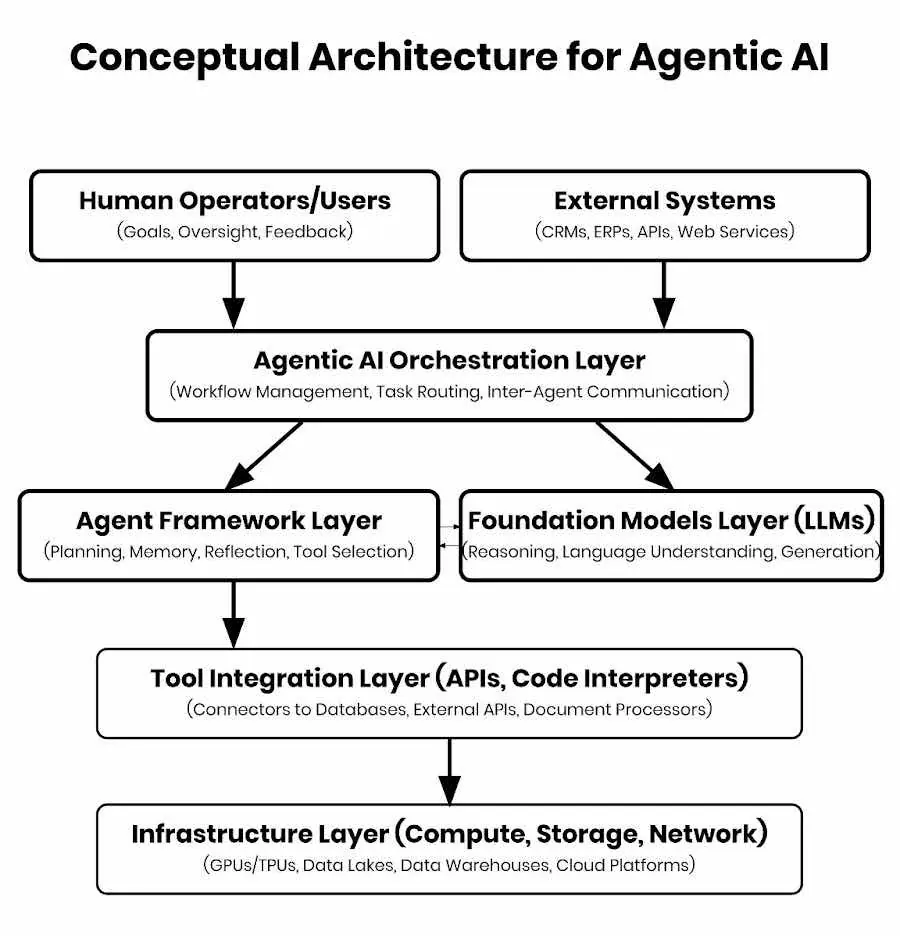
- Foundation Models & Agent Frameworks: Leverage powerful Large Language Models (LLMs) for reasoning, planning, and context understanding. Integrate these with specialized agent frameworks (like LangChain, AutoGen) that provide capabilities for task decomposition, memory retention, self-reflection, and tool selection.
- Scalable Compute & Storage: Agentic AI requires significant computational resources for training and inference, often utilizing GPUs and TPUs. Data lakes and robust data warehouses are essential for storing the vast amounts of structured and unstructured data agents need to access and learn from. Cloud infrastructure is paramount for scalability and flexibility.
- Seamless Tool Integration (APIs): Agents must be able to interact with external tools, applications (ERP, CRM, OMS), and data sources to perform actions. A strong API layer is crucial for standardized, secure, and low-latency communication. This enables agents to query customer data, update inventory, or send communications autonomously.
- Execution Environment & Orchestration: Establish secure, sandboxed runtime environments for agents to operate safely and manage permissions. An orchestration layer is needed to coordinate multiple agents, route tasks based on specialization, and manage inter-agent communication protocols.
- Observability & Monitoring: Implement comprehensive logging, monitoring, and alerting tools to track agent activities, performance, and identify deviations or issues in real-time. This ensures transparency and helps in debugging and continuous improvement.
- Security Architecture: Integrate robust security measures from the ground up:
- Data Access Controls: Ensure agents only access data necessary for their specific tasks.
- Encryption: Protect data in transit and at rest.
- Threat Detection: Implement AI-specific cybersecurity strategies, including proactive threat detection for autonomous systems.
- Sandboxing: Isolate agent environments to prevent malicious actions from spreading.
Conceptual Architecture for Agentic AI (Simplified):
Pillar 4: Data – The Lifeblood of Autonomous Intelligence
An agentic AI system is only as effective as the data it consumes. High-quality, real-time, and contextually rich data is the fuel for autonomous understanding, decision-making, and action. A robust data strategy is non-negotiable for agentic AI success.
Key Considerations for Data:
- Data Quality and Integrity: This is paramount. Agentic systems trained on or accessing incomplete, inconsistent, or biased data will yield flawed insights and take erroneous actions. Implement continuous data profiling, cleansing, and validation processes. Human-in-the-loop validation is essential to ensure accuracy and reliability.
- Real-time Access & Integration: Agentic AI often operates in dynamic environments, requiring real-time or near-real-time data feeds. Establish robust data pipelines and API-driven integrations to continuously feed agents with fresh, relevant information from various internal and external sources (CRMs, ERPs, IoT devices, web data).
- Semantic Layer & Contextualization: Agentic AI thrives on understanding context. Develop a semantic layer (using ontologies, taxonomies, and rich metadata) to provide agents with a unified, contextually rich view of your enterprise data. This breaks down data silos, facilitates knowledge sharing, and allows agents to reason effectively about relationships between different data points (e.g., customer, product, order history).
- Data Governance and Security: Implement stringent data governance policies, including data access controls, encryption (in transit and at rest), and comprehensive audit trails for all data processed by AI agents. This protects sensitive information, ensures compliance with regulations, and builds trust. The principles of FAIR data (Findable, Accessible, Interoperable, Reusable) are critical here.
- Bias Mitigation: Actively work to identify and mitigate biases within training data to ensure ethical and fair behavior from your AI agents. This requires continuous monitoring and re-evaluation of data sources and model outputs.
Next Steps for Part 3: With the foundational understanding of agentic AI and the critical organizational pillars established, we are now ready to explore the actionable strategies. In Part 3, we will focus on the practical aspects of designing and managing Human-AI Collaboration and Agentic System Trust, providing frameworks and best practices to operationalize these concepts within your organization.