
Digital analytics is constantly evolving, and businesses are starting to recognize the power of data to drive better decision-making. But as organizations collect vast amounts of data, the challenge often lies in making that data actionable.
In this interview, we speak with Steen Rasmussen, an expert in digital analytics and Co-Founder of IIH Nordic! Steen has spent his career turning data into actionable insights, helping organizations transition from gut-driven decisions to data-informed strategies. Steen is also one of our featured speakers at the Data Innovation Summit 2025, where he’ll dive into how businesses can move from data-driven insights to decision-specific solutions. We discuss digital analytics, and how emerging technologies like AI-supported decision augmentation are shaping the future of business.
Join us as we explore Steen’s journey and uncover his insights on making data impactful!
Hyperight: Can you give us an overview of your career journey and how you became a leading figure in digital analytics?

Steen Rasmussen: I fell into digital analytics before it was even a thing. Back then, we just called it “trying to figure out what the internet was doing.”
Coming from corporate communication, I quickly realized that most businesses weren’t struggling with a lack of data – they were struggling with knowing what to do with it.
So, I made it my mission to connect data with business decisions instead of just producing pretty reports that no one reads. Along the way, I’ve worked with brands like IKEA, LEGO, and a long list of others, helping them shift from gut-driven decision-making (which sounds exciting but is usually just expensive) to data-informed strategies. 
I also co-founded IIH Nordic because I firmly believe that data by itself is useless – value comes from making the right decisions. Over the years, I’ve spoken at conferences, advised global companies, and tried (sometimes successfully) to make analytics sound a little less like a science experiment and a little more like a business tool.
Hyperight: Your presentation at the Data Innovation Summit 2025 on making data actionable, will cover moving from data-driven insights to decision-specific solutions. What can the delegates expect from your presentation?
Steen Rasmussen: A reality check.
Too many organizations collect mountains of data, generate dashboards, and then… nothing happens. Because data doesn’t create value – decisions do. My session will be about fixing that gap.
I’ll demonstrate how companies can shift from just “having data” to actually using it for something useful, Like making better business and marketing decisions. Expect some real-world examples, practical takeaways, and possibly some more or less hard truths about why your data strategy might not be working. But don’t worry, I’ll also give some practical pointers on how to fix it and even touch upon some AI.
Hyperight: What are the most common pitfalls of attempting to make data “everything to everybody,” and how can organizations avoid them?
Steen Rasmussen: The biggest mistake? Throwing data at people and expecting them to know what to do with it.
Companies love the idea of “democratizing data,” but in reality, they often just create a data free-for-all, where everyone gets a dashboard, no one knows what to do with it, and the only outcome is more meetings.
Instead, organizations should focus on decision access instead of just data access. Ask: What decision are we trying to make? Then deliver data in a way that helps make that decision – without overwhelming people with 47 KPIs they don’t need.
Another common pitfall? Thinking more data = better decisions. In reality, more data often leads to decision paralysis. The real skill is knowing what not to look at.
Hyperight: What does a “decisions-first” approach to data mean in practice, and how can it drive more targeted and effective business strategies?
Steen Rasmussen: Most companies start with data and then try to figure out what to do with it. That’s like buying all the ingredients in a supermarket and then deciding what to cook – it’s really messy, very expensive and usually inefficient.
A decisions-first approach flips this. You start by asking the stakeholders: What business decisions do you need to make? What do you want to cook? Then, you work backward to find the data or ingredients that you actually need for that.
For example, instead of saying, “Let’s track everything on our website,” ask: “What data do we need to make the decisions to improve conversions?” or even more complex issues like “What data do we need to make decisions around increasing the loyalty of our suppliers?” That way, you end up with the data that has actual value in the organization and don’t end up with the usual vanity metrics that might look nice but don’t move the needle where it matters.
Hyperight: As a leader in the field, what mindset shifts or cultural changes are necessary for organizations to fully embrace a decisions-first approach?
Steen Rasmussen: First, stop treating analytics as a reporting function and start seeing it as a business driver. That means analysts should be invited into the strategic conversations with their unique insights and not just be left sitting in a corner making dashboards and PowerPoints no one reads. The analyst is the person who has the strongest direct connection to the market and the customers, so why not use that actively?
Second, embrace less is more. I know it sounds counterintuitive, but when people have too much data, they make worse and much more inconsistent decisions, because they expect to find value in all the data, so they tend to overcomplicate each decision, because they have data they have not used. But the goal of business isn’t to provide all the data – it’s to provide the right data at the right time to make decisions faster and more consistently.
Finally, shift from trusting reports to trusting decisions. If an insight doesn’t lead to action, it’s just noise. If a metric doesn’t drive a change, it’s just decoration. The best organizations focus on turning insights into outcomes, not just information. But it’s important to stress that everything doesn’t have to be a change, it’s perfectly fine not changing something – as long as it happens as a deliberate choice and not as an “in-action.”
Hyperight: What trends or technologies in analytics are you most excited about, and how do you see them influencing the future of decision intelligence?
Steen Rasmussen: The real game-changer isn’t just AI – it’s AI-supported decision augmentation. Not AI replacing humans, but AI supporting and enabling decision-making faster, easier, and less reliant on individual research.
To illustrate this on a more practical level, we did a calculation that a self-driving car with the technology we have today is digesting, analysing and evaluating the content of 17 full books of input every minute or 70 pages every second to handle the car.
In a process like that any human input would slow the process down to an unsafe level.
Now business is a lot more complicated than driving a car, but we’re moving into an era where businesses won’t have to dig through reports and large data sets anymore – AI will surface the right insights at the right time, so we can make the decision. That’s a huge shift because right now, too many organizations waste time looking for data to deliver insights instead of acting on them.
So in addition to this I’m also excited about real-time decision intelligence. Static reports are dying and businesses are moving toward live, dynamic decision-making.
The companies that crack this will gain an enormous competitive edge, while the rest will be stuck in the past, waiting for next month’s historical report to tell them what already happened.
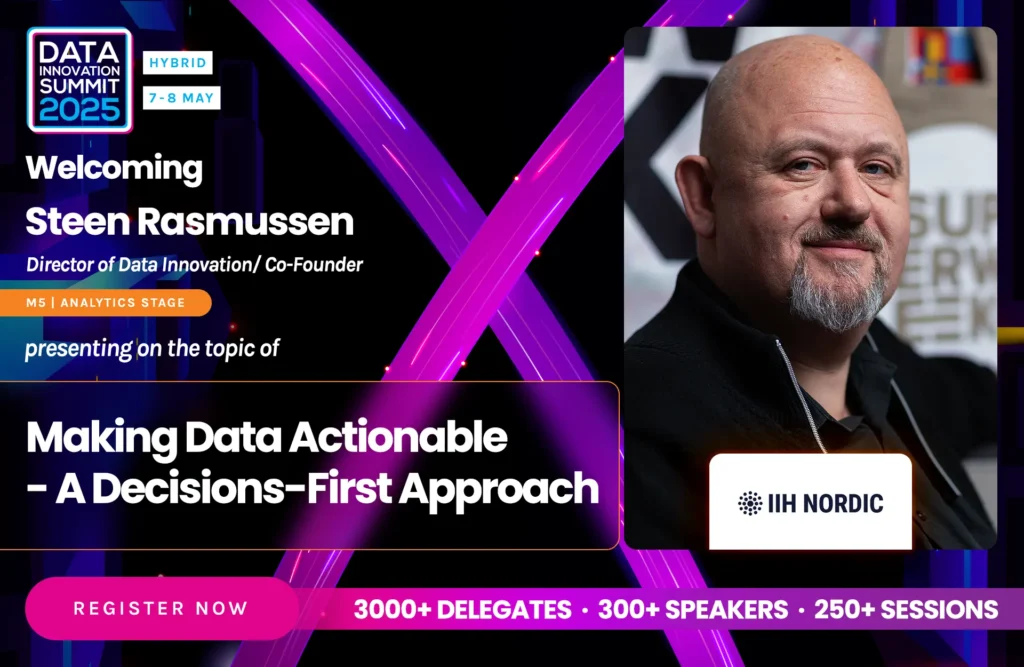
Don’t miss Steen’s presentation at the Data Innovation Summit 2025! Steen will dive into how organizations can bridge the gap between raw data and meaningful decisions, offering strategies to help businesses move from data-driven insights to decision-specific solutions. He’ll also explore emerging technologies, like AI-supported decision augmentation, and their potential to revolutionize how businesses approach decision intelligence.
Join him to learn from his experience with global brands like IKEA and LEGO, and discover how adopting a decisions-first approach can lead to more targeted, effective business strategies. If you’re ready to unlock the true value of your data, Steen’s session at the summit is a must-attend!