

A company can put AI into its products, processes and customer interactions while leaving its most influential decision-making body largely unchanged.
The board receives familiar papers. Investments arrive as separate business cases. Technology, people and risk occupy different parts of the agenda. Progress is assessed against a plan approved months earlier, even as the assumptions behind it begin to shift.
Eventually, that gap becomes a business constraint. Management is asked to build an adaptive enterprise within arrangements that make adaptation difficult.
This was the challenge at the heart of Episode 194 of the AI After Work (AIAW) Podcast with Ingo Paas, board member of Svenska kraftnät, former CIO and author, and Helena Hörnebrant, whose technology and transformation leadership experience includes Nasdaq, Scania and TRATON Financial Services. Together with Henrik Göthberg and Anders Arpteg, we explored a fundamental question: can boards continue to fulfil their responsibilities without changing how they exercise them?
The mandate remains. The conditions are changing. Intelligence is becoming part of operational infrastructure, decisions can be executed automatically, and enterprises depend on capabilities shared across organisational boundaries.
Those developments affect how directors understand value, support leadership, allocate capital and oversee risk. A board’s own readiness becomes part of the enterprise transformation it expects management to deliver. 
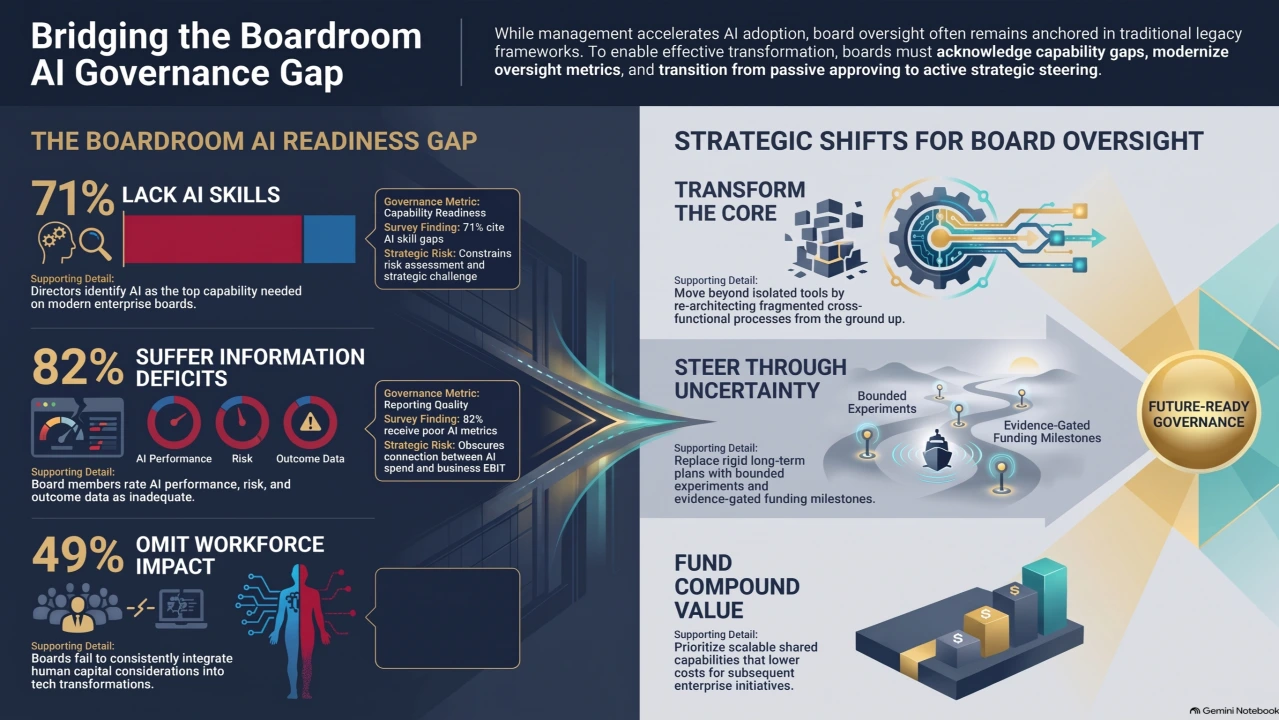
PwC’s September 2026 Annual Corporate Directors Survey provides context: 71% of directors identified AI as the leading skill their boards needed to strengthen. Readiness varies, but the need for development is clear.
The question is how that development translates into better board work. It starts with examining AI through the responsibilities directors already carry.
Strategy and value creation: what will customers still pay for?
As intelligence becomes more accessible, customers gain capabilities of their own. They can research alternatives, compare offers and generate analyses that previously required specialist assistance. Suppliers can provide more personalised services at a different cost. Competitors can challenge established ways of delivering work.
For a business charging for expertise or time, this can reach directly into pricing and margins. If an analysis takes a fraction of the previous effort, what justifies its price? The answer might lie in proprietary knowledge, trusted judgment, implementation or responsibility for a measurable outcome. It needs to be explicit.
A strategic test from the episode makes the issue tangible: does the company become stronger as AI becomes more capable, or does improving AI threaten the basis of its advantage?
That question belongs alongside discussions about market share and growth. It reveals whether the enterprise is strengthening something distinctive or relying on a capability customers and competitors may increasingly obtain for themselves.
Pressure to invest offers little guidance on where value will emerge. Directors need to understand which customer problem is being solved, why the proposed approach matters and how the company will capture the benefit. Adding AI without that logic can increase cost and complexity while leaving the strategic weakness untouched.
Leadership and capability: who owns work executed by AI?
An AI-enabled process brings together commercial decisions, technology, data and employee responsibilities. Organisations often manage these through separate functions, each with its own expertise and authority. A customer experiences the combined result.
Consider the episode’s hypothetical example of an automated discount decision. An AI system makes an incorrect offer, then repeats the mistake at scale. Who owns the outcome? Assigning the software to IT does not resolve responsibility for the revenue loss or customer experience.
The business owner needs sufficient understanding of the technology to exercise responsibility. Technical specialists need enough commercial context to build appropriate controls. Leadership must make those responsibilities work together.
This is also a workforce issue. New capabilities require changes in skills, roles and expectations. Deloitte’s November 2026 survey of 806 board members and executives across 53 countries found that 49% said their boards did not consistently include human capital considerations in AI and technology transformation discussions. The research covers technology transformation broadly, including AI, and illustrates how connected changes can be governed apart.
For directors, the leadership question extends beyond appointing someone enthusiastic about technology. Management must be capable of preserving today’s performance while developing a different way of operating. The board needs to understand whether its mandates, incentives and expectations support that work.
Performance and capital: what does an investment make possible?
Imagine two enterprises that have completed ten AI initiatives. Both can report activity, expenditure and results. Their readiness for the next investment may nevertheless be very different.
One starts again with each project. It reconnects data, recreates controls and repeats integration work. The other develops capabilities its next team can use. Knowledge, infrastructure and working methods carry forward.
Separate business cases can conceal this difference. An initiative may bear costs that enable several others. Benefits may emerge across functions or over a longer period. Judged alone, an enabling investment can appear unattractive even when it improves the economics of the wider portfolio.
Boards need visibility into those relationships. What will later initiatives reuse? Who will adopt the capability? How will management demonstrate that reuse has reduced cost, effort or risk?
There is still a financial limit. Shared infrastructure can be poorly designed or underused. Reuse can remain a promise. Directors need evidence of benefit alongside a credible account of operating costs and adoption.
The investment question therefore includes both the immediate return and the enterprise’s cumulative ability to deliver. A growing collection of projects offers little assurance that the organisation is becoming more capable.
Risk and accountability: can control keep up with action?
The same dependencies that support scale can spread failure. A shared data source, model or access mechanism may underpin several services that appear separate in investment reports.
An error can travel across those services. A supplier disruption can affect activities owned by different executives. Assessing projects independently may obscure the concentration of exposure.
Delegated authority adds another dimension. An AI system that recommends an action creates different consequences from one authorised to change records, send offers or commit resources. Giving it that authority transfers part of the enterprise’s capacity to act into its infrastructure.
A person can remain accountable on paper while lacking a realistic ability to supervise the activity. Human involvement becomes meaningful when authority has defined limits, behaviour is monitored and intervention is possible within the time available.
Resilience also belongs in this discussion. Reliable delivery can influence why a customer chooses a supplier. Security and continuity can contribute to customer value where important activities depend on the service.
The board should understand how service commitments, operating dependencies and protective investment fit together. Its task is to assess whether management can deliver sufficient control and recovery, while executives remain responsible for designing and running the arrangements.
The connections change the governance problem
Looking across these responsibilities reveals a common pattern. Customer value depends on operating capabilities. Those capabilities depend on shared infrastructure, workforce skills and decisions about authority. The same relationships influence financial performance and risk.
The enterprise becomes harder to understand as a collection of self-contained initiatives. Decisions in one area can change the economics or exposure of another, including through suppliers and partners outside the company.
A supplier’s model update, for example, could alter the behaviour of a customer process without changing the enterprise’s stated strategy. Management then needs to assess the operational consequences, the commercial effect and the adequacy of existing controls together. Directors need a view of whether those responsibilities are coordinated across the organisation and its partners. The company boundary remains important for accountability, but it no longer describes every capability on which performance depends.
Three shifts in board thinking follow from that observation. They offer propositions to examine against the realities of each business: move from additive to multiplicative thinking, add navigation and stewardship to planning and control, and support transformation from the core.
First shift: from additive to multiplicative thinking
Additive thinking assesses a series of initiatives and combines their expected returns. Multiplicative thinking examines how those initiatives change the conditions for one another.
A common data capability can reduce the effort required for several services. An evaluation method can improve successive deployments. Experience with failures can strengthen future decisions. The value resides partly in the relationships between investments.
Ingo captured this ambition with a simple phrase: “You have one capability addressing 50 problems.” The number is illustrative. The principle is to develop capabilities that become more useful as the organisation builds on them.
For boards, this requires examining what the enterprise retains after delivery. Can another team use what has been built? Has the organisation reduced repeated work? Does each investment leave it better prepared for the next opportunity?
The same scrutiny must run in the opposite direction. A common capability may create a bottleneck or transmit a failure. An architecture that accelerates adoption can also concentrate dependence on a provider or dataset.
Directors therefore need to understand where connections multiply value and where they amplify risk. A portfolio report should make those dependencies visible enough to challenge, with evidence that expected benefits are actually materialising.
This changes the unit of analysis. An individual business case remains useful, but its place within the enterprise’s wider capabilities and commitments becomes essential to judging it.
Second shift: add navigation and stewardship to planning and control
A company can know the business outcome it wants without knowing exactly which combination of technology, process changes and adoption efforts will deliver it. Its investment arrangements need to accommodate that uncertainty.
Helena’s experience at TRATON Financial Services provides a practical example: establish the ambition at board level, then steer through smaller steps and regular reviews. Direction gives management a mandate. Evidence informs further commitment.
Navigation means understanding changing conditions and adjusting the route. Stewardship means preserving the enterprise’s long-term viability, integrity and purpose while doing so. Together, they add a discipline that a fixed plan cannot provide on its own.
The challenge is to support learning without creating permission for indefinite experimentation. A trial should answer a business question. Expansion should depend on evidence of adoption, reliability and economics in the intended setting. A result that disproves an assumption can prevent a larger mistake.
Different activities also need different rhythms. An operational exception may require an immediate response. An experiment may warrant frequent review. A significant strategic commitment may require deliberate analysis and independent challenge.
Directors cannot respond to machine-speed activity by supervising transactions themselves. They need clear management mandates, timely information and escalation arrangements for material changes.
Better feedback matters as much as faster reporting. Board information should test the assumptions behind the strategy, including evidence that the plan itself deserves reconsideration. Otherwise, directors can become well informed about progress towards an outcome that is losing relevance.
Third shift: transform from the core
Many enterprises operate through fragmented applications and processes that work because people bridge the gaps. Employees reconcile records, interpret inconsistencies and resolve exceptions that no single team owns.
AI can perform some of that activity while making the underlying fragmentation easier to tolerate. The organisation gets faster without becoming more coherent.
Transformation from the core begins with the enterprise’s customer relationships, products, processes, data and decision-making. It asks how intelligence can strengthen those capabilities together, including the organisational arrangements needed to use it effectively.
That involves authority and operating logic as much as technology. Who can change a workflow? Who is accountable for its complete outcome? Can the responsible teams combine commercial knowledge, technical expertise and workforce development?
The transition must also respect the existing business. Helena’s observation about holding “two truths at the same time” captures the leadership challenge. Current operations generate revenue and fund change. Emerging capabilities may require different structures and expectations. Both need attention.
A board should support that transition through appropriate mandates, leadership choices and investment decisions. It should expect management to explain how the pieces fit together, with enough clarity to challenge whether proposed changes address the underlying constraints.
Principles remain important. Execution needs scrutiny.
A central disagreement in the episode deserves to survive any neat framework. Does AI require a different model of governance, or does it expose weaknesses in how existing principles are applied?
Slow, reactive review clearly struggles when an automated system can make thousands of consequential decisions before anyone intervenes. Yet responsibility, supervision and monitoring remain relevant. Artificial agents need enforceable boundaries just as human activity does.
The disagreement also guards against a tempting shortcut: assuming that automated oversight resolves the problem simply because manual oversight cannot keep up. Systems used to monitor other systems still require testing, clear responsibilities and scrutiny of their own limitations. The board should understand what assurance management can provide and where uncertainty remains.
The difficulty is implementing those principles at the necessary speed and scale. Nominal oversight offers little protection if the organisation lacks effective monitoring or a practical way to stop unacceptable activity.
NIST’s AI Risk Management Framework Playbook provides supporting context by connecting AI governance with existing controls, defined responsibilities, testing, monitoring and incident response. These are foundations; their existence alone does not establish that a deployment is adequately controlled.
Boards need informed ambition and independent scrutiny together. Technical achievement, commercial success and effective governance deserve separate evaluation. Speed can inform what an enterprise attempts; it cannot by itself validate how authority is exercised.
Seven practical changes for the boardroom
These actions translate the episode’s arguments into an agenda directors can apply, assess and revisit.
1. Make AI learning continuous and practical
Build recurring learning around actual company decisions. Give directors experience with approved tools and suitable information, including unreliable outputs and failed assumptions. Assess proficiency honestly and revisit gaps as capabilities change. The objective is better judgment about strategy, investment and control. Include bounded experiments in board preparation, with source verification, to understand how AI can improve directors’ own work while preserving independent challenge.
2. Stress-test customer value and competitive advantage
Ask how increasingly capable AI could change pricing, customer expectations and the basis of differentiation. Examine where the enterprise becomes stronger and where its contribution becomes easier to replace. Agree which assumptions require testing and which signals should trigger strategic review. Require management to explain how the company will capture value, alongside any productivity forecast, and connect those choices to the capabilities it needs next.
3. Examine ownership across one core workflow
Follow a commercially important process from customer need to outcome. Review how people, AI, systems and data work together. Identify the executive accountable for the complete result and test that accountability against an automated error. Include workforce skills and cross-functional dependencies. The board should gain assurance that management has integrated responsibility across the process, with the authority and information needed to exercise it.
4. Release funding against evidence
Agree the intended outcome, spending boundaries and evidence required for further investment. Review adoption, reliability, commercial benefit and material risk together. Establish criteria for changing direction, stopping and expanding. This gives executives a mandate to learn while preserving financial discipline. It also distinguishes permission to explore a promising opportunity from permission to deploy a consequential service at scale, where the requirements for assurance become greater.
5. Measure reuse and shared exposure
Require significant proposals to explain what later initiatives can reuse and who will adopt it. Revisit whether promised benefits materialise in deployment time, duplicated effort, cost or reliability. Examine common dependencies alongside those gains. Directors should be able to judge whether investment is building adaptable capability, creating an operational bottleneck or concentrating exposure that separate project reports would otherwise conceal.
6. Define and test delegated authority
Establish which AI systems advise and which act. Ask management to demonstrate limits, monitoring and intervention arrangements for consequential uses. Rehearse a failure involving a customer, a shared capability or a supplier. Test who can stop activity, correct outcomes and communicate with those affected. The relevant assurance is whether accountability works under realistic conditions, including when action happens faster than manual review can accommodate.
7. Adapt information and decision rhythms
Agree what management can decide within its mandate, what requires immediate escalation and what belongs in periodic review. Request concise reporting connecting outcomes, investment and risk. Ensure committee responsibilities fit together across technology, workforce and commercial changes. Review whether directors have enough visibility to challenge direction while executives can act. Adjust these arrangements as experience reveals where oversight is too slow, incomplete or unnecessarily restrictive.
What remains fundamentally human?
AI counterparts attending board meetings and agents handling more investment decisions are possibilities explored in the episode. Their timing and feasibility remain uncertain. They raise a useful question now: what should human authority mean as more intelligence becomes available for delegation?
An enterprise needs people who can define its purpose, examine competing interests, establish boundaries and accept responsibility for consequential choices. More capable execution makes clarity about those choices increasingly important.
The board’s future contribution may place greater emphasis on intent: which outcomes the enterprise should pursue, which commitments it must honour and what it should refuse to optimise away. That emphasis adds to its responsibilities rather than making financial control or accountability disappear.
Readiness for AI becomes visible in how directors connect purpose with leadership, capital and oversight. It requires enough understanding to support opportunity, enough independence to challenge assumptions and enough humility to learn when conditions change.
Every enterprise asking its workforce to adapt should expect the same effort from its board. Transformation reaches the top through the decisions made there. Those decisions will be more effective when directors examine their own working practices with the seriousness they bring to management’s performance.
*This article was enhanced with the help of AI tools, drawing on the podcast transcript and complementary online research. To go deeper into the source material, I encourage you to listen to the full episode and make your own learnings.
See or hear the full episode here.