

What Stefan Wendin’s experiments with agent memory reveal about building autonomous systems that can revise what they know, explain what they did, and recognize when they should wait.
At the end of a month, an enterprise agent approves a supplier under the rules it has been using for weeks. The next morning, it receives a policy change that took effect three days earlier. What should it do with that information? It needs to apply the new rule to future decisions. It may also need to flag the approval for review. And when someone asks how the original decision was made, the agent needs to reconstruct what it knew at the time, including the fact that the new rule had yet to reach it.
A larger context window might hold both versions of the policy. A vector search might retrieve both passages. The hard part is deciding how those versions relate to each other, whether the change applies to this supplier, and what the agent has authority to do about a decision it already made.
In Episode 193 of the AI After Work (AIAW) Podcast, we welcomed back Stefan Wendin, Deployment Strategist at QuTwo, to talk about this problem with Anders Arpteg and Henrik Göthberg. Stefan came to the conversation with a background in knowledge graphs and a set of experiments in which he built his own memory system, put different agents on top of it, and used it himself. He went in asking what kind of database makes the best agent memory. The work led him to a harder question. Can a system change what it treats as true while preserving enough of its past to explain its decisions?
That question matters the moment an AI system carries state from one task to the next. A bad answer can be corrected in a conversation. A bad memory can outlive the conversation, travel to another agent, and influence decisions for weeks. The reliability of an autonomous system therefore depends in part on the quality of its revisions, including what it chooses to forget.
A memory needs two clocks
Stefan made the point with an example about drinking water from a wine glass. Suppose an agent has recorded that preference. The next time it sees him, he uses a different glass. Has the preference changed? One observation could reflect what was available that day. A direct statement from Stefan would be stronger evidence. A preference might also vary by setting. A memory system that treats every new observation as a replacement turns ordinary variation into a succession of false certainties. 
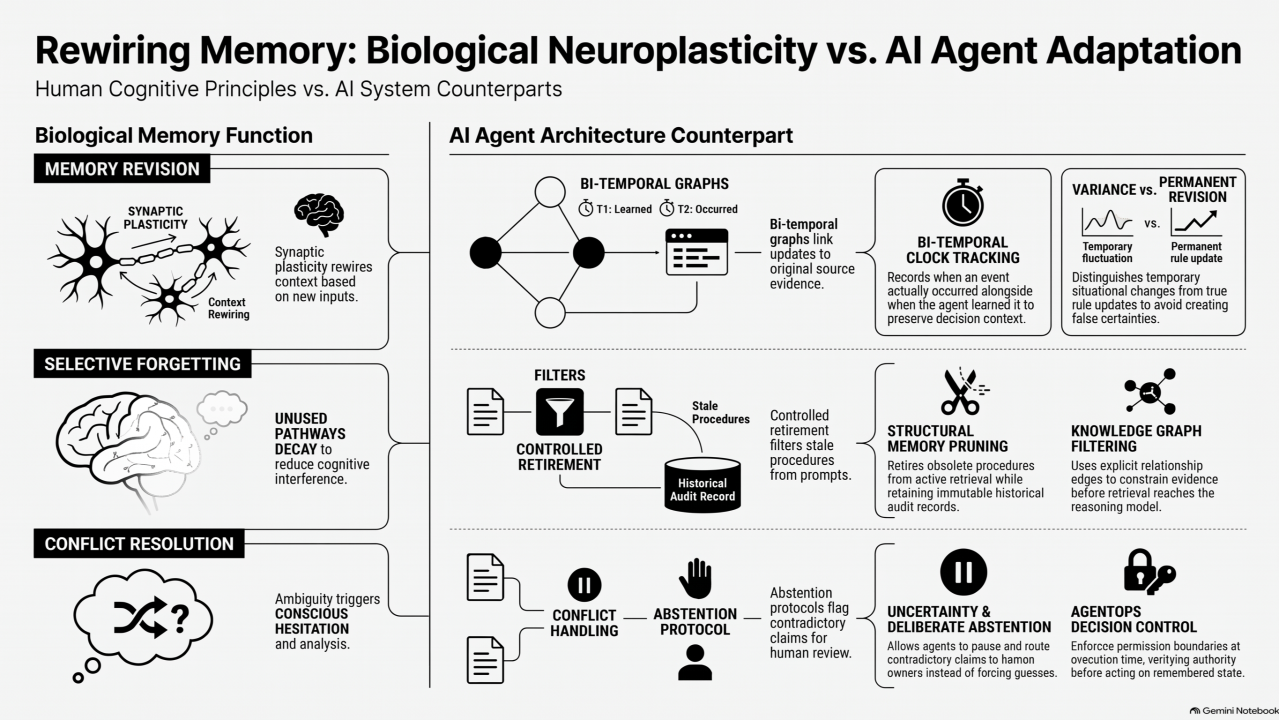
Stefan’s starting point is to keep track of two clocks. One marks when something happened or when a claim was valid. The other marks when the system learned or recorded it. In the supplier example, the new policy was already in effect when the agent approved the supplier, although the old policy was still the version available to the agent. Those two answers support two different business questions. What should we do under the applicable policy? What evidence did the agent have when it acted?
The difference becomes more important when information moves across teams and systems. A contract can be signed on one date, take effect on another, and reach the agent on a third. A later correction can reveal that the effective date was wrong all along. A simple overwrite erases the difference between a policy change and a correction to the record. Keeping both dates and linking the revision to its source gives a reviewer a way to see what happened and decide whether past actions warrant a closer look.
There is another distinction here between an event and the claim drawn from it. A customer saying “we are likely to renew” is a recorded event. A renewal commitment is a different claim, with different evidence and business consequences. If a summary turns the first into the second, every subsequent use of that summary can amplify the mistake. A reviewable memory lets someone follow the claim back to the original statement and correct the interpretation at its source. Stefan develops the case for preserving these relationships in his essay on memory and revision.
Use the graph to narrow the context
One of Stefan’s most interesting points was about what he would use a knowledge graph for. An embedding search excels at finding passages that resemble a question, even when the wording differs. An explicit relationship can express that an amendment supersedes a clause, that a procedure applies to one business unit, or that a named role approved an exception for a defined period. The agent can use those relationships to narrow the evidence it considers.
Think of a support agent looking up how to handle a product return. A similarity search could surface a current return policy, its predecessor, and an almost identical policy for another market. All three are useful search results. Only some are applicable. A relationship to the market, purchase date and governing policy version can constrain the evidence before it reaches the model. The aim is to give the model fewer plausible ways to apply the wrong policy.
A graph makes those constraints possible when the underlying relationships are reliable. An edge marking an exception as company-wide will spread an error just as efficiently as a correct edge will narrow the search. Someone has to decide how to identify the same customer across systems, what a relationship means, and who can assert that a policy supersedes another. Anders pushed Stefan on how teams get there. Stefan described using a language model as a sparring partner to explore possible structures. The domain expert still has to know which decisions the structure must support and which distinctions are consequential.
Stefan used SQLite in his experiments because it was cheap and quick to change. That choice is worth paying attention to given his graph background. When the team is still learning whether it needs to distinguish a policy, an exception and an approval as separate entities, the ability to test another design in an afternoon matters. At production scale the economics change. A memory design carries a cost to populate, query, correct and maintain. A relationship that is elegant to draw can be expensive to keep accurate across millions of records. The test is whether the added structure earns its place in the workflow.
Temporal graph architectures already illustrate part of the design space. The Zep paper describes a graph that combines business data and ongoing conversations while preserving historical relationships. SodaMem, a 2026 preprint, links assertions to evidence and represents updates and contradictions explicitly. These approaches are useful to examine for the distinctions they make expressible. For a buyer, the revealing question is what the system will actually return when two sources disagree about an exception, and what it will do after the source owner corrects the record.
Give the agent a way to say it cannot decide
Stefan described a set of experiments that varied a familiar needle-in-a-haystack test. The researchers invented terms and placed incompatible claims about them across documents. They wanted to see what would happen when several candidate answers had textual support and the correct response was to acknowledge the conflict. As Stefan recounted it, some models selected one of the supported claims. In some runs, giving a model room to elaborate led it to recognize the conflicting evidence and still produce a confident justification for picking one answer.
The experiment is revealing as a failure mode, and the episode account gives little basis for ranking model families. Retrieval can work, the model can identify the relevant passages, and the system can still mishandle the decision. It matters whether the workflow accepts uncertainty as an outcome. An agent that can only approve or reject a request has to force ambiguous evidence into one of those choices. An agent that can pause, record the conflict and route it to an owner has another course of action.
Conflicts also take different forms. Two policy records may both be right for different markets. A newer message may genuinely supersede an older instruction, or it may be a proposal from someone who lacks approval authority. Several summaries that repeat the same claim may all derive from one email. Treating them as independent sources inflates confidence. For a procurement agent, resolving the source and scope of the discrepancy can matter more than adding another document to the prompt.
There is also a difference between recognizing a contradiction and having the authority to resolve it. The agent may be able to show a reviewer both claims and identify the contract clause in question. It still needs a rule for who can approve an exception and how that approval reaches the system. In a companion essay, Stefan explores how a well-maintained record can still lead to an unauthorized action if the same planner interprets its own restrictions and controls the tool that executes the decision. A practical implication is to enforce approval requirements where the action happens. A remembered approval should remain evidence whose authority can be checked.
From MLOps to AgentOps
The operational implications become clearer in Stefan’s attempt to let models from two providers work against the same store. His aim was to get them to collaborate without overwriting each other’s work. He described finding himself at his desk, pointing at two screens like a newly promoted manager trying to micromanage his team. The results were difficult to make consistent. The story captures a familiar problem in enterprise software. A shared resource feels like a shortcut until the participants bring different assumptions about what they can change.
Imagine one agent recording an observation from a call while a second updates a case summary and a third reads the summary to prepare an action. If the summary silently drops a qualification, the third agent can act on a certainty that none of the original sources expressed. If a retry writes the same observation twice, another component might treat the duplicates as corroboration. Each model can look competent in isolation while the system as a whole gradually distorts the record.
MLOps disciplines such as versioning, monitoring and regression testing still apply. AgentOps extends the operating responsibility to the state that agents read and write, the tools they use, and the decisions that follow. For a consequential action, it helps to be able to identify the policy version, the evidence available to the agent, and the permission under which the tool ran. That is an inspectable record of the decision conditions. The operational owner can use it to distinguish a stale index from a model error, a misapplied exception, or a workflow that gave an agent too much discretion.
It also changes what counts as a good release test. Give the agent a policy and then an amendment that arrives after its effective date. Ask it to answer a current question and reconstruct an older decision. Add a second document that appears to reverse the amendment but lacks authority. Run the sequence after replacing the model or changing the memory component. A pass requires the agent to apply the right version, preserve the discrepancy for review and stop where approval is missing. A strong score on isolated questions would miss much of that behavior.
LongMemEval gives teams a starting vocabulary by treating knowledge updates, temporal reasoning and abstention as distinct capabilities. Its successor, LongMemEval-V2, examines whether agents can use experience gathered while interacting with specialized environments. The researchers also report a latency cost for methods that do more work to gather evidence. That matters in a live workflow. An architecture that spends heavily reconstructing context for every routine question may perform well in a test and still be a poor fit for the workload. The time and cost to establish usable evidence belong in the evaluation alongside answer quality.
Forgetting is an operational decision
When Stefan tested the system on himself, he found stored notes he wanted to remove, including things he found embarrassing or initially thought irrelevant. He then questioned whether the memory had actually improved. Something he disliked seeing might still have explained a later choice. Henrik described the broader idea as plasticity. The current picture changes shape as new information arrives, and older material can lose influence without losing its historical significance.
For an enterprise, forgetting can mean retiring a procedure from active use while retaining the record that governed old cases. It can mean expiring a temporary preference so it stops resurfacing in future tasks. It can also mean removing information under the applicable policy, which raises a different question about the summaries, indexes and links derived from it. These operations have different consequences. Treating all of them as a single delete button makes it hard to tell what the agent can still retrieve and harder to explain why.
Henrik connected this to Peter Drucker’s idea of systematically abandoning activities that have outlived their purpose. He made the point with a joke about an organization that has fourteen processes, creates a standard to replace them, and ends up with fifteen. An agent can make that pattern worse. Index the new standard alongside the old ones and each version remains available to influence a decision. An effective change therefore includes a way to retire the old procedure from active retrieval, identify the scope of the replacement, and preserve whatever history the organization still needs.
There is a human side to this. A persistent assistant can make an old preference feel current by bringing it back at the wrong moment. A team may become accustomed to an agent’s account of why an earlier decision was made, particularly if it tells a coherent story. Over time, people may start deferring to that account. The ability to inspect and contest a memory is part of preserving human judgment. So is allowing an agent to preserve a disagreement in the record until the people responsible have resolved it.
Who owns the experience the agents accumulate?
The episode moved between personal, team and enterprise memory. The distinction is useful because the same observation changes meaning as it moves across those boundaries. A personal preference can help an assistant draft an email. A team convention can guide a handover. An enterprise policy can govern whether an agent is allowed to make a commitment. A system that promotes repeated local behavior into a company-wide rule can make a team’s workaround look like official policy.
Henrik argued for relationships between these layers, and Stefan kept returning to the work of discovering what matters at each one. Take a sales team that routinely handles an unusual class of renewals by involving finance early. That pattern might be valuable to remember at team level. It could also reflect a temporary workaround for a staffing gap. If the enterprise chooses to make it a formal control, it needs a decision and an owner. The agent can surface the pattern and the cases that support it. The organization decides what status to give it.
Stefan also discussed the possibility of training specialist models on richer representations of how work happens. He described organizational knowledge as something that lives between people and artifacts, such as the conversation between two colleagues, the PDF they were looking at, and the sketch they made on a whiteboard. A specialist model might become better at reading that structure or performing a narrow task with it. The signed approval, the effective dates and the right to correct a mistaken claim still benefit from an inspectable record outside the model. That gives the organization a way to change what the agent uses without waiting for another training cycle.
For me, this is where sovereignty becomes a practical question about enterprise memory. Suppose you move the same workflow to another model. Can you carry over the evidence, the history of corrections, the access rules and the decisions your teams made along the way? Can a domain owner amend a claim and see the effect across the agents that use it? A company might retain every original document and still lose the relationships that explain why an exception exists or which record a team actually used. That accumulated knowledge is part of the asset.
What happens when the agent is wrong?
The question I came away with is simple. When someone says “that’s wrong,” what happens next? Can the agent identify the claim in dispute and show where it came from? Can it recognize that a colleague is correcting a fact while a customer is expressing a different preference? Can the organization make a correction once, update the decisions still in flight, and preserve the history it needs to review completed actions?
The answer will vary with the job. An assistant brainstorming campaign ideas can let stale suggestions fade with little ceremony. An agent that approves a purchase needs tighter rules for what counts as current evidence and who can authorize a change. Between those two sit the daily decisions where people have to decide how much work to delegate and how easily they can take it back. A memory system earns more responsibility when its behavior under revision is as legible as its behavior on a good day.
In the opening example, the agent can show the policy it used, record when the amendment arrived, and identify which approvals fall in the affected period. It can then route them to the people with authority to decide what happens next. That is the kind of memory worth building. It gives the organization a way to learn from what happened and enough control to change course.
*This article was enhanced with the help of AI tools, drawing on the podcast transcript and complementary online research. To go deeper into the source material, I encourage you to listen to the full episode and make your own learnings.
Link to the full episode here.