Moving AI from experimental testing to classified, contested environments might bring complex organizational and architectural friction to the surface. Ahead of the NDSML Summit, Senadin Alisic, Strategic Planner at Combitech and Saab, discusses why scaling defense AI requires decoupled data products and an evolved operating model.

In defense and high-reliability environments, deploying artificial intelligence can introduce challenges that extend beyond algorithmic performance. While sandboxes may indicate feasibility, moving toward live operations can mean addressing fragmented data ownership, strict security classifications, and edge connectivity limits.
At Combitech and Saab, Strategic Planner, Senadin Alisic, aligns business strategy with operational delivery. Ahead of his session at the NDSML Summit, Senadin explains how attaching governance directly to data products, establishing continuous oversight, and decoupling architecture allow defense organizations to build resilient, adaptive systems.
What specific constraints make deploying AI into live defense operations so complex?

Building the AI model is rarely the hard part. A prototype works in a sandbox and the pilot gets applause. Then it meets the real environment: several business areas, several domains, several data owners, classified networks, degraded connections, and approval chains designed for a different kind of work. On top of that sit legal limits on autonomy and the need for accountability when a system acts.
So, the constraint is not the algorithm. It is that data, decisions and responsibility are spread across organizations that were never designed to work as one system.
Why is decoupling data architecture from individual applications so important for mission-critical defense systems?
When data is locked inside the application that created it, each new model typically needs a new integration, and each new agent often needs its own data access approval. That is slow, and in a mission it is also fragile, because critical data depends on specific systems and the connections between them. Decoupling data from the application, with clear ownership, defined quality levels, and clear rules for use, can make data reusable beyond any one system. 
Then applications become easier to replace or upgrade, ecosystem partners become easier to add, and models and agents can reuse the same trusted data without rebuilding the pipeline each time. It also makes it easier to keep critical data available locally when connections are degraded, which is common at the edge.
In the end availability is not easy to guarantee, so critical data must be prioritized, available locally, protected, and tested under degraded conditions.
When separating data governance from AI applications, how do you enforce strict classification rules while maintaining system interoperability?
This is a real challenge, and it is one of the barriers to scaling AI. The two goals are in tension. Classification rules say, “restrict and separate”, while interoperability says “connect and share”. If we rely only on strict separation, data stays in silos and AI can use only a fraction of it. If we connect everything, we increase the risk of security breaches and of combined data revealing more than any single source would.
At the highest level, the principle is that the rules should follow the data, not sit only in the application. Each data product carries its classification, owner, and permitted use as metadata. Within the boundaries of accredited systems and security domains, policy can then determine access based on who is asking, for what purpose, and from which network. Shared standards and common semantics support interoperability, so systems can understand each other without sharing everything. Governance also becomes continuous, with logging and monitoring complementing formal approvals.
The exact mechanisms differ between nations and systems, so these are design principles rather than a specific product. Any solution must be adapted to the applicable classification rules, security requirements, and regulations.
What structural changes must defense organizations make to their operating models before AI can deliver strategic value?
AI delivers sustained strategic value when the operating model is redesigned around a clear business model. The business model sets the direction, and the operating model largely determines whether it is achieved. In defence, that means first deciding what value AI should create for the customer and the mission: faster decisions, higher availability, better situational awareness, or new data-enabled services alongside products.
The challenge is that many of today’s operating models were built to minimize variation, often for good reasons such as safety and certification, while AI creates value by learning from it. The task is to make room for that learning without losing control.
Closing the gap between the old and new operating models typically requires several shifts. Decisions move from layered approvals toward delegated authority within clear limits. Governance expands from upfront gatekeeping to continuous stewardship, with humans retaining final accountability. Ownership and funding move from temporary projects toward persistent teams that develop capability and own outcomes end to end. Data moves from being locked in systems toward governed data products with clear owners. And human oversight is matched to risk, keeping people in the loop for critical decisions and on the loop where appropriate, with the skills and capacity to oversee effectively.
What concrete data practices can defense borrow from smart ports and smart cities?
Three practices stand out. First, shared data spaces, where many actors exchange data under common standards and agreed rules, without one party owning everything. Second, data contracts: clear agreements between data providers and consumers on ownership, quality, and permitted use. Third, open interfaces, often combined with digital twins, that let partners add new services without rebuilding the whole system. Ports and cities also show that competitors and public bodies can share data and capabilities when they gain more together than apart. Defence has stricter security needs, so these practices must be adapted, not copied. But the discipline of shared standards and clear ownership can transfer well, and NATO’s Data Strategy points in a similar direction.
How will data-centric operating models redefine defense readiness over the next decade?
I believe readiness in the next decade will depend not only on what an organization owns, but also on how well it uses data.
Today, readiness is measured mainly in capabilities: platforms, people, supplies, and how well they work together. These will remain essential. In a data-centric model, readiness also means how quickly the organization can turn data into a trusted decision and act on it. That includes updating models and software frequently and safely, sharing data securely with allies, and continuing to operate when networks are contested.
As AI makes many tasks cheaper and faster, judgment, trust, and coordination become increasingly scarce. Organizations that adapt fastest, with the clearest ownership of data and decisions, are likely to gain the advantage.
I believe that readiness will be judged not only by what we have, but also by how quickly we can learn and adapt.
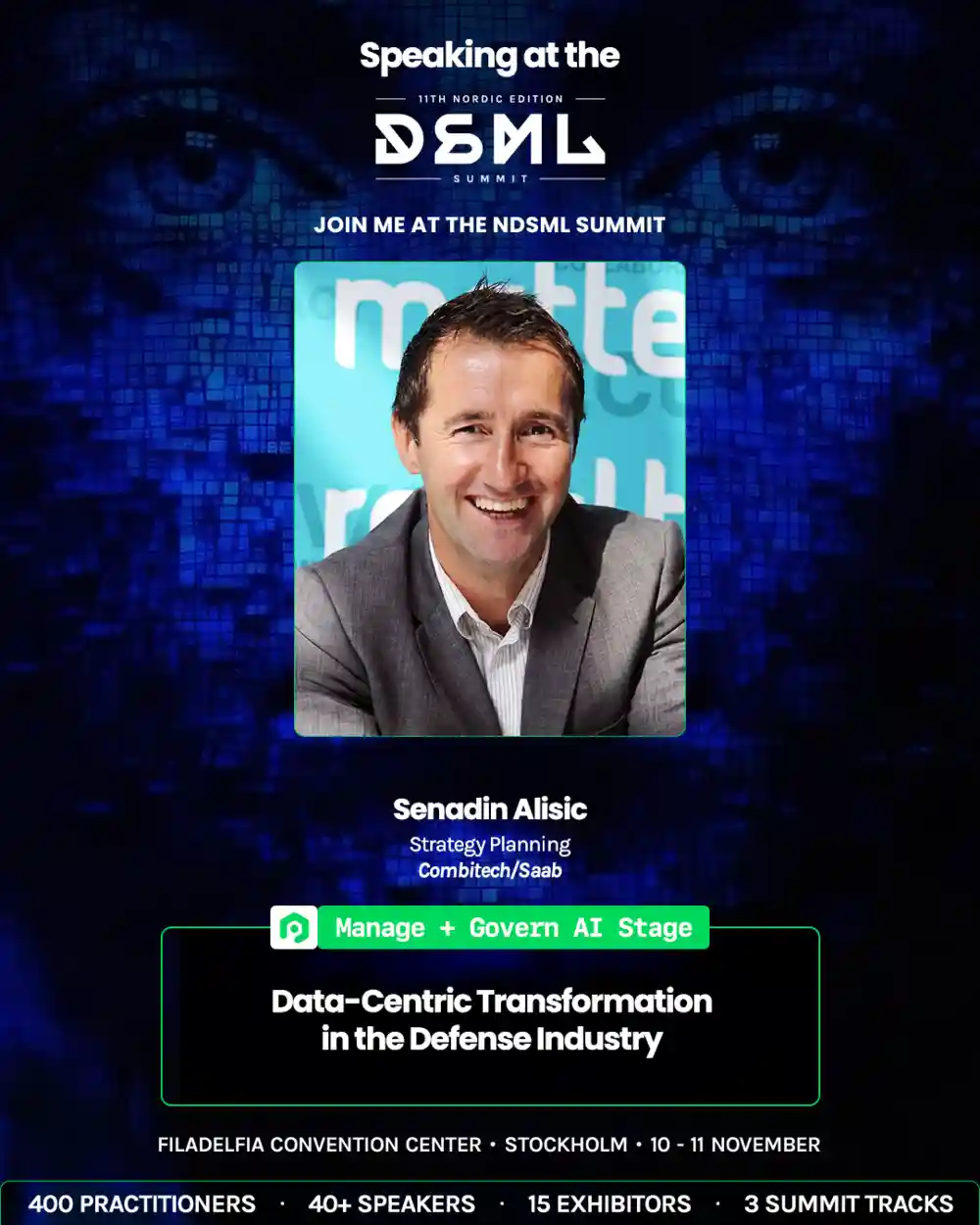
To learn more about connecting AI experimentation to strategic capability, join Senadin Alisic at the NDSML Summit. His session examines how defense and industrial enterprises can decouple data architecture, restructure operating models, and leverage ecosystem collaboration to scale AI effectively in high-reliability environments.