

Major corporate mergers can often present operational friction, leaving enterprise data organizations with fragmented legacy architectures, duplicate tooling, conflicting logic, and widespread shadow IT. For Søren Meincke Persson, Director of Data & AI Platforms at Norlys, this challenge shifted from a hypothetical scenario to an urgent operational requirement following a series of rapid acquisitions, including the purchase of Telia Mobile Denmark, alongside a simultaneous structural partition of the parent enterprise into three distinct infrastructure and commercial entities.
Key Presentation Takeaways
- Structure Drives Execution: Clear engineering blueprints and automated linting (automated programs that scan the source code to find programmatic errors, bugs, security vulnerabilities, and stylistic inconsistencies) establish the operational baseline necessary for domain teams to deploy solutions rapidly without compounding technical debt.
- Technological Focus Enables Scale: Concentrating internal competence around a high-performance core technology stack gearing towards faster delivery than attempting to support multiple competing frameworks.
- AI Capabilities Depend on Governance: Conversational interfaces, automated analytical tools, and machine learning models rely fundamentally on centralized, well-governed semantic definitions.
When Denmark’s largest integrated energy and telecommunications cooperative, Norlys, acquired Telia Mobile Denmark, it inherited a complex technical landscape shaped by over 40 mergers across ten years. The expansion left the organization managing nearly 500 shared group applications that required complete extraction within two years, alongside strict regulatory mandates to segregate data between its infrastructure networks and commercial customer operations. Compounded by an ecosystem of 40 separate BI solutions, disconnected customer definitions across four billing engines, and the operational necessity of maintaining zero business disruption, the data leadership faced an immense challenge. Rather than patching a fragmented infrastructure, Norlys capitalized on a rare enterprise opportunity: tearing down legacy systems to build a unified, domain-driven data and AI platform from the ground up.
Scaling the Workforce: From 5 to an Enterprise Unit
The company treated the change as an opportunity and created a division called AI & Data.
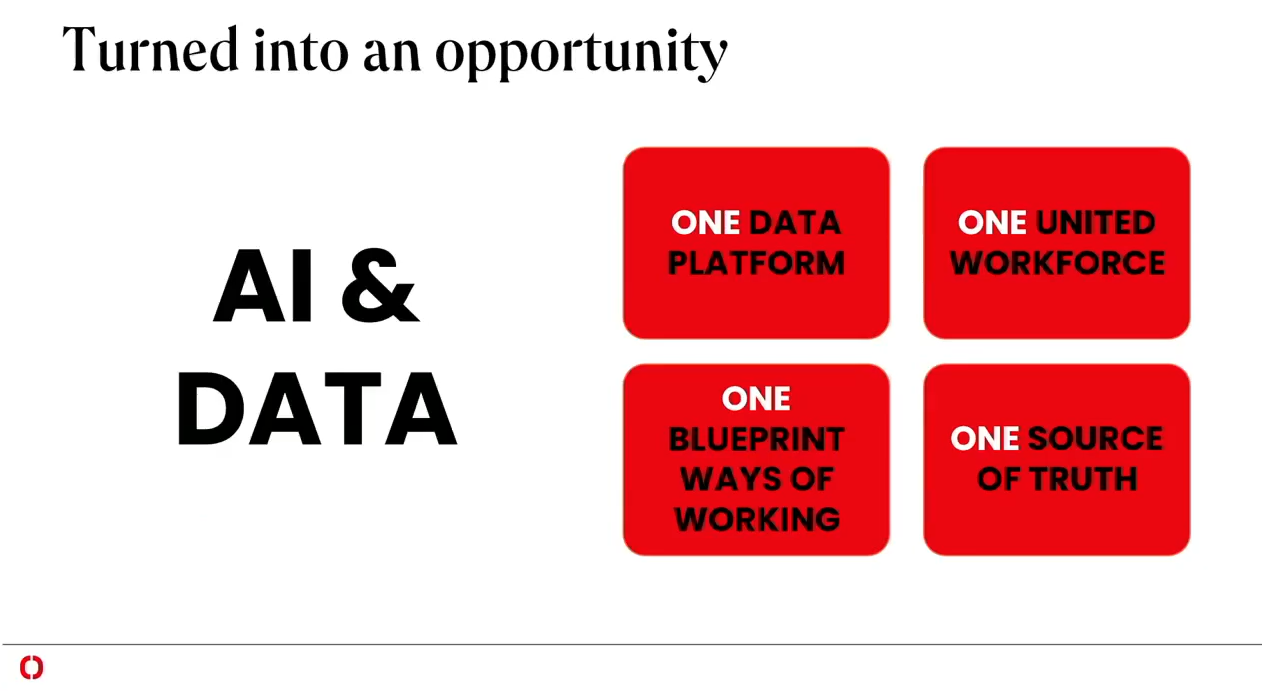
Scaling an internal data platform team from five engineers to an enterprise-wide department within a ten-month window required a fundamental structural transformation. Moving away from a generalist model where full-stack engineers handled every phase of the pipeline, Norlys transitioned to dedicated domain teams supported by centralized platform engineering and architecture units.
To maintain output quality and operational speed during this rapid expansion, leadership established strict engineering and code standards. Enforcing single-language standards (such as using SQL exclusively for data transformations) minimized onboarding friction, eliminated unnecessary tooling debates, and accelerated delivery across newly integrated teams.
Platform Consolidation and Metric Standardization
A central mandate of the transformation involved establishing a single source of truth across all business divisions. Shadow IT solutions and direct-to-source analytics were decommissioned in favor of a lean, unified platform stack: 
- Snowflake serves as the centralized processing engine, paired with dbt (data built tool) for data transformations, automated lineage, pipeline monitoring, and contract-driven data sharing.
- Rather than recreating hundreds of static BI dashboards, engineering focus was directed toward building a centralized metric layer using dbt’s semantic capabilities. This guarantees that core metrics such as customer counts or revenue streams remain consistent across commercial, operational, and AI applications.
- Implementing strict end-to-end security policies across raw, transformation, and presentation layers ensures full compliance with privacy mandates surrounding sensitive telecommunications and human resources records.
Preparing Data for AI Integration
Centralizing and standardizing metric definitions through a unified semantic layer created an optimal foundation for intelligent exploration and generative AI tools. During the presentation, Persson demonstrated how connecting dbt’s semantic layer with Model Context Protocol (MCP) servers and Large Language Models enables conversational querying across complex financial datasets.
By translating natural language prompts into precise, metric-backed SQL queries and dynamic front-end visualizations on the fly, the architecture illustrates how structured data governance directly accelerates the shift from raw datasets to actionable enterprise insights.
Persson emphasised the importance of trust, while relying on the employees and them having a key role at performing these tasks because having tools means nothing if there are no employees and teams to work with them, especially when there is limited time to do complex work. He also shed light on the fact that having available managers whenever the employees or the teams need support is what completes a successful team.
To explore the complete architectural breakdown, observe the demonstration of the MCP and LLM semantic querying integration, and examine the strategic scaling decisions behind the 10-month enterprise migration, watch the full session.
Join Us at Data 2030 Summit 2026
Interested in enterprise data platform migrations, modern semantic architecture design, and real-world AI deployment strategies? Join industry executives, data architects, and technology directors in Stockholm for the 2026 edition of the Data 2030 Summit. Peer-tested frameworks, strategic insights, and emerging technologies shaping the future of enterprise data management.