
Modern warfare is increasingly becoming a contest over who can observe reality faster, understand it more accurately, adapt technology more quickly, and turn learning into action before an opponent can do the same. Artificial intelligence matters enormously in this environment, but perhaps not for the reason that receives the most attention. The defining advantage may not come from building the most intelligent autonomous weapon or possessing the most advanced individual AI model. It may come from building organizations and societies capable of learning faster than the environment around them is changing.
That was one of the most important ideas that emerged from my recent AIAW Podcast conversation with Carl Heath , Senior Researcher and focus leader for digital resilience at RISE Research Institutes of Sweden. Carl works at the intersection of digital resilience, innovation management, psychological defence, information influence and emerging technology, including field-oriented work connected to Ukraine. His perspective is therefore unusual because he is not looking at military AI only as a technology problem. He is interested in the larger system surrounding the technology, including the institutions that discover it, the researchers who test it, the organizations that deploy it, the commanders who depend on it, the societies that must remain resilient around it, and the democratic mechanisms that ultimately determine what should and should not be done. RISE describes his work as spanning digital structural transformation, democracy, digital resilience and innovation management, while its Center for Security Design and Innovation also works with psychological defence and field-oriented support related to Ukraine.
The conversation began with an everyday description of life in Kyiv that immediately made the subject tangible. Air alerts are not theoretical signals when they interrupt meetings, sleep and ordinary work for hours. Carl described how people learn where the nearest shelters are, organize meetings around them, use apps to understand changing threat levels, and continue working from underground when necessary. What stood out was not simply the presence of military technology, but how quickly a society reorganizes itself around changing technological threats. Faster drones change warning times, warning systems adapt, people change their behaviour, workplaces change their routines, and another cycle of adaptation begins.
That dynamic offers a useful starting point for understanding AI and the future of warfare, because modern conflict is increasingly a collection of interacting learning loops.
The battlefield is becoming a learning system
Carl described the Ukrainian battlefield as increasingly transparent, with drones, sensors, ground robots, electronic warfare systems and intelligence platforms creating a constantly changing digital representation of what is happening across the battlespace. Some drones observe, some attack, some intercept other drones, some carry supplies, while unmanned ground systems can support logistics, evacuation and combat operations. Artificial intelligence contributes to navigation, object recognition, classification, sensor processing and decision support, helping humans manage volumes of information that would otherwise become impossible to process quickly enough.
The significance of this development goes beyond autonomous weapons. AI is becoming part of the information architecture through which warfare is understood. 
A commander confronted by thousands of sensor inputs does not simply need more information, because more information can create paralysis rather than clarity. What matters is the ability to identify which signals require attention, distinguish meaningful changes from noise, recognize emerging patterns and move relevant information toward the appropriate human decision-maker. AI therefore becomes important not only because machines can perform tasks autonomously, but because humans increasingly require machines to make complex environments cognitively manageable.
This is closely connected to the military concept known as the OODA loop, developed from the work of US Air Force strategist John Boyd. The logic is deceptively simple: observe what is happening, orient yourself to what it means, decide what to do, act, observe the result and begin again. Carl’s argument was that AI is compressing this cycle at almost every level of modern warfare, while also expanding it beyond what we traditionally consider military operations.
A drone may operate inside one loop, a battlefield commander inside another, senior military leadership inside another, and increasingly the research and innovation ecosystem itself becomes part of the same structure. When an adversary deploys a new capability, observing the battlefield is only the beginning. Someone must understand what has changed, researchers may need to identify an appropriate technology, engineers need to modify it, manufacturers need to produce it, military users need to test it, and lessons from deployment must return immediately into the next iteration.
Research, engineering and procurement are therefore moving closer to the operational loop.
Ukraine’s defence technology ecosystem illustrates this shift. Brave1, the Ukrainian government-backed defence technology cluster, currently reports more than 2,500 participating companies and more than 5,000 products, including hundreds of companies working with UAVs, electronic warfare, ground robotics and AI. In June 2026, Brave1 described battlefield innovation speed as a critical factor in modern warfare at the NATO-Ukraine Defense Innovators Forum, where Ukrainian companies presented technologies including autonomous systems, drones, electronic warfare and communications.
The speed of this development is visible in specific systems. Brave1 reported in June 2026 that a Ukrainian company had developed a drone interception system automating much of the process from launch through interception, while still allowing the human operator to abort the engagement. In September 2026, it also reported that the number of strikes involving AI-assisted terminal guidance had increased tenfold since the beginning of the year. These are claims from the Ukrainian defence innovation ecosystem itself, rather than independent assessments, but they nevertheless demonstrate the direction and pace at which autonomy is being developed and field tested.
NATO is drawing a similar conclusion at the institutional level. Its July 2026 technology and innovation overview states that AI, drones and autonomous systems are reshaping conflict and argues that the Alliance must develop and adopt technologies at the speed and scale required by the changing security environment.
This may be one of Ukraine’s most consequential lessons for European defence. Technological superiority is increasingly temporary, because any successful innovation creates the conditions for a countermeasure. The real capability is therefore not merely invention. It is continuous adaptation.
The real competitive advantage may be organizational
One of Carl’s most revealing stories concerned the discovery of a new AI model that appeared promising for classification tasks. He encountered it while reading about new technology on a Friday evening, shared it with colleagues, and by Sunday the team in Kyiv had already experimented with incorporating the approach into its workflow and was evaluating where similar open models might fit into secure environments.
Whether a particular model ultimately proves transformative is less important than the organizational behaviour behind the story.
Traditional research environments are designed to reduce uncertainty before producing recommendations. Researchers investigate, validate, review and gradually build confidence, which is entirely appropriate when errors have serious consequences and when knowledge needs to remain credible over many years. Wartime innovation confronts organizations with another reality. Sometimes an 80 percent solution available in two weeks creates more value than a theoretically superior solution arriving months later, because the underlying problem may already have changed.
When Carl’s team initially approached Ukrainian partners, he explained, they discovered that some Swedish assumptions about research and innovation did not fit the environment they had entered. The lesson was not that rigorous research had become unnecessary, but that rigor needed to coexist with another operating speed.
Carl uses the image of two clock speeds. One part of an organization may require stability, careful governance, predictable processes, long-term testing and regulatory discipline, while another must continuously experiment, absorb new technologies and respond to new threats. The leadership problem is therefore not choosing speed instead of stability, because some systems absolutely should move slowly. The challenge is designing organizations capable of operating at both speeds simultaneously.
Carl described this through the research concept of organizational ambidexterity, but he also introduced an even more useful metaphor: the gearbox.
If different parts of society necessarily operate at different speeds, then the objective should not be forcing every institution into the same rhythm. Governments, universities, research institutes, startups, military units and industrial manufacturers all have legitimate reasons for operating differently. What is missing is often the mechanism that connects those speeds, allowing an insight discovered in one environment to create value in another without either destroying the speed of the innovator or bypassing the safeguards of the institution.
That is a powerful lesson far beyond defence.
Most large enterprises face exactly this challenge with generative AI. Employees can discover new tools within hours, teams can prototype something within days, yet cybersecurity reviews, architecture decisions, procurement processes, legal assessments and operating-model changes may take months. When the gap becomes too large, employees begin working around formal systems, creating shadow AI in much the same way organizations previously experienced shadow IT. Carl’s warning is particularly relevant here: excessive restriction does not necessarily create greater security, because it can push experimentation into invisible environments where governance becomes even harder.
The alternative is not uncontrolled experimentation. It is bringing security, legal, policy and operational expertise closer to the innovation loop so that constraints are discovered while a solution is being designed rather than after months of development. Later in the conversation, Carl described this as incorporating policy and regulatory thinking directly into experimentation, creating faster feedback between innovation and governance.
That approach deserves attention from every executive currently struggling with AI adoption. The important question may no longer be how quickly the technology department can deploy AI. It is how quickly the entire institution can learn safely.
Information itself has become contested terrain
The discussion then moved from physical systems to psychological and information warfare, where AI’s impact may ultimately prove just as significant.
Carl has worked with questions surrounding democracy, digital resilience and information influence for years, including as a special investigator for the Swedish government examining democracy in a digital age. His concern is that modern information infrastructure was never designed primarily for democratic resilience. It developed around commercial platforms whose incentives frequently reward attention and engagement, because attention creates advertising revenue.
The difficulty is that systems optimized for engagement can also provide exceptionally effective infrastructure for influence operations.
An influence campaign does not always need to persuade someone to accept an entirely new worldview. It can be more effective to identify an existing fear, grievance or social division and amplify it. AI reduces the cost of generating, translating, adapting and distributing content, while algorithmic platforms help identify narratives that generate reactions.
This creates a particularly difficult security problem because the human being remains part of the attack surface.
Carl described the simplest version beautifully: somebody encounters something online that immediately creates anger, and the instinct is to share it. An influence operation does not necessarily need that person to believe everything contained in the message. It may only require an emotional reaction strong enough to turn the recipient into another distribution mechanism.
NATO now explicitly identifies AI and deepfakes as technologies capable of amplifying hostile information activities, creating confusion and subtly altering perceptions, while its broader approach to information threats describes coordinated manipulation as an attempt to deepen divisions, destabilize societies and weaken resilience.
Carl added another concept that deserves far more attention outside military and security communities: reflexive control.
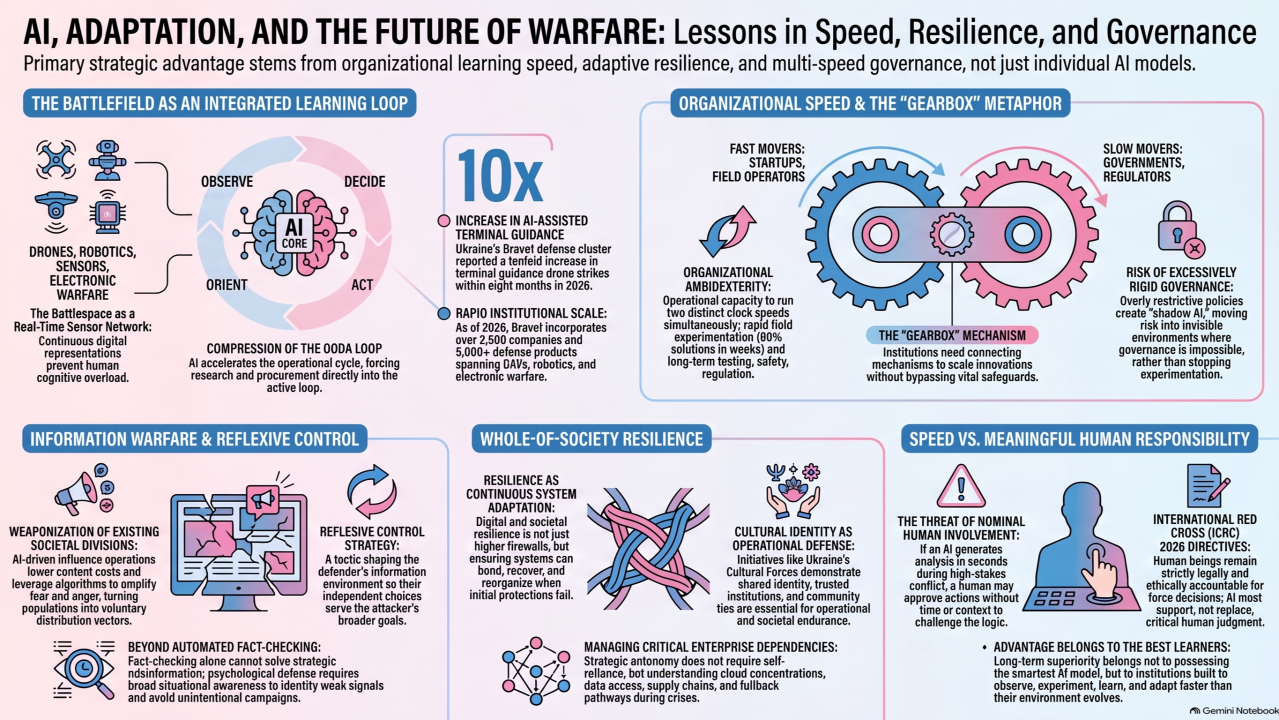
The basic idea is not simply to deceive an opponent. It is to shape the opponent’s information environment so effectively that the opponent makes what appears to be an independent decision, while that decision actually serves the initiator’s wider strategy.
Imagine creating several influence campaigns that are intentionally easy for fact-checkers to discover. The defenders notice them, commit analytical resources, issue corrections and believe they are successfully responding. Meanwhile, a more consequential operation occurs elsewhere in the information environment with less attention. The defender is active and apparently making rational choices, yet the attacker has influenced where the defender looks and therefore indirectly controls part of the response.
That changes how we should think about AI-enabled information defence.
The answer cannot simply be more automated fact-checking, because increasing the efficiency of the wrong response loop does not solve the strategic problem. The deeper requirement is situational awareness across the information environment, including the ability to recognize weak signals, coordinate intelligence, decide which narratives merit intervention and understand when reacting might actually amplify the operation. Carl therefore connects psychological defence back to the same OODA logic governing the physical battlefield. Whoever can observe, orient and learn faster has a structural advantage.
Resilience is larger than cybersecurity
Perhaps the most unexpected part of the conversation was Carl’s description of psychological defence as a whole-of-society capability.
Modern warfare does not remain neatly separated into military, cyber, economic and information domains. Physical attacks can create psychological effects, information campaigns can affect political and military choices, attacks on infrastructure can undermine confidence, while culture and shared identity can strengthen the willingness of a population to continue functioning under pressure.
Carl described meeting representatives connected to Ukraine’s Cultural Forces, an initiative in which culture itself becomes part of societal and military resilience. Musicians, writers and other cultural contributors support soldiers and society, including efforts to bring books and cultural material toward frontline environments. His broader point was that psychological resilience cannot be produced exclusively by a government communications department. It emerges from education, trusted institutions, culture, communities, independent media, digital literacy and the everyday relationships through which people understand their society.
There is an important technology lesson hidden inside this argument.
We often describe resilience as a technical property, asking whether networks remain operational after attack or whether infrastructure can recover from disruption. Carl’s perspective is broader. Resilience is the ability of the entire system to continue adapting while under pressure.
RISE makes a similar argument in its current work on resilient information systems, noting that highly interconnected digital societies were largely built during a period when the geopolitical environment appeared much more optimistic. As that environment changes, the objective cannot simply be constructing higher digital walls, because systems also need the capacity to bend, recover and reorganize when protections fail.
For enterprises, this suggests that AI resilience cannot be reduced to model security either. It includes organizational knowledge, supply chains, infrastructure dependencies, cloud concentration, access to data, human expertise, governance and the ability to continue operating when one part of the technology stack becomes unavailable.
The same principle applies nationally. Strategic autonomy does not necessarily mean building everything domestically, which would be economically unrealistic for most European countries. It means understanding where critical dependencies exist, which capabilities must remain accessible during a crisis, and where alternative pathways are required.
Speed cannot remove human responsibility
As autonomous systems become more capable, another tension becomes unavoidable. The same AI that helps humans manage the complexity and speed of warfare can also create pressure to remove humans from decision loops because humans increasingly become the slowest component.
That is precisely where technological efficiency collides with legal, ethical and democratic responsibility.
The International Committee of the Red Cross warns that military AI can accelerate the pace and scale of warfare while introducing unpredictability, automation bias and reduced human control. Its 2026 guidance emphasizes that humans remain legally responsible for decisions concerning the use of force and argues that AI should support human judgment rather than replace it.
This distinction matters enormously.
Keeping a human nominally involved does not automatically create meaningful human control. If an AI system processes thousands of signals, produces a recommendation within seconds and operates inside a situation where hesitation could create military disadvantage, the human may technically authorize the decision without realistically possessing sufficient time or information to challenge it.
The governance question is therefore becoming more sophisticated than asking whether there is a human in the loop. We need to ask whether the human understands the recommendation, whether alternatives can be considered, whether the system’s limitations are known, whether intervention remains possible, and whether responsibility remains identifiable when something goes wrong.
These questions become even more important as AI moves from individual platforms into connected decision systems.
Europe needs a different innovation architecture
The conversation repeatedly returned to what Europe should learn from Ukraine, and the answer was not that European institutions should simply copy wartime practices.
War creates conditions that democratic societies should not want to reproduce. It also creates extraordinary pressures that make certain forms of experimentation possible because the cost of moving slowly can be existential. The challenge for Europe is extracting useful organizational lessons without abandoning the safeguards that distinguish democratic institutions from wartime improvisation.
Carl’s gearbox metaphor provides a productive way forward.
Europe does not need every institution operating permanently at wartime speed. It needs better connections between institutions operating at different speeds. Research needs faster pathways toward experimentation. Startups need realistic pathways toward procurement. Governments need ways of learning from technological deployment while regulations are still being developed. Military users need mechanisms for returning operational experience to engineers. Legal and security specialists need to participate earlier in innovation rather than appearing only at the final approval stage.
RISE’s own work on secure innovation reflects precisely this challenge, particularly because modern societal resilience depends on cooperation between government, research organizations and private companies. Much contemporary innovation happens between organizations rather than inside a single institution, which means secure collaboration becomes a capability in its own right.
This might be the most transferable insight from the entire episode.
In an AI-driven economy, competitive advantage increasingly belongs not only to organizations possessing technology, but to organizations capable of absorbing it. The same model may be available to thousands of companies. What differentiates them is the speed at which they can reorganize workflows, data, governance and decision-making around what the technology makes possible.
Ukraine is demonstrating an extreme version of this phenomenon under conditions nobody would choose. Europe should nevertheless study the organizational mechanics carefully.
The future of AI may be less about intelligence than adaptation
Toward the end of the conversation, the discussion inevitably reached more speculative questions around advanced AI and the possibility of systems beyond today’s transformer-based models.
Carl’s position was deliberately balanced. He argued that we have barely begun extracting the positive potential from AI systems already available, while those same systems can also be used for harmful purposes. His conclusion was therefore not that society must choose innovation or safety. The challenge is developing institutional capabilities capable of pursuing both simultaneously.
That feels particularly important when talking about AGI and warfare.
It is tempting to imagine a future in which one extraordinary system fundamentally changes the balance of power, yet the current war in Ukraine suggests another possibility. The transformative effect of AI may emerge through thousands of smaller integrations across sensing, logistics, analysis, cyber operations, communications, manufacturing, electronic warfare, autonomous systems and decision support.
The strategic question may therefore be less about when one machine becomes generally intelligent and more about what happens when entire organizations become capable of continuously learning through machines.
That possibility changes the leadership conversation.
The organizations that succeed will still need advanced technology, but they will also need people capable of questioning it, institutions capable of governing it, infrastructure capable of surviving disruption, and organizational architectures capable of changing when yesterday’s solution suddenly stops working.
Technology matters tremendously, but technology alone does not learn lessons. Institutions do.
The clearest message I took from Carl Heath’s experience in Ukraine is therefore that the future of warfare, and perhaps the future of AI-enabled organizations more broadly, will be determined by the speed and quality of their learning loops.
The battlefield already demonstrates what happens when technological development, operational feedback and organizational adaptation become tightly connected. The information environment demonstrates what happens when AI can industrialize persuasion and manipulation. Ukraine’s societal response demonstrates that resilience involves culture and human agency as much as infrastructure. The debate around autonomous systems reminds us that increased machine capability makes human responsibility more important, not less.
For leaders in data, AI and technology, these are not distant military lessons. They are early signals of a broader organizational transition.
The question is no longer simply whether an organization has access to AI. Increasingly, the question is whether it has built the institutional capacity to observe change, understand its consequences, make decisions, experiment safely, learn from outcomes and repeat the cycle faster than its environment evolves.
In warfare, the consequences of failing that test can be immediate. In business and government they may unfold more slowly, but the underlying dynamics are becoming remarkably similar.
The future may belong less to whoever possesses the smartest individual system and more to whoever builds the strongest system for learning.
Listen and watch the entire episode here.
*This article was enhanced with the help of AI tools, drawing on the podcast transcript and complementary online research. To go deeper into the source material, I encourage you to listen to the full episode and make your own learnings.